D-Wave on rails: Company tests entanglement on its dual-rail qubits
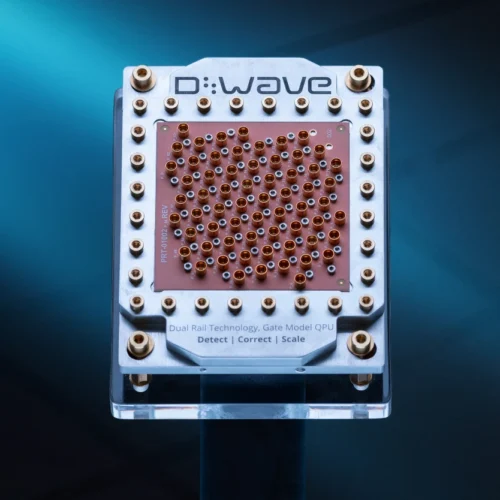
D-Wave, best known for its quantum annealing machines, has published a paper in Nature demonstrating that it can entangle two "dual-rail" qubits without disrupting their key error-detection advantage. The company, which recently acquired Yale spinout Quantum Circuits, is pursuing dual-rail qubits alongside its existing fluxonium-based gate-model hardware, betting that this approach will let it build useful quantum computers with less hardware than error-correction schemes typically require.
Dual-rail qubits store information as a photon shared between two linked resonators, and their main advantage is that the most common failure mode—the photon escaping entirely—is easy to detect without extra qubits, leaving only rarer phase-flip and bit-flip errors to correct with a simpler code. D-Wave's Trevor Lanting said the new two-qubit gate preserves this favourable "error hierarchy" even during entangling operations, addressing a concern that computations could otherwise introduce different, harder-to-manage error types. The technique differs from Amazon's use of the same dual-rail concept, which sidesteps direct entanglement by mediating connections through an intervening transmon-based qubit.
- D-Wave entangled two dual-rail qubits while preserving easy-to-detect error pattern
- Result published in Nature, following its acquisition of Yale spinout Quantum Circuits
- Approach aims to cut hardware needed per error-corrected logical qubit