Trump confirms decoy aircraft switch amid Iranian missile threat
Developed over time first seen 2 months ago
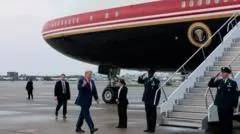
President Trump has confirmed that he secretly changed aircraft after a Nato summit in Ankara because of an alleged Iranian missile threat. The manoeuvre was intended to protect the President by allowing Air Force One to act as a decoy, highlighting the security measures used when intelligence suggests a direct risk to presidential travel.
Trump said the aircraft he travelled on was considered at greater risk, but the switch was made to prevent adversaries from identifying his location. He was reportedly moved between planes inside a catering truck, while the presidential Boeing 747 departed separately; he later returned to Air Force One alongside unaware members of the press. Trump and Defence Secretary Pete Hegseth have linked the operation to claimed Iranian attempts on his life, though the operation was not disclosed publicly until more than a month afterwards.
- Trump confirmed a covert aircraft switch over an alleged Iranian missile threat.
- Air Force One reportedly flew as a decoy.
- The operation was kept secret for more than a month.
New here? Start with this
Both major US commercial and military conflicts with Iran have escalated since President Trump's return to office, with periodic exchanges of threats and, at times, direct military action between the two countries. Air Force One is the well-known call sign for the US president's usual aircraft, and any deviation from its use is treated as a significant security matter, typically only arising when intelligence agencies flag a specific and credible threat.
The Ankara summit was a gathering of NATO, the military alliance of the US, UK and other Western nations, held in Turkey in June. Details of what happened there are only now emerging publicly, some weeks after the event, through officials and reporting on the president's security arrangements rather than through the summit's usual proceedings.
Presidential security operations are normally handled discreetly by the Secret Service alongside military personnel, and such measures are rarely disclosed unless confirmed after the fact, as is the case here. The story matters because it points to how seriously US agencies are treating potential threats linked to the Iran-US standoff, and it offers a rare public glimpse into the kind of contingency planning that usually stays hidden from view.
Both sides, in good faith
The strongest fair case each way — we don't pick a winner.
The case for
Those who take the account at face value argue it reflects the sober reality of a presidency operating under genuine, elevated threat: intelligence agencies identified a credible risk and protective services responded with a swift, professional countermeasure that ultimately kept the president safe. On this view, confirming the episode afterwards is a legitimate act of transparency about the real dangers of the current US-Iran standoff, and the elaborate ruse itself is evidence that security professionals, not politicians, were driving the decision. Far from theatre, they see this as sober risk management working exactly as intended.
The case against
Sceptics of the framing argue that publicising such an operation well after the fact invites questions about motive and timing, since dramatic personal-danger narratives can serve to bolster a leader's image or justify a harder line on Iran regardless of how credible the underlying intelligence actually was. They also note that details of specific threats and protective tactics are traditionally kept confidential precisely because disclosure can compromise future operations or be exploited for political effect, and that the public has no independent way to verify the severity of the alleged threat. On this view, caution is warranted before treating an unverifiable, self-reported security scare as proof of the scale of danger being described.
Coverage
- BBC World — Trump says he switched planes after Nato summit because of possible threat
- BBC World — Trump’s dramatic plane swap hints at personal stakes of Iran war
Culture Geopolitics Government Middle East Politics Travel World