Glacial collapse triggers deadly floods on Nepal–Tibet border
Developing story first seen 6 hours ago
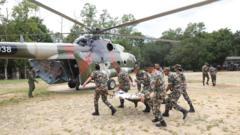
The US Geological Survey has revised its initial assessment, saying the disaster was caused by a glacial collapse and debris flow rather than a magnitude 4.4 earthquake. The change is significant because it focuses attention on unstable ice, landslides and possible climate-related factors as rescuers search for hundreds reported dead or missing on both sides of the Nepal–Tibet border.
Scientists are examining whether a landslide first blocked a river before water burst through, producing the destructive flood; one expert said the glacier collapse may have occurred hours or days earlier. Debris swept through areas around the Bhote Koshi, Trishuli and Narayani rivers, destroying buildings, roads and vehicles, while officials warn that temporary blockages in the Trishuli could create a landslide dam and trigger further flooding.
- USGS says a glacial collapse, not an earthquake, caused the disaster.
- Hundreds are reported dead or missing.
- River blockages could cause secondary flooding.
New here? Start with this
The disaster took place in the Himalayas, where Nepal borders Tibet, the Chinese-controlled region on the northern side of the mountains. This area has steep valleys, large glaciers and fast-flowing rivers, leaving settlements, roads and border crossings exposed to landslides and sudden floods.
A glacial collapse happens when ice, rock and other material high in the mountains gives way and rushes downhill. It can create a debris flow — a fast-moving mixture of water, mud and boulders — which may block rivers or send floodwaters through valleys with little warning.
The affected rivers flow through northern Nepal towards larger river systems, so damage can extend well beyond the point where the collapse began. Scientists are studying whether warmer conditions, melting ice, thawing frozen ground, heavy rain or a river blockage contributed, as these hazards are becoming an increasing concern in high mountain regions.
Full account
A destructive flash flood and landslides struck the Nepal–Tibet border region, devastating settlements along mountain rivers and prompting search, rescue and evacuation work. Military teams were deployed, while officials on both sides of the border warned of major losses. The affected area lies north of Kathmandu and includes routes used by climbers and pilgrims.
Early accounts treated the incident as a possible earthquake-triggered landslide. The US Geological Survey initially recorded a seismic event, but later said further examination of seismic data and satellite imagery showed that no earthquake had occurred. It concluded that the signal had instead been produced by a glacial collapse and debris flow, whose impact was powerful enough to be detected seismically.
Preliminary scientific assessments indicate that ice and rock may have fallen from high ground near Langtang Lirung into the Lende Khola, a tributary of the Bhote Koshi. This appears to have sent water, mud, sediment and boulders rapidly downstream. ICIMOD’s analysis said river levels rose by roughly seven to nine metres within half an hour, damaging or sweeping away monitoring equipment. The steep valleys in the area may have concentrated and accelerated the flow.
The precise sequence, and the reason for the glacier’s failure, remain under investigation. Scientists are examining whether an initial landslide blocked a river before water burst through, and whether rainfall, meltwater or drained glacial lakes played a part. Researchers also say warming and degrading permafrost can weaken mountain slopes; climate change may therefore be a contributing factor, though it has not been established as the direct cause of this particular collapse.
Where outlets differ
The first report describes casualties broadly as hundreds dead or missing and focuses on the correction of the initial earthquake account. The second gives a preliminary death toll of at least 177 and says more than 800 people were missing.
The second report provides more detail from ICIMOD, including the Lende Khola route, the estimated seven-to-nine-metre river rise and damage to monitoring stations. The first places greater emphasis on possible climate-related weakening of permafrost and on the wider rescue response.
Both reports identify a likely glacial collapse, but retain uncertainty over the trigger and the exact timing between any slope failure, river blockage and flood surge.
More coverage
- BBC World — Collapsed glacier likely caused devastating Nepal-Tibet floods, scientists say
- Deadline — Richard Gere Sends Message Of Support To Nepal & Tibet Following Devastating Mudslides & Flash Floods
- BBC World — What caused the Nepal-Tibet flash floods?
- NPR — At least 1,500 missing after deadly Nepal-Tibet floods
Read the full article at the source →
Originally published by BBC World as “What we know about deadly Nepal-Tibet floods”.