Bedford Train Crash: Driver Accelerated After Red Signal Warning, Killing 1 and Injuring 160
Developing story first seen 1 hour ago
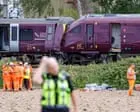
The interim investigation has strengthened calls from crash survivors and their representatives for automatic braking protection on the line near Bedford. It found that driver Shaun Burton passed a red signal after acknowledging an alarm, then accelerated; lawyers say a trackside system designed to stop trains in that situation could have prevented the collision.
Burton, 60, was killed when his train hit the back of a high-speed train on 19 June, injuring 160 people, 11 very seriously. The train ahead had stopped unexpectedly because of a safety-system fault; Burton reached 76mph and braked about ten seconds before impact. The line did not have the Train Protection and Warning System (TPWS), after Network Rail classified the signal as low risk, partly because no signal-passing incidents had been recorded there since 1985. Network Rail says it is considering the interim findings and cooperating with the ongoing investigation.
- Investigators found the driver passed a red signal and accelerated.
- The Bedford collision killed one person and injured 160.
- Survivors’ representatives say TPWS could have prevented the crash.
New here? Start with this
A train operated by East Midlands Railway collided with a stationary train near Bedford in June, resulting in one death and over 160 injuries. The driver received an automatic safety warning when the train passed a red signal, but instead of slowing down, the train continued to accelerate and struck the stationary train at approximately 76mph.
An interim investigation confirmed that the driver acknowledged the automatic warning system but failed to respond appropriately by reducing speed. The collision has raised questions about how signalling and train safety systems operate and whether current safeguards are sufficient to prevent such accidents.
Survivors and their legal representatives have called for changes to rail safety, specifically the installation of automatic braking systems that would force trains to stop when passing red signals. They are also pushing for enhanced trackside safety measures, arguing that such technology could have prevented this collision and could protect passengers on other services across the network.
Both sides, in good faith
The strongest fair case each way — we don't pick a winner.
The case for
Automatic braking systems represent proven technology that removes the critical human-error variable in safety-critical situations. This accident demonstrates that even explicit warnings can fail to prompt appropriate driver response, whether due to fatigue, medical episodes or distraction. Installing automatic braking systems that override manual control when red signals are passed would eliminate precisely this failure mode, and the life-saving benefits justify the infrastructure investment.
The case against
Whilst automatic braking has merit, a measured approach warrants investigation into the specific causes before mandating expensive network-wide changes. Thorough analysis of why this driver failed to respond—fatigue, medical events, distraction—may reveal more targeted interventions such as enhanced crew monitoring, improved rest protocols, or medical screening. Automatic systems themselves carry implementation risks and potential failure modes, and resources should be allocated to the most cost-effective safety improvements based on comprehensive accident analysis rather than reactive mandates.
Full account
A Luton Airport Express service operated by East Midlands Railway collided with a stationary train south of Bedford station in June 2026, resulting in one fatality and 160 injuries. The crash occurred at approximately 5.13 pm on 19 June when the southbound service from Corby struck the rear of a train that had unexpectedly come to a halt on the same track. The impact proved severe enough to reduce the combined length of both trains by ten metres.
The driver of the incoming service, 60-year-old Shaun Burton, was killed in the collision. Investigation findings published this week by the Rail Accident Investigation Branch disclosed that Burton had passed through a red signal but continued accelerating rather than braking despite receiving an automatic warning. The train's Automatic Warning System had alerted him to the danger, and Burton acknowledged the warning, yet the service reached 76 miles per hour before emergency braking commenced approximately 850 feet from the obstruction ahead. The collision occurred during this deceleration phase.
The circumstances leading to the collision involved several converging factors examined by accident investigators. The stationary train ahead had stopped as a result of its own safety system malfunctioning, generating an alarm despite passing through a green signal. Both services represented modern rolling stock, with Burton's train constituting a relatively recent addition to the East Midlands Railway fleet. The red signal through which Burton's train passed had not been displayed at that location throughout the preceding months of 2026, which may have affected driver response protocols. Investigators continue to examine why the signal was breached and whether all safety systems performed as intended.
The incident has prompted examination of railway safety systems amongst those affected and their legal representatives. Discussion has centred on the Train Protection and Warning System (TPWS), which differs from the Automatic Warning System in its capacity to enforce automatic stops when signals are breached, rather than merely issuing audible warnings. Legal representatives of injured passengers contend that installing such a system at this location would have prevented the collision and have highlighted that Network Rail had recently assessed the area as presenting low risk. The investigation continues as authorities work to complete their comprehensive analysis.
Where outlets differ
Train classification: Source 1 identifies the incoming train as an Aurora class 810 Hitachi model; Source 2 identifies it as a Class 360 Luton Express
Source 1 emphasises technical investigation findings and signal history; Source 2 emphasises legal implications and the absent TPWS system
Source 1 notes this was the fourth serious passenger train collision since 2020; Source 2 does not reference this statistic
Source 1 mentions a driving instructor was present; Source 2 does not include this detail
Coverage
- The Guardian — Bedford crash train accelerated after driver acknowledged red signal warning
- Daily Mail — Bedford crash survivors urge fitting of automatic train braking system