Google opens AI content detector to users with major tech accounts
Developing story first seen 2 hours ago
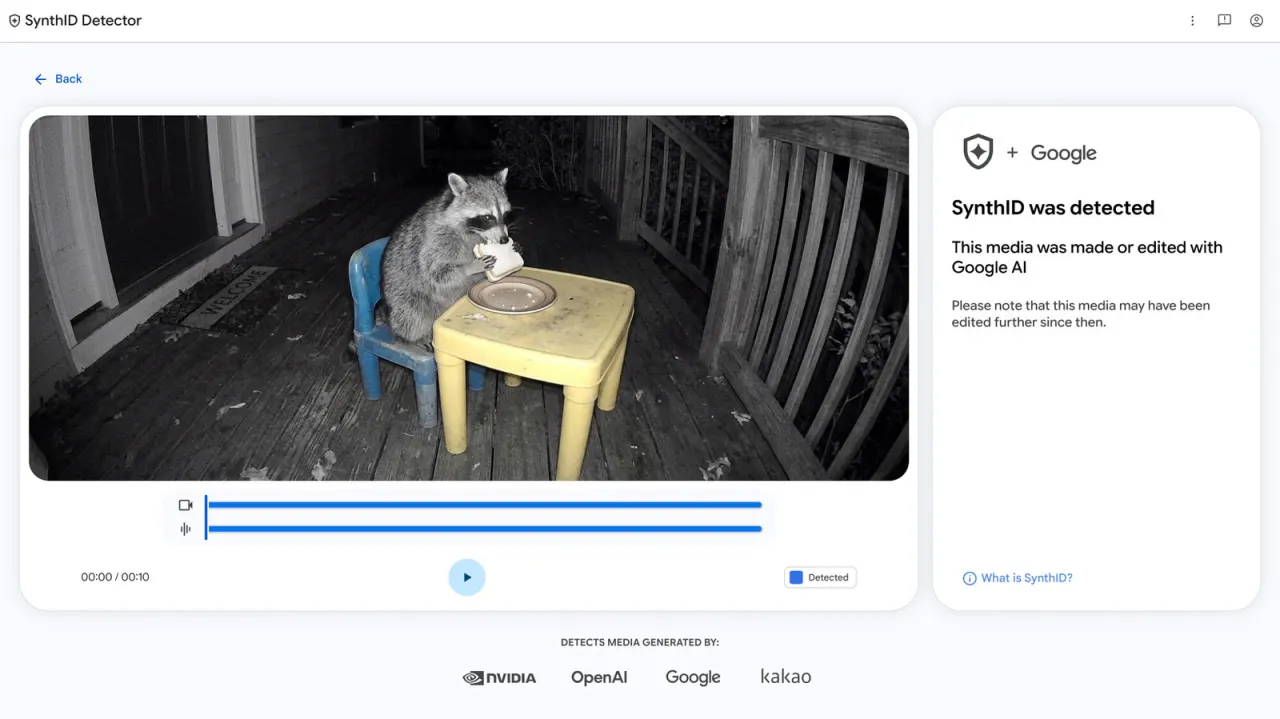
Google has expanded access to SynthID Detector, its AI detection tool, opening it to all users with Google, OpenAI, or Apple accounts. Previously limited to journalists and media professionals, the free web tool at synthid.com now allows anyone to check whether images, video and audio contain AI-generated or AI-edited content. This broadened availability marks a step towards making AI-generated content more transparent as synthetic media proliferates online.
The detector can identify content from Google, OpenAI, NVIDIA and Kakao, with Apple Intelligence support arriving soon. Google has spent over a year developing SynthID and has integrated detection into its Circle to Search feature and Gemini app. However, significant limitations exist: the tool relies on watermarks that companies implement inconsistently, cannot detect all AI-generated content, cannot distinguish between wholly synthetic and edited material, and watermarks can be stripped. A universal detection standard remains absent, with competitors like Meta developing isolated tools that only identify their own models.
- Google broadens SynthID access to general users after restricting it to media professionals.
- Tool detects AI content via watermarks but misses many cases and can be stripped.
- AI detection lacks universal standards as companies implement different watermarking methods.
New here? Start with this
Artificial intelligence can now generate convincing images, videos and audio that did not exist before, or edit existing content in ways that are hard to detect with the human eye. As these tools become more widely available, concerns have grown about misinformation, fraud, and the difficulty in knowing what is real online. Technology that can verify whether content has been created or altered by AI systems has therefore become a subject of interest for media companies and the public.
Google has developed SynthID Detector, a tool designed to identify when images, videos and audio have been created or edited using artificial intelligence. The tool is available to anyone with certain tech company accounts and works with content produced by major AI providers including Google, OpenAI, and NVIDIA.
The detector has several limitations. It works only with content created by certain AI companies and cannot identify all AI-generated material, since different systems use different watermarking methods and watermarks can be removed. It also cannot reliably distinguish between content that is entirely AI-created and content that has been partially edited by AI.
Both sides, in good faith
The strongest fair case each way — we don't pick a winner.
The case for
Making detection tools publicly available represents a meaningful step towards transparency as AI-generated content becomes ubiquitous. By democratising access to Google's detection technology, users gain agency to identify synthetic media and make informed decisions about content consumption and sharing. Whilst imperfect, the tool provides a valuable defence against deepfakes and AI-generated misinformation that could otherwise proliferate unchecked. As synthetic media capabilities advance, having accessible detection tools from reputable companies is a crucial component of maintaining public trust in digital media.
The case against
Whilst public access to detection tools sounds positive in principle, this particular offering illustrates why detection-focused approaches may be fundamentally insufficient. The tool's admitted inability to detect all AI-generated content, its vulnerability to watermark stripping, and the fragmented detection landscape mean users may develop false confidence in its reliability. Rather than investing in imperfect detection systems, meaningful progress requires establishing mandatory watermarking standards, regulatory frameworks governing synthetic media, and comprehensive media literacy education—addressing root causes rather than attempting to police an ever-expanding universe of generated content.
Full account
Google has made its SynthID Detector tool publicly accessible via a new website, extending what was previously restricted to accredited media professionals and selected testers. This artificial intelligence content identification system can recognise media containing watermarks from multiple technology companies including OpenAI, Nvidia, Kakao, with Apple's detection support anticipated in the coming weeks. The detector functions as a unified platform for checking whether images, videos, and audio files bear these invisible identifying markers inserted by collaborating AI developers.
The technology embeds imperceptible markers within the digital structure of media—specifically integrated into visual data for images and videos, and modulated through audio waveforms for sound files. Google has deployed SynthID across an extraordinary volume of content via Gemini: 180 billion visual items and over 240,000 years worth of audio material. Before this week, anyone outside Google's initial testing cohort had to rely on Gemini itself to detect these watermarks, which proved inefficient and occasionally produced ambiguous results. The dedicated website eliminates this dependency, offering direct confirmation of watermark presence without requiring interaction with the AI model itself.
The service operates under several access restrictions despite its public availability. Users must authenticate using credentials from Google, OpenAI, or Apple, and face a limit of approximately ten daily content checks per account. Google ascribes this constraint to preventing the development of tools designed to circumvent or strip SynthID detection. The website provides only basic confirmation of whether watermarks are present, without pinpointing specific elements that are synthetically generated or offering granular details about creation and editing methods employed.
The announcement underscores persistent fragmentation across the artificial intelligence sector regarding detection standards and methodologies. Competitors have adopted divergent watermarking approaches—Meta operates a proprietary detection system serving exclusively its own products—whilst certain developers implement no detection mechanism whatsoever. Although SynthID represents meaningful advancement in consolidating detection frameworks into a single interface, its scope remains constrained to participating technology partners. Google has signalled commitment to expanding partnerships further, yet truly comprehensive detection spanning all artificial intelligence-generated content remains technically unachievable with existing infrastructure.
Where outlets differ
Source 2 provides specific deployment scale metrics (180 billion images and videos, 240,000 years of audio); Source 1 omits these quantifications entirely
Source 2 emphasises the previous inefficiency of requiring Gemini queries for detection and describes this method as clunky; Source 1 does not foreground this usability concern
Source 2 explains the quota system's security rationale explicitly, citing prevention of removal tools; Source 1 mentions the quota without providing reasoning
Source 1 explicitly details prior availability to journalists and media professionals; Source 2 references a 'trusted tester program' less specifically
Source 1 specifically names ElevenLabs' partnership commitment to support SynthID; Source 2 does not reference this company
Source 2 describes the previous internal tool's technical capability to highlight pixel-level SynthID indicators with region highlighting; Source 1 does not mention this technical detail
More coverage
Read the full article at the source →
Originally published by Engadget as “Google’s AI detection website is now available”.