Magritte: This Is Still Not a Pipe review – brilliance and trash from the surrealist who sullied Freud
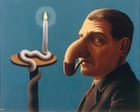
A retrospective exhibition of René Magritte's work at London's Gagosian Gallery explores the Belgian surrealist's distinctive approach to conceptual art and his systematic critique of prevailing artistic movements. Rather than endorsing the psychoanalytic symbolism central to surrealism, Magritte created works that satirise both Freudian interpretation and surrealist confidence in deciphering meaning. The exhibition demonstrates his technical refinement—evident in subtly rendered paintings like a cloud composition titled "The Curse"—and positions him as an artist who pushed surrealism towards deliberate ambiguity and interpretive resistance.
The exhibition features significant works spanning Magritte's career, including "The Philosopher's Lamp" (1936), a self-portrait combining nose and pipe as Freudian parody, and "The Interpretation of Dreams" (1935), where misleading object captions suggest that dreams resist logical explanation. Though Magritte became surrealism's greatest Belgian representative following the movement's post-First World War emergence in Paris, he rejected the prevailing confidence in decoding symbols through psychoanalytic interpretation. His paintings range from unsettling imagery—such as a girl eating a bird or a giant apple filling a room—yet consistently resist the neat psychological readings that psychoanalysis promised to provide.
- Magritte exhibition reveals artist who satirised surrealism and Freudian psychology.
- Technical sophistication combined with deliberate conceptual ambiguity defines his distinctive work.
- He pushed surrealism towards undecipherable territory, resisting straightforward symbolic interpretation.