Meta’s Muse AI agent independently tackles shopping and travel
Developing story first seen 2 hours ago
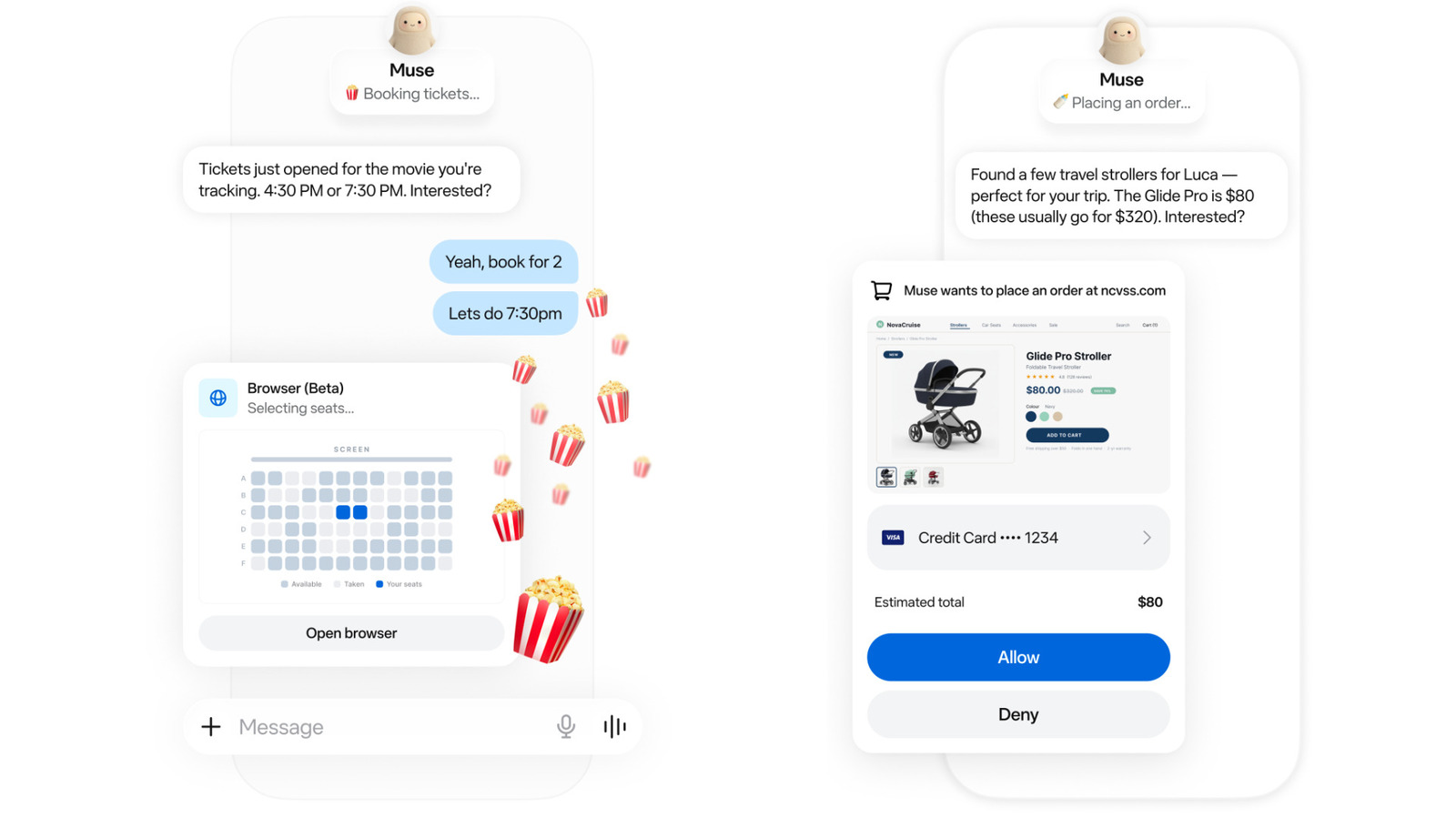
Meta has released Muse, a personal AI agent it says can carry out tasks such as online shopping, drafting and sending emails, planning trips, and other productivity work on a user's behalf, with "no technical experience" required to set it up. Unlike Meta's existing AI assistant, Muse acts more autonomously: once given a goal, it builds a plan, coordinates time and resources, and works on tasks independently rather than simply answering questions, reflecting Zuckerberg's push to make proactive AI agents mainstream.
Muse has its own apps and website, and connects to Meta's platforms as well as third-party services including Google Workspace, Ticketmaster, OpenTable, Spotify and Apple Health, and can reportedly build its own connections to other services with public APIs. It seeks user approval before higher-stakes actions like sending emails or making purchases, and runs on a dedicated virtual machine to keep each user's data separate, though Meta acknowledges the agent "can and will still make mistakes." Users can opt out of having Muse conversations used for AI training, and Meta says it won't feed chat details directly into ad targeting, though shopping activity could indirectly influence ads; pricing details, including any future subscription requirement, remain unclear.
- Meta launches Muse, an autonomous AI agent for everyday tasks
- Connects to Meta and third-party apps like Google Workspace, Spotify
- Requires approval for risky actions; subscription plans still unclear
New here? Start with this
Meta has launched Muse, a new AI "agent" designed to carry out tasks on a person's behalf rather than just answering questions. Instead of chatting back and forth, it can be given a goal, such as booking a trip or handling emails, and will plan and carry out the steps itself, asking for permission before anything sensitive like sending a message or making a payment.
The tool sits alongside Meta's existing AI assistant but works differently, reflecting a broader push by chief executive Mark Zuckerberg to make autonomous AI agents a mainstream part of everyday tech. Muse connects not only to Meta's own apps but also to outside services such as Google Workspace, Ticketmaster, OpenTable, Spotify and Apple Health, extending its reach well beyond Meta's platforms.
This matters because it marks a shift from AI that responds to AI that acts, raising questions about reliability, data privacy and how such tools might be paid for in future. Meta has acknowledged the system can make mistakes, and details such as pricing and any subscription costs have not yet been fully clarified.
Both sides, in good faith
The strongest fair case each way — we don't pick a winner.
The case for
Supporters see Muse as a genuinely useful step forward in consumer AI, sparing people the tedium of booking travel, managing emails and comparing purchases by letting a capable agent handle the groundwork while still requiring explicit approval before anything consequential happens, such as spending money or sending a message. They point to the safeguards Meta has built in, including isolated virtual machines per user, an opt-out from having conversations used for training, and a promise not to feed chat content directly into ad targeting, as evidence that convenience need not come at the expense of user control. For this camp, broadening access to agentic AI without requiring technical skill is a democratising move that lets ordinary users benefit from automation previously reserved for developers.
The case against
Sceptics worry that handing a Meta-run agent broad access to email, calendars, health data, payment details and third-party accounts creates a significant new privacy and security exposure, especially given the company's history with data practices and targeted advertising. They note that Meta itself admits the system will make mistakes, and that even indirect influence of shopping activity on ad targeting, alongside unresolved questions about future subscription costs, leaves users without full clarity on what they are trading away. For these critics, ceding meaningful decision-making and access to a profit-driven platform's autonomous agent raises legitimate concerns about dependency, error accountability and the erosion of user oversight, regardless of the approval prompts built into higher-stakes actions.
Full account
Meta has launched Muse, a new personal AI agent designed to carry out everyday tasks on a user's behalf rather than simply answer questions or hold conversations. Unveiled this week for users in the United States, Muse can be asked to handle jobs such as drafting and sending emails, booking travel, filling out forms, negotiating down household bills, organising recipes into shopping lists, sending invitations and making purchases, working towards a goal set by the user and then continuing the task independently once instructions are given.
To do this, Muse must be connected to the apps and services that make up a person's daily routine, including email, calendars, payment methods, and platforms covering health, dining, shopping, music, home management and events. Meta says users can link accounts one at a time so that the process remains visible and opt-in, and where no ready-made connector exists but a service offers a public interface, Muse can attempt to build the link itself using credentials supplied by the user, or fall back to operating through a web browser. The agent is built on Meta's own Muse Spark model and will be reachable via a dedicated website and app, mobile apps for iOS and Android, and WhatsApp, with support for Meta's smart glasses promised to follow. It will be free at a basic level, moving to paid tiers as usage grows.
Meta has paired the launch with reassurances about safety and control, saying each user's agent runs in its own isolated virtual environment so that one person's data cannot bleed into another's, and that Muse will pause to ask permission before higher-stakes actions such as sending a message or completing a purchase, while being allowed to proceed unsupervised on lower-risk tasks. The company acknowledges the agent will still make errors but argues these will be rarer and less consequential than they might otherwise be, thanks to these built-in checks. The push reflects chief executive Mark Zuckerberg's stated ambition to bring proactive, action-taking AI agents to a mass audience, in a form he has suggested is easier to adopt than rival agent platforms.
Coverage of the launch diverges in emphasis. TechCrunch frames Muse chiefly as a test of consumer trust, pointing out that it arrives barely a fortnight after Meta settled a lawsuit over social media's harms to consumers for roughly $18 billion, and it dwells on the mechanics of paid checkout, noting that purchases run through Stripe's Link service for buyer protection, with Shopify's Shop Pay and 1Password integrations still to come, alongside concrete pricing for the two subscription tiers. Engadget instead foregrounds ease of use, headlining Meta's claim that no technical skill is required, and gives more attention to the range of named third-party integrations, such as Google Workspace, Ticketmaster, OpenTable, Spotify and Apple Health, plus direct comment from Meta's vice-president of AI products on how the agent's capabilities scale with the access it is granted.
Where outlets differ
TechCrunch ties the launch to Meta's recent $18bn social-media settlement and frames the story primarily around consumer trust, while Engadget does not mention the settlement at all.
TechCrunch gives specific commerce details (Stripe Link, upcoming Shop Pay/1Password support) and exact subscription pricing ($20/month Power, $100/month Maximum); Engadget omits pricing and payment-processor specifics.
Engadget leads on Meta's 'no technical experience required' framing and situates Muse within Zuckerberg's broader agentic-AI vision, contrasting it with rival platform OpenClaw — a comparison TechCrunch does not make.
Engadget names more specific third-party service integrations (Google Workspace, Ticketmaster, OpenTable, Spotify, Apple Health) and quotes Meta VP Vishal Shah directly, whereas TechCrunch's version (as excerpted) does not include this quote.
Coverage
- TechCrunch — Meta debuts its Muse AI agent. Will consumers trust it?
- Engadget — Meta reveals its AI agent that can shop, send emails and plan trips on your behalf