World news and discussion on TalkFuse.
German car workers protest as tariffs and weak demand threaten jobs
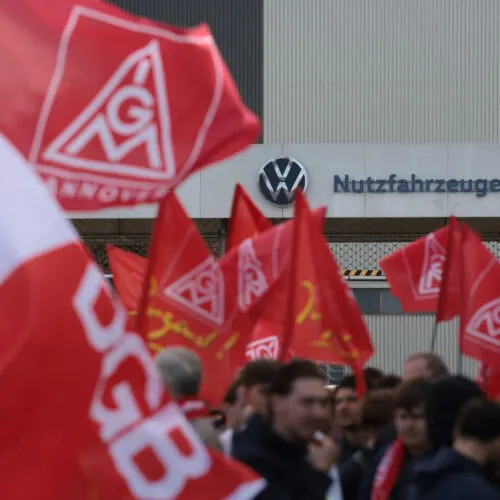
Germany’s car industry is facing mounting pressure from weaker domestic demand, tougher Chinese competition and new US tariffs, raising the prospect of factory closures and significant job losses. The problems threaten a sector long regarded as a cornerstone of Germany’s economy, with workers protesting at major manufacturers and suppliers over the future of automotive employment.
European car sales fell from almost 18 million in 2019 to about 13 million in 2025, while US imports now face a 25% tariff. Volkswagen is considering closing four German factories and has written down $11.5 billion, including $6.9 billion linked to Porsche, whose slowing Chinese sales and weak electric-vehicle demand have reduced profitability. Mercedes-Benz has also warned it may close one German assembly plant and one powertrain plant, while VW says it will accelerate efforts to reduce costs and its workforce.
In short
- Germany’s car industry faces weaker sales, Chinese competition and US tariffs.
- Volkswagen and Mercedes-Benz are considering German factory closures.
- Workers protested as job losses and restructuring loom.
Steelman: both sides, in good faith
The strongest fair case each way — we don't pick a winner.
The case for
Restructuring and possible plant closures may be necessary if demand remains weak, Chinese competition intensifies and US tariffs raise costs; failing to adapt could leave manufacturers less competitive and put even more jobs at risk. Supporters of cost cuts argue that a leaner industry can protect viable factories, sustain investment in new technology and preserve Germany’s automotive base over the longer term.
The case against
Closures and workforce cuts would impose severe costs on employees, communities and suppliers, while weakening a sector central to Germany’s economy. Critics can argue that companies should explore alternatives such as negotiated reduced hours, retraining and investment in competitive electric vehicles, rather than shifting the burden of market pressures onto workers.
Explained simply
Germany’s car industry employs hundreds of thousands of people, directly in vehicle and parts factories and in businesses that supply them. Car-making has also supported exports and regional economies, so changes in production can affect workers and towns well beyond the major manufacturers.
The industry is being reshaped as buyers shift towards electric cars and Chinese companies become stronger competitors, particularly in China, an important market for German brands. At the same time, demand for cars in Europe has been lower than before the pandemic, while trade barriers can make selling vehicles in other markets more costly.
Volkswagen, Mercedes-Benz and Porsche are among Germany’s best-known carmakers, alongside a large network of parts suppliers. Their decisions about costs, factories and staffing matter to workers and local communities, as well as to Germany’s wider economy.
Read the full article at the source →
Originally published by Ars Technica as “Protests for Germany’s car industry as job losses loom”.