Reaction wheel failures leave Swift rescue mission spinning in orbit
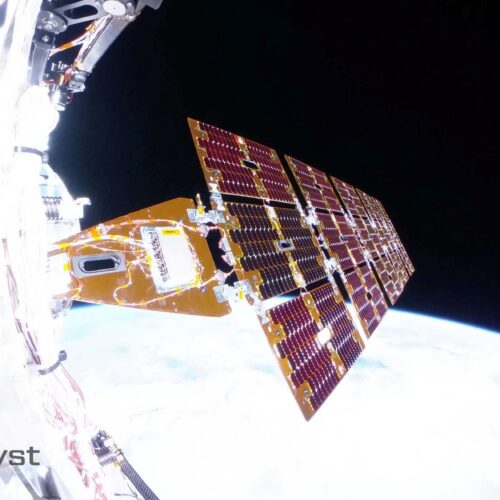
A commercial satellite built to rescue NASA's ageing Swift gamma-ray observatory from atmospheric reentry has encountered significant technical problems weeks into its mission. The Link spacecraft, launched on 3 July by Katalyst Space Technologies, experienced attitude control failures over the weekend that left it spinning and degraded communications; two of its three reaction wheels—critical for pointing control—are now inoperable, and its cold-gas thruster system has suffered partial failure. The spacecraft remains powered and in contact with ground teams, giving engineers time to develop solutions.
Swift, a nearly 22-year-old observatory that specialises in detecting gamma-ray bursts (the universe's most powerful explosions), would reenter Earth's atmosphere within months without intervention. Lacking its own propulsion, Swift cannot extend its own orbit. NASA awarded Katalyst a $30 million contract to perform the rescue, which also serves as a proof-of-concept for the commercial satellite-servicing industry. Engineers are now attempting to use Link's primary electric thrusters—ordinarily reserved for approaching and rendezvous with Swift—to stabilise the troubled spacecraft, creating additional risk to the already high-stakes mission.
- Link, a commercial rescue satellite launched in July to save NASA's aging Swift gamma-ray telescope from burning up in the atmosphere, has suffered reaction wheel failures after nearly a month in orbit.
- Two of Link's three attitude-control wheels are non-functional and its thruster system is degraded, forcing engineers to repurpose its primary electric thrusters—designed for the rendezvous and orbit-raising mission—to stabilize the spacecraft.
- Swift, a 22-year-old space observatory that detects gamma-ray bursts, cannot self-rescue due to lack of propulsion; NASA is paying Katalyst $30 million for the rescue attempt, which also serves as a commercial satellite-servicing technology demonstration.