RugOne Xsnap 7 Pro adds removable action camera to rugged smartphone lineup
Developing story first seen 52 minutes ago
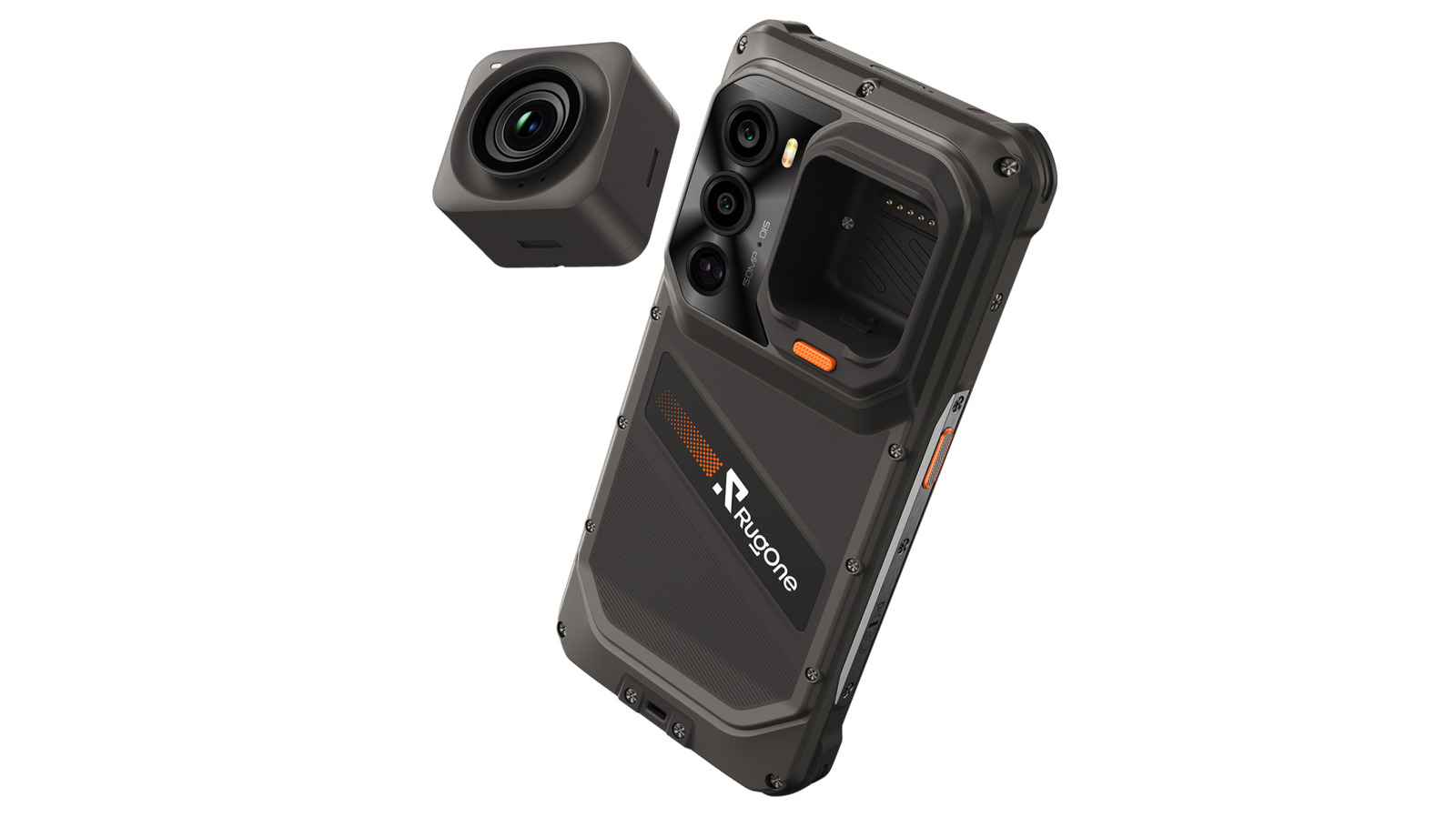
RugOne has unveiled the Xsnap 7 Pro, a rugged smartphone that distinguishes itself through a modular design centred on a detachable camera system. One of its three rear cameras features a magnetic mount that allows it to be removed and used independently as a standalone action camera for wearable or handheld filming.
Launched at MWC 2026, the device targets adventure seekers and extreme sports enthusiasts, combining rugged engineering with water and dust protection suitable for demanding outdoor environments. The removable camera module eliminates the need for a separate action camera, addressing a market segment that values both durability and versatile capture capabilities without adding bulk.
- RugOne's Xsnap 7 Pro features a magnetic, detachable camera module that works as both a fixed rear lens and standalone action camera
- The rugged device debuted at MWC 2026 with water and dust protection, targeting extreme sports and outdoor use cases
- The modular camera system sets the phone apart from the smartphone market's typical uniform slab design conventions
Full account
RugOne, the rugged-phone brand operated by Ulefon, has unveiled the Xsnap 7 Pro, a heavy-duty smartphone whose standout feature is a rear camera module that detaches magnetically and doubles as a standalone action camera. First shown as a prototype at MWC 2026 earlier in the year, the handset has now been formally introduced at IFA 2026 in Berlin. Early-bird orders open via Kickstarter on 7 September at a discounted price of €799 (roughly $930) for a limited run, ahead of a wider release next month through Amazon and RugOne's own online store at $999, in Sand Dune and Classic Black finishes.
As a phone, the Xsnap 7 Pro is built for punishment, carrying both IP68 and IP69K certification, meaning it can withstand high-pressure water jets as well as full submersion up to two metres deep for half an hour; one report also notes it is rated to survive drops of 1.5 metres onto concrete. Its 6.67-inch AMOLED display runs at up to 120Hz, with one account citing peak brightness of 1,700 nits and another noting a Corning Gorilla Glass Victus panel. Power comes from a MediaTek Dimensity 8400 5G chipset, paired with 12GB of RAM according to one source, running Android 16 with a promised upgrade path stretching to Android 20. Alongside the detachable unit, the phone's fixed camera array includes a 32-megapixel selfie camera, a stabilised 50-megapixel main sensor, and a 64-megapixel infrared night-vision camera aided by built-in LEDs for low-light shooting.
The real novelty is the removable module itself, an almost cube-shaped unit weighing around 39 grams that captures video at up to 2.7K resolution and 30 frames per second through a 133-degree ultra-wide lens, falling short of the 4K capture offered by rivals such as the DJI Osmo Nano or Insta360 Go Ultra, according to one report. RugOne says onboard software handles distortion correction and image stabilisation, including a horizon-lock function and a 'Freeframe' mode that records the full sensor area so footage can be cropped to vertical or horizontal later, even after the camera has been flipped through 360 degrees. The module itself can survive submersion to five metres, deeper than the handset, and holds roughly eight hours of 1080p footage across its 64GB of built-in storage, with clips transferring to the phone's 512GB of storage whenever the two are reconnected. Battery life is quoted at up to 40 minutes of continuous recording per charge, extending to as much as 800 minutes across a session when the module is repeatedly topped up from the phone's 9,300mAh battery.
Coverage of the launch varies in emphasis. One outlet frames the phone primarily through its spec sheet, drawing a direct comparison with established action cameras and detailing the software update commitment and RAM, and describes the handset's own screen doubling as a wireless viewfinder for the detached camera at distances of up to roughly 160 feet (about 50 metres). The other, reporting from IFA in Berlin, foregrounds RugOne's ownership by Ulefon, notes the review unit had not yet been tested hands-on, and highlights extra accessories such as a magnetic pendant for wearing the camera on the body and compatibility with third-party universal mounts, alongside sale channels and colour options; it cites the wireless preview range via a companion app as up to 50 metres, broadly consistent with the other account's figure despite the different framing.
Where outlets differ
One source (Verge-style) leans on spec comparisons — explicitly benchmarking the detachable camera against the DJI Osmo Nano and Insta360 Go Ultra — while the other (reported live from IFA in Berlin) foregrounds hands-on impressions, noting the reviewer had not yet tested the unit in person.
Only one source mentions RugOne's parent company, Ulefon, and its history making rugged phones.
Figures for the wireless preview range are given differently: one cites 'up to 160 feet' from the phone's own screen, the other 'up to 50 metres' via a companion app — these are roughly equivalent but framed differently (device screen vs dedicated app).
Only one source details extra accessories (a magnetic wearable pendant, third-party mount compatibility) and confirms sale channels (Amazon, RugOne's store) and colour options (Sand Dune, Classic Black).
Only one source specifies 12GB RAM, the Android 16-to-20 upgrade promise, and Gorilla Glass Victus; the other instead cites 1,700-nit peak screen brightness and a 1.5-metre concrete drop rating, details absent from the first.
Coverage
- The Verge — This rugged phone’s removable camera can survive and capture your extreme adventures
- Engadget — This rugged smartphone’s camera is a removable action cam