School Protests Spread Across France Amid Education Concerns and Rising Violence
Developing story first seen 1 hour ago
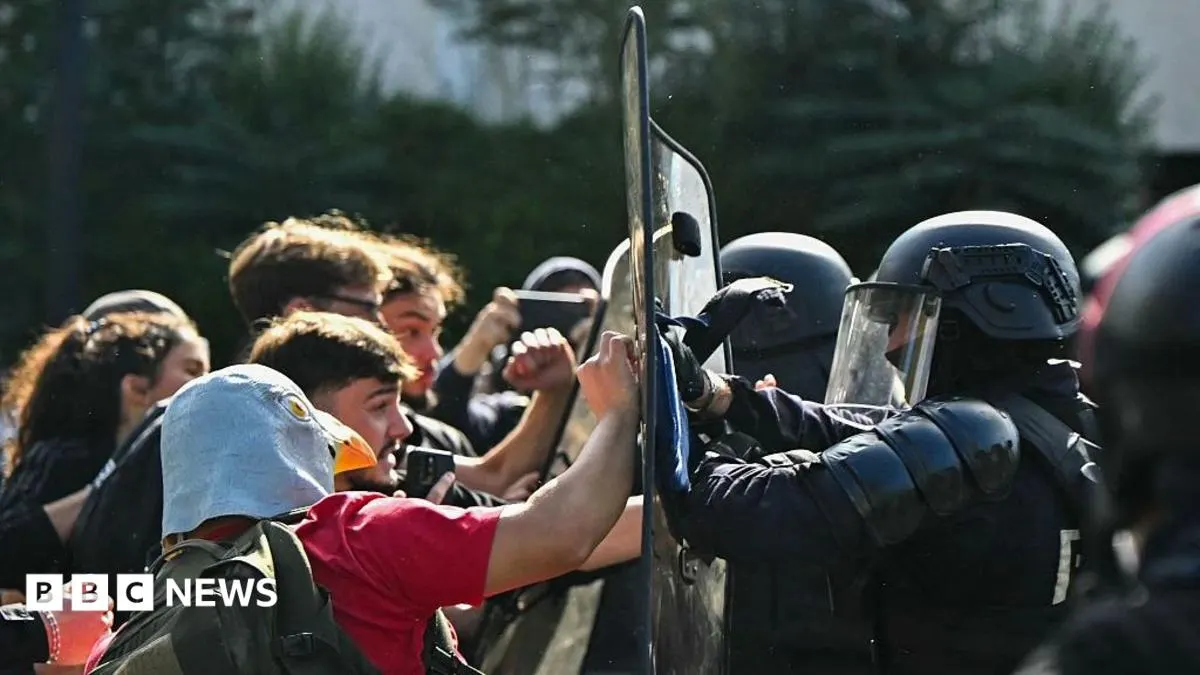
Violent groups have hijacked student protests in France, with documented attacks including a woman assaulted with a makeshift flamethrower and an off-duty police officer beaten unconscious. The Interior Minister has opened an attempted voluntary homicide investigation, with far-left groups blamed for encouraging vandalism that has overtaken the originally peaceful demonstrations over education conditions.
Since the protests began, 65 staff members have been injured (including 40 school principals), 170 students hurt, and over 100 high schools suffered severe damage. The underlying grievances centre on long school hours, poor conditions and insufficient staffing. Though the government acknowledges these education complaints are legitimate, officials distinguish between the original demonstrators and violent groups now dominating the movement.
- French student education protests descended into violence across multiple cities.
- Woman attacked with flamethrower; police officer beaten unconscious, triggering homicide investigation.
- 65 staff and 170 students injured; 100+ schools damaged; far-left groups blamed.
New here? Start with this
France is experiencing widespread student protests that began in a low-income area near Paris and have now spread to multiple cities, closing hundreds of schools and drawing both secondary and university students. The demonstrations are centred on concerns about education conditions and reflect broader grievances among the country's young people.
The protests have turned violent in some places, with reports of attacks on school staff, police officers and members of the public, resulting in injuries and damage to property. The government has acknowledged that students' underlying concerns about education have merit, but has expressed alarm at the violent elements and indicated it will not accept further escalation.
The timing is significant because France is approaching national elections, and officials worry that the demonstrations could expand beyond their current participants and influence broader public opinion. The government faces pressure to address education concerns whilst managing what it views as destructive consequences of some protest actions.
Both sides, in good faith
The strongest fair case each way — we don't pick a winner.
The case for
Student demonstrations stemming from low-income areas articulate genuine, government-acknowledged education grievances that warrant serious attention and reform. The broad movement represents young people exercising their democratic right to demand change for their futures, and treating the entire movement as invalidated by incidents of violence risks suppressing legitimate voices and concerns that a functioning democracy must hear and address.
The case against
Whilst education reform complaints deserve policy engagement, the documented violence—including attacks on teachers, police, and civilians—represents criminal behaviour that fundamentally cannot be tolerated or downplayed as incidental to the movement. The government is right to maintain this distinction and respond firmly; permitting violence to proceed without serious consequences risks normalising it as an acceptable tactic and undermining both public safety and the rule of law that democratic society depends upon.
Full account
Student unrest has engulfed hundreds of schools across France over the past fortnight, with the movement escalating dramatically this week into nationwide disruption. What began as a localised protest in the working-class Seine-Saint-Denis district north of Paris has spread countrywide, forcing educational institutions to close their doors. By Thursday, hundreds of secondary schools (lycées) had been blockaded by students, with authorities subsequently shutting approximately 400 educational establishments to safeguard staff and pupils. Universities have begun joining the movement, signalling potential for further expansion.
The emergence of youthful protest movements carries particular weight in French political culture. Since the seismic student uprisings of May 1968—infamously dismissed by President de Gaulle—successive governments have approached youth demonstrations with considerable caution. Such movements are characterised by their unpredictability and fluid organisation, making them difficult to negotiate with. Additionally, public sympathy tends to favour young protesters, and any heavy-handed police response risks serious political fallout. With presidential elections approaching, the Macron administration finds itself in a precarious position, as reported by Le Monde.
Student grievances, whilst not formally systematised, centre on inadequate educational funding and resources. Protesters have called for increased teacher recruitment, reduced class sizes, and improvements to school infrastructure. These concerns are not isolated to the protesting youth; they reflect broader frustrations within French society about the state of the education system. The initial phase of the movement appears to have been characterised by constructive activism aimed at bringing these issues to public attention.
The protests have become marred by significant violence and property destruction. A lycée in Nantes experienced a major fire that consumed its main hall, whilst numerous school gates have been torched across the country, with damage estimates reaching millions of euros. According to the Education Ministry, 65 staff members, including 40 school principals, have sustained injuries. Authorities report that some 300 police and firefighters have also been injured, and approximately 2,000 people—predominantly minors—have been detained. Specific incidents include assaults on both police officers and members of the public. Student advocacy groups have simultaneously documented alleged injuries inflicted by police, including serious eye trauma and dental injuries sustained by teenagers.
Where outlets differ
Source 1 adopts a contextual, analytical approach examining historical precedent and governmental calculations; Source 2 emphasises shocking incidents and describes the movement as having devolved into violence
Source 1 characterises participants as youth or students; Source 2 labels violent perpetrators as hooligans, thugs, and rioters
Source 2 attributes escalation to far-left political groups encouraging vandalism; Source 1 does not attribute responsibility for violence to external political movements
Source 2 provides graphic descriptions of specific violent incidents including weapon use; Source 1 maintains greater editorial distance from sensational detail
Source 2 reports approximately 170 students have been wounded; Source 1 does not provide a corresponding figure for student injuries
Source 2 extensively quotes authorities framing violence as unacceptable; Source 1 balances official statements with claims from protest groups regarding police conduct
Coverage
- BBC World — School protests spread across France, raising alarm in Macron’s government
- Daily Mail — France is rocked by more violence linked to far-left student protests as videos show shocking attacks on people trying to protect schools
Art Business Celebrity Culture Entertainment Europe Government Markets Politics World