The James Webb Telescope Is Changing Astronomers’ Understanding of the Ancient Cosmos
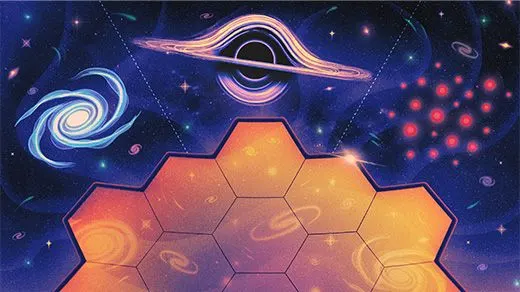
The James Webb Space Telescope (JWST) has been overturning astronomers' assumptions about the early universe, revealing objects and phenomena that established theories struggle to explain. Since coming online in 2022, JWST has spotted "little red dots," black holes far larger than expected for their age, and ancient galaxies that don't fit models of the universe's first billion years, prompting researchers worldwide to develop new theories to make sense of the observations.
Little red dots, discovered by the hundreds, began appearing in significant numbers roughly 650 million years after the Big Bang and were never observed before JWST. One leading hypothesis, explored by astrophysicist Charlotte Mason of the Cosmic Dawn Center in Copenhagen, suggests they may be black holes enveloped in thick, possibly clumpy gas that emits light like a stellar atmosphere—a potential new class of object dubbed a "black hole star." Separately, astrophysicist Jenny Greene of Princeton University highlighted the puzzle of billion-solar-mass black holes found growing just a few hundred million years after the Big Bang, far too massive and fast-growing to fit current models of how black holes form from collapsing stars.
- JWST keeps finding early-universe objects that defy current astrophysics theories
- "Little red dots" may be black holes wrapped in thick gas clouds
- Ancient black holes appear far too massive to fit existing formation models