Trump gushes about Kim Jong Un as he orders scaled-back US military exercises with South Korea… after country’s two-word snub over Iran war
Developed over time first seen 2 months ago
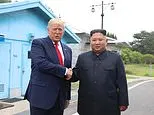
Donald Trump has ordered a scaling back of joint US military exercises with South Korea, while offering warm praise for North Korean leader Kim Jong Un. The move comes shortly after South Korea reportedly gave a terse "two-word" response to Trump regarding the recent conflict involving Iran, suggesting some friction between Washington and Seoul over the issue.
Details of the exact nature of the reduced exercises and the specific snub were not fully set out, but the shift marks a notable change in tone from Trump towards North Korea's leader, with whom he has previously pursued direct diplomacy. The development comes against a backdrop of wider tensions in the region following the Iran war, with South Korea's brief reaction apparently prompting Trump's response on the scale of joint drills.
- Trump scales back US-South Korea military exercises
- Trump praises North Korea's Kim Jong Un warmly
- Move follows South Korea's terse response over Iran war
New here? Start with this
Trump has ordered a reduction in the scale of joint US-South Korea military exercises, moves that have historically been a source of tension with North Korea, which sees them as a rehearsal for invasion. At the same time, he has spoken warmly about North Korean leader Kim Jong Un, whom he met several times during his first term for direct talks on North Korea's nuclear weapons programme, though those negotiations ultimately stalled without a lasting deal.
The backdrop is a period of heightened tension in the wider region following a recent conflict involving Iran, during which South Korea reportedly gave Trump a curt reply that has been read as a snub. South Korea is a longstanding US treaty ally, hosting American troops and relying on Washington for its defence against the North, so any friction between the two allies, or any softening of America's posture towards North Korea, is being watched closely across the region.
This matters because decisions on US troop levels and exercises in Korea affect the security balance on a peninsula that has been divided and technically at war since the 1950s, and any shift in tone towards Kim Jong Un raises questions about the direction of US policy on North Korea's nuclear ambitions.
Both sides, in good faith
The strongest fair case each way — we don't pick a winner.
The case for
Supporters of a lighter-touch approach argue that large-scale joint exercises have long been a flashpoint that Pyongyang cites to justify its own military build-up, and that easing them could open space for renewed dialogue with Kim Jong Un, echoing the direct diplomacy that produced unprecedented summits during Trump's first term. They contend that reducing tension through gestures of goodwill, rather than continual displays of force, better serves the ultimate goal of denuclearisation and regional stability, and that flexibility in military posture is a reasonable price for keeping communication channels open with an unpredictable nuclear-armed state.
The case against
Critics argue that scaling back joint exercises risks eroding decades of deterrence built with a key treaty ally, sending a signal of weakened resolve at precisely the moment North Korea continues to expand its nuclear and missile capabilities. They caution that warm rhetoric towards Kim Jong Un, apparently linked to irritation over a curt diplomatic response from Seoul, conflates personal pique with strategic decision-making, and that allies should not fear military commitments being downgraded over perceived slights, since this could unsettle Seoul's confidence in Washington's security guarantees and embolden Pyongyang without securing any reciprocal concessions.
More coverage
Americas Asia Fitness Geopolitics Government Health Middle East Politics World