Sport news and discussion on TalkFuse.
We shouldn’t confuse politics and football – Scaloni


England squad
- Full squad
-
1 Jordan PICKFORD Goalkeeper
-
2 Ezri KONSA Defender
-
3 Nico OREILLY Defender
-
4 Declan RICE Midfielder
-
5 John STONES Defender
-
6 Marc GUEHI Defender
-
7 Bukayo SAKA Forward
-
8 Elliot ANDERSON Midfielder
-
9 Harry KANE Forward
-
10 Jude BELLINGHAM Midfielder
-
11 Marcus RASHFORD Forward
-
12 Trevoh CHALOBAH Defender
-
13 Dean Henderson Goalkeeper
-
14 Jordan HENDERSON Midfielder
-
15 Dan BURN Defender
-
16 Kobbie MAINOO Midfielder
-
17 Morgan ROGERS Midfielder
-
18 Anthony GORDON Forward
-
19 Ollie WATKINS Forward
-
20 Noni MADUEKE Forward
-
21 Eberechi EZE Midfielder
-
22 Ivan TONEY Forward
-
23 James TRAFFORD Goalkeeper
-
24 Reece JAMES Defender
-
25 Djed SPENCE Defender
-
26 Jarell QUANSAH Defender
Argentina squad
- Full squad
-
1 Juan MUSSO Goalkeeper
-
2 Marcos SENESI Defender
-
3 Nicolas TAGLIAFICO Defender
-
4 Gonzalo MONTIEL Defender
-
5 Leandro PAREDES Midfielder
-
6 Lisandro MARTINEZ Defender
-
7 Rodrigo DE PAUL Midfielder
-
8 Valentin BARCO Midfielder
-
9 Julian ALVAREZ Forward
-
10 Lionel MESSI Forward
-
11 Giovani Lo Celso Midfielder
-
12 Geronimo RULLI Goalkeeper
-
13 Cristian ROMERO Defender
-
14 Exequiel PALACIOS Midfielder
-
15 Nico GONZALEZ Midfielder
-
16 Thiago ALMADA Forward
-
17 Giuliano SIMEONE Forward
-
18 Nico PAZ Forward
-
19 Nicolas OTAMENDI Defender
-
20 Alexis MAC ALLISTER Midfielder
-
21 Jose Manuel LOPEZ Forward
-
22 Lautaro MARTINEZ Forward
-
23 Emiliano MARTINEZ Goalkeeper
-
24 Enzo FERNANDEZ Midfielder
-
25 Facundo MEDINA Defender
-
26 Nahuel MOLINA Defender
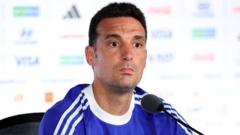
Argentina manager Lionel Scaloni said his team’s World Cup semi-final against England should be treated strictly as a football match, not as an extension of political tensions between the two countries. Speaking before Wednesday’s game in Atlanta, he said it would be disrespectful to conflate sport with the legacy of the 1982 Falklands War, describing that period as a sad chapter in history. His remarks matter because England-Argentina matches carry unusual historical weight, both because of the sovereignty dispute over the Falklands/Malvinas and the long football rivalry between the sides.
The semi-final takes place on 15 July at 20:00 BST, with added security in Atlanta because of the fixture’s political and cultural sensitivity. Recent tension has been heightened by Argentina players being filmed singing a chant about the islands after their 3-2 last-16 win over Egypt, while memories also linger from Diego Maradona’s decisive role in Argentina’s 1986 World Cup win over England. On the pitch, Lionel Messi, now 39, has scored eight goals at the tournament, while England’s Harry Kane and Jude Bellingham have six each; Argentina have reached the last four despite needing extra time in both the last 32 and quarter-finals.
In short
- Scaloni said football and politics should not be mixed
- England and Argentina meet in a highly charged semi-final
- Messi and England’s stars headline the contest
Steelman: both sides, in good faith
The strongest fair case each way — we don't pick a winner.
The case for
Scaloni's argument reflects the view that sport offers a rare space for peaceful competition between nations, and using football as a vehicle for political grievances undermines this distinctive value. Treating the match primarily through a political lens risks dishonoring those affected by actual conflict and diminishes the athletes' accomplishments on the pitch. This perspective holds that the best tribute to historical tragedy is channelling national passion into fair athletic competition rather than reviving old tensions.
The case against
The counterargument holds that international football cannot be meaningfully divorced from the historical and cultural contexts in which nations meet. The Falkland Islands remain a genuine sovereignty dispute, and supporters' expressions of national identity around this fixture reflect legitimate ongoing concerns rather than seeking revived conflict. This view suggests that acknowledging the historical weight of such encounters is not disrespectful but rather an honest recognition that sport exists within real political and cultural reality.
Explained simply
England and Argentina have one of football's most politically charged rivalries. The two countries dispute sovereignty over the Falkland Islands (known as the Malvinas in Argentina), a territory in the South Atlantic that was the subject of a brief war between them in 1982. This historical conflict means matches between the nations carry symbolic weight beyond the football pitch.
The semi-final scheduled for 15 July comes amid heightened sensitivity. Last week, Argentine players were filmed singing a chant about the Falklands after their quarter-final victory, which reignited political tensions surrounding the fixture. The rivalry is also coloured by football history, particularly Diego Maradona's decisive role in Argentina's 1986 World Cup victory over England.
Both teams have strong attacking talent in form at this tournament. Argentina's Lionel Messi, aged 39, has scored eight goals, whilst England's Harry Kane and Jude Bellingham have six each. Argentina advanced to the semi-finals through two rounds of extra time, and security arrangements for the Atlanta match reflect concerns about the fixture's political and cultural sensitivity.