The day 60,000 migrants swept their way into Europe as wave after wave of predominantly young men storm Spanish island
Developed over time first seen 3 months ago
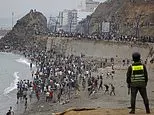
Tens of thousands of migrants entered Spain's North African enclave of Ceuta from Morocco this week, with more than 60,000 people reported to have crossed by swimming, climbing fences or rushing the border in a surge that began on Thursday. The influx overwhelmed the small territory, home to around 84,000 people, prompting unrest, clashes with security forces and reports of 57 deaths, and has raised diplomatic tensions within the EU, with Italy suspending Schengen free-movement arrangements with Spain and several other countries considering similar steps.
Journalists reported migrants arriving at a rate of roughly 200 a minute, with crowds also breaching the border at Melilla, Ceuta's sister enclave 140 miles away. Spanish soldiers used tear gas while Moroccan forces deployed water cannon, but vehicles were burnt and clashes broke out on the streets. Local residents described chaotic and unsanitary conditions and accused the Madrid government of abandoning them, while Prime Minister Pedro Sánchez blamed trafficking gangs for organising the crossings; anti-migrant protests also took place in Madrid. Some observers suggested Morocco may have allowed the surge to pressure Spain over the disputed status of Ceuta.
- Sources
- 2
- Outlets
- 1
- Left · Centre · Right
- 0 · 0 · 2
In short
- Over 60,000 migrants crossed into Spain's Ceuta enclave from Morocco this week
- Clashes, fires and 57 reported deaths accompanied the unprecedented surge
- Italy suspended Schengen ties with Spain; other EU states weighing similar action
How this story developed
- 3 months ago Tens of thousands of migrants entered Spain's North African enclave of Ceuta from Morocco this week, with more than 60,000 people reported to have crossed by swimming, climbing fences or rushing the border in a surge that began on Thursday.
Full account
Spanish authorities faced a major border incident in Ceuta, the Spanish autonomous city on Morocco’s northern coast, after reports said that around 60,000 migrants entered or attempted to enter the territory on Thursday. The accounts describe people reaching Ceuta by sea and over land, including through or around border barriers. Both reports characterise the event as an exceptional one-day movement into the European Union, though the precise scale, casualty total and sequence of events were not independently established in the material provided.
The first report says the pressure continued after the initial crossings, with large groups gathering near the frontier and on beaches. It reports that Moroccan forces used water cannon on their side of the border, while Spanish security personnel used tear gas amid clashes and damage to vehicles. It also says there were confrontations in Ceuta involving some new arrivals and local residents, and cites residents who said public services and basic facilities were under severe strain. It further reports deaths during attempted crossings, although no official confirmation or detail on their circumstances is included in the supplied account.
The second report focuses more heavily on the political consequences beyond Spain. It says Spanish Prime Minister Pedro Sánchez described the episode as an attack on Spain and said his government was seeking the return of those who had entered to Morocco. It also reports calls from politicians in Italy, France, Poland and the UK for tighter border measures, alongside concern that people who reached Spain could later travel towards northern Europe. European Commission President Ursula von der Leyen was quoted as saying that unauthorised entry into the Union could not be accepted.
Both reports raise the possibility that Morocco allowed or encouraged the crossings to increase diplomatic pressure on Spain, particularly in relation to Ceuta, but present this as speculation rather than an established fact. Ceuta and Melilla, another Spanish territory on the North African coast, have long been sensitive points in relations between Madrid and Rabat and are also among the EU’s external land borders. The immediate priorities described in the reports were restoring order, providing basic assistance, determining how many people had entered, and managing any returns or asylum claims under Spanish and European law.
Where outlets differ
From the full account, which is AI-written from the sources:
Source 1 concentrates on scenes at the border and inside Ceuta, including alleged violence, property damage, conditions for arrivals and residents’ accounts of disruption. Source 2 gives greater prominence to British political reactions and possible implications for UK border policy.
Source 1 says Italy had suspended Schengen arrangements with Spain and that several other countries were considering similar action. Source 2 attributes a unilateral Italian suspension to Giorgia Meloni, says Finland supported calls to suspend Spain from Schengen, and adds that France would tighten controls at its Spanish border. These claims would require independent official verification.
Source 1 reports 57 deaths and says journalists saw roughly 200 arrivals a minute; Source 2 does not repeat either figure. Both use the figure of 60,000 migrants, but neither supplied extract identifies an official source for it.
Source 1 includes Donald Trump’s description of the events as an ‘invasion’; Source 2 instead highlights UK politicians’ concerns and Louise Haigh’s rejection of the idea that the crossing force was an invading nation or force.
Steelman: both sides, in good faith
The strongest fair case each way — we don't pick a winner.
The case for
These migrants are fleeing desperate circumstances in Morocco and beyond, often driven by poverty, conflict, or lack of opportunity that are not of their making. The focus on border security and deterrence obscures the human tragedy: people willing to risk their lives swimming across dangerous waters represent an urgent humanitarian crisis requiring coordinated international solutions, legal migration pathways, and investment in root causes. The reported deaths and harsh security responses raise legitimate questions about whether wealthy nations are meeting their moral obligations to vulnerable people, particularly when geopolitical tensions or trafficking networks may have exploited their desperation.
The case against
Nations have a fundamental right to control their borders and maintain the rule of law, which requires orderly, legal immigration processes rather than mass breaches that overwhelm local communities and public services. Ceuta's residents—already living in compressed conditions with 84,000 people—are entitled to security and stability, and the chaos, vehicle fires, and violent clashes represent lawlessness that cannot be tolerated regardless of migrants' circumstances. The evidence that criminal trafficking gangs orchestrated this influx highlights the need for robust security responses; compassion must be balanced with responsibility to existing citizens, and accepting mass illegal entry sets dangerous precedents that encourage further organised exploitation of vulnerable people.
Explained simply
Ceuta and Melilla are small Spanish territories on the North African coast, surrounded by Morocco. Their land borders with Morocco are also external borders of the European Union, and Spain has fences and security forces there to control crossings.
People seeking to enter Europe have tried to reach the enclaves by swimming or crossing those fences. Spain’s government, led by Prime Minister Pedro Sánchez, manages the territories, while Moroccan authorities control the surrounding area and play a central role in border security.
The enclaves’ location makes migration a matter for Spain, Morocco and the wider EU. Ceuta and Melilla are also disputed by Morocco, so disagreements over their status can affect relations between the two countries.
Coverage · 2 sources
Bias meters
From 2 rated sources.