Culture news and discussion on TalkFuse.
Astronomers Have Detected an Exomoon for the First Time
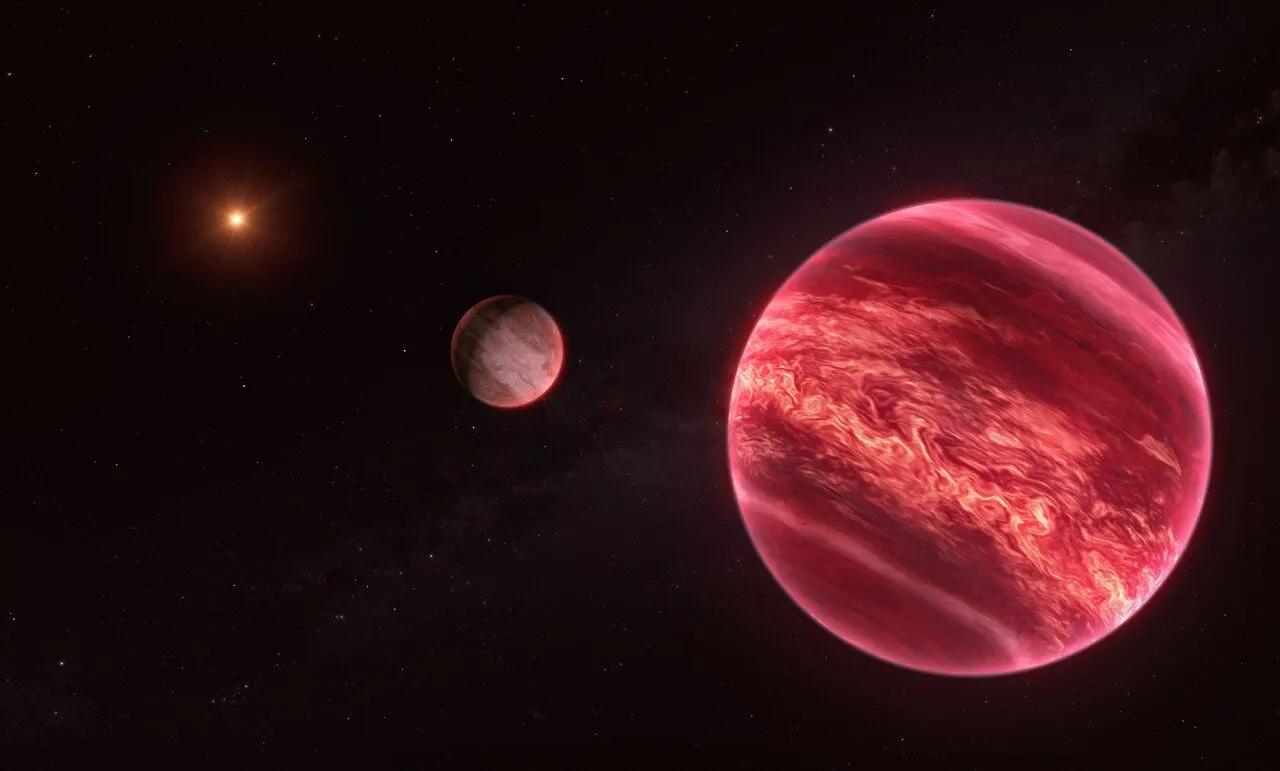
An international team of astronomers has found evidence of a moon-like companion orbiting the brown dwarf CD-35 2722 B, 73 light-years from Earth. If confirmed, it would be the first detected exomoon-like object beyond the solar system and could help address the longstanding lack of definitive evidence for moons in other planetary systems.
The suspected “exosatellite” has a mass of at least 0.9 Jupiter masses and appears to orbit every 170 days, making it far larger relative to its host than any familiar moon in the solar system. Researchers used 23 nights of observations between October 2023 and February 2026 with the Very Large Telescope, detecting the brown dwarf’s gravitational wobble; they also ruled out several alternative explanations and found the orbit should be physically stable.
In short
- Evidence suggests a giant moon-like body orbiting a brown dwarf.
- It may be the first exomoon detected beyond the solar system.
- The object is at least as massive as Jupiter.
Explained simply
Brown dwarfs are objects larger than planets but too small to sustain the steady nuclear reactions that power stars. CD-35 2722 B is one such object, about 73 light-years from Earth; a light-year is the distance light travels in a year.
An exomoon is a moon orbiting a planet or similar body beyond our solar system. Astronomers have found thousands of planets around other stars, but confirming moons there is difficult because they are small and far away. A moon can be inferred from its effect on the motion of the body it orbits.
The proposed companion is unusually large compared with its host, so researchers describe it as moon-like rather than like familiar moons in our solar system. If its existence is confirmed, it could help scientists understand how such pairs form and whether moons are common elsewhere.
Art Celebrity Culture Entertainment Research Science Space Technology