World news and discussion on TalkFuse.
How Spain’s migrant crisis created a political storm – whipped up by social media
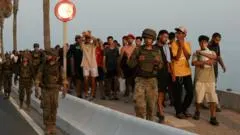
Thousands of migrants swam from Morocco into the Spanish exclave of Ceuta on Thursday in an unprecedented surge, with at least 67 people dying and their bodies recovered from the sea. Most have since returned to Morocco, escorted by Spanish troops and police, but the episode has reignited deep political divisions across Europe over migration policy and exposed how social media can rapidly mobilise mass movement across borders.
Spanish Prime Minister Pedro Sanchez accused fellow EU members, particularly Italy, of exploiting the crisis rather than supporting Spain, after Giorgia Meloni's Fratelli d'Italia party publicised images of the arrivals and Meloni suspended Italy's Schengen agreement with Spain, citing security concerns. Almost two dozen EU heads of state backed a call for an urgent interior ministers' meeting, targeting Spain's policy of regularising undocumented migrants, though those arriving in Ceuta were not connected to that scheme. Instead, investigators point to viral social media posts, some from accounts only weeks old with tens of thousands of likes, falsely claiming "Spain is Open," alongside a misreading of a Spanish Supreme Court ruling barring immediate pushbacks of those arriving by sea. Migrants who reached Ceuta found no food, shelter or route onward to mainland Europe, and most swiftly turned back, leaving open questions over whether the surge was spontaneous or deliberately orchestrated.
In short
- Thousands swam into Spain's Ceuta from Morocco; at least 67 died
- Most migrants have returned to Morocco after finding no onward route
- Italy suspended Schengen ties with Spain, deepening EU migration row
- Viral social media posts falsely promised easy access to Europe
Steelman: both sides, in good faith
The strongest fair case each way — we don't pick a winner.
The case for
Those sympathetic to Spain's position argue that a tragedy which claimed dozens of lives should prompt solidarity rather than point-scoring, and that Italy and other member states seized on distressing images for domestic political advantage rather than offering practical support. They note that the surge was demonstrably driven by viral misinformation and a misreading of a court ruling, not by Spain's regularisation scheme, so directing criticism at that policy is misplaced. On this view, migration pressure at any external EU border is a shared European challenge, and mutual aid, rather than blame or unilateral moves like suspending Schengen cooperation, is the responsible response.
The case against
Those sympathetic to Italy and the other EU states argue that an unprecedented, socially-mobilised surge across an external border is precisely the kind of event that justifies heightened vigilance, regardless of what ultimately triggered it, since porous borders and rapid mass movement pose genuine security and administrative strains that ripple across the passport-free Schengen area. They contend that questioning Spain's broader approach to undocumented migrants, including regularisation policies, is a legitimate and foreseeable line of debate when such policies are seen as creating pull factors, even if this particular episode had a different immediate cause. On this view, robust scrutiny and coordinated EU-level discussion, rather than deference to any one member state's handling, are a reasonable and proportionate response to an event of this scale.
Explained simply
Spain's north African exclave of Ceuta, a small Spanish-controlled city bordering Morocco, has long been a crossing point for migrants trying to reach European Union territory without needing to cross the Mediterranean by boat. It has previously seen large, sudden influxes when Moroccan border controls have loosened, and its position makes it a recurring flashpoint in wider European debates about how migration into the EU should be managed.
The latest surge has drawn in politicians well beyond Spain. Spanish Prime Minister Pedro Sanchez and Italian Prime Minister Giorgia Meloni, leaders of governments with differing approaches to migration, have found themselves at odds, while other EU leaders have used the episode to press Spain over its separate policy of granting legal status to undocumented migrants already living in the country. Migration policy remains one of the most contested issues in EU politics, with member states divided over how much responsibility to share and how strictly borders should be controlled.
What is new in this episode is the apparent role of social media in prompting people to attempt the crossing, based on misleading claims spread online about Spain's policies. This raises broader questions, still unresolved, about how misinformation on social platforms can influence real-world movements of people across borders, and about who, if anyone, was behind spreading it.