Entertainment news and discussion on TalkFuse.
Flight 13 of Starship was (mostly) a triumph for SpaceX
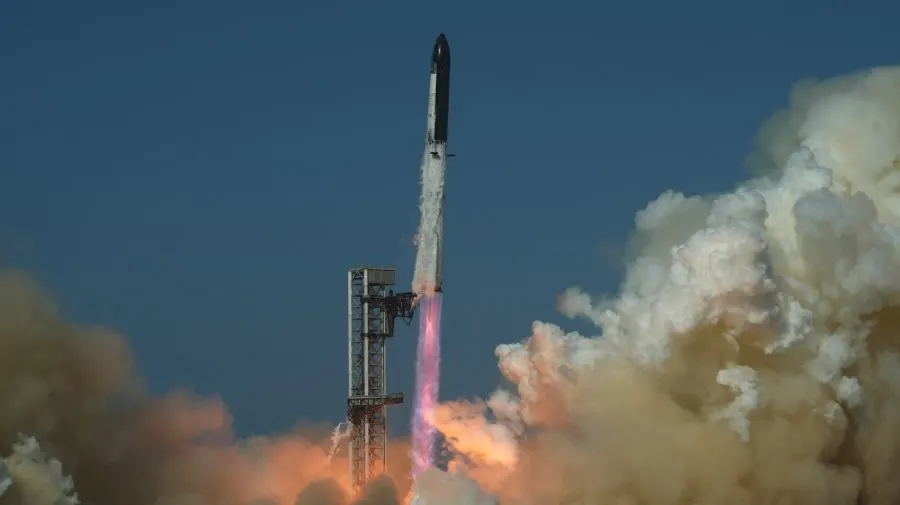
SpaceX’s 13th full-scale Starship test flight was largely successful, marking a significant recovery after engine problems on the previous mission. The upgraded rocket reached space from Texas, while the Starship upper stage survived re-entry and made a controlled splashdown in the Indian Ocean, an important demonstration for SpaceX’s ambitions to make the system reusable.
All 33 Raptor 3 engines fired at lift-off, and the roughly hour-long suborbital mission also deployed next-generation Starlink test satellites. The Super Heavy booster was lost after several engines failed to ignite during its landing sequence in the Gulf of Mexico, but the upper stage remained intact, floated after landing and continued transmitting data. It was the second flight of Starship’s Version 3 design, which is intended eventually to carry large payloads and support missions beyond Earth orbit.
In short
- Starship’s upper stage survived re-entry and splashed down intact.
- Booster engine failures prevented a successful Gulf landing.
- The flight advanced testing of SpaceX’s upgraded reusable rocket.
Steelman: both sides, in good faith
The strongest fair case each way — we don't pick a winner.
The case for
This flight demonstrates genuine progress towards reusable rockets that could transform space access. Recovering the upper stage intact after re-entry is a critical engineering milestone, and successfully deploying next-generation Starlink satellites proves the vehicle has practical utility beyond testing. The fact that SpaceX recovered from previous engine problems to execute a largely successful mission shows organisational competence and the value of rapid iterative testing.
The case against
The repeated loss of the Super Heavy booster and continued engine failures during landing procedures reveal unresolved technical challenges at the programme's core. Each test flight is extraordinarily expensive, and the slow pace of achieving full reusability of both stages raises legitimate questions about whether this development approach is ultimately the most efficient path to affordable spaceflight compared to other strategies.
Explained simply
Starship is a two-part rocket built by SpaceX, the US company founded by Elon Musk. Its Super Heavy booster provides the power to leave the ground, while the upper stage, also called Starship, is designed to carry people or cargo and return from space.
SpaceX is developing the system to carry larger payloads and, eventually, support missions to the Moon and beyond. Reusing both stages could help make launches more frequent and less costly, but the rocket is still being tested and each flight helps engineers assess how its parts perform.
Celebrity Culture Entertainment Politics Space Technology Travel