Technology news and discussion on TalkFuse.
Lego deploys Hubble Space Telescope as detailed desktop model
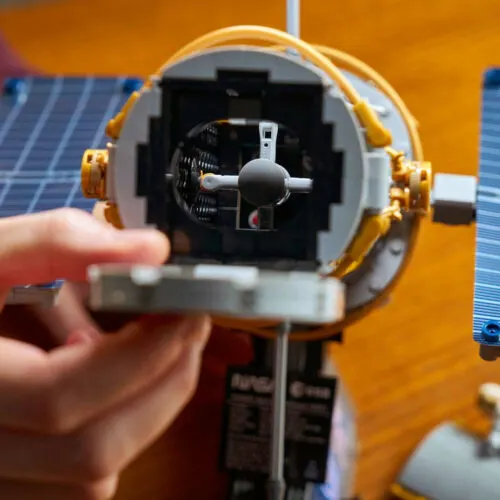
Lego has released a new, more detailed model of the Hubble Space Telescope as part of its Icons line, marking a fresh tribute to the observatory 35 years after its launch. The set is notable for being the first Lego Hubble model built to minifigure scale, complete with removable panels revealing internal instruments, making it more of an educational display piece than previous versions.
The Lego Icons Hubble Space Telescope (set 11382) went on sale on 1 August for $140, containing 1,252 pieces and measuring 15 inches (38cm) long, roughly twice the size of earlier Lego Hubble sets. Built in close collaboration with NASA and ESA, it reflects Hubble's configuration after its fifth and final servicing mission in 2009, including instruments such as the Space Telescope Imaging Spectrograph, Cosmic Origins Spectrograph and Advanced Camera for Surveys, with an opening aperture door and removable body panels exposing the mirrors and internal baffle.
In short
- Lego releases new $140 Hubble Space Telescope model, set 11382
- First Hubble set built to minifigure scale with removable panels
- 1,252-piece kit reflects Hubble's post-2009 servicing configuration
Explained simply
The Hubble Space Telescope is a space observatory launched in 1990 by Nasa, the United States space agency, with support from the European Space Agency. It orbits above much of Earth’s atmosphere, which can blur views from telescopes on the ground, and has been used to study stars, galaxies and other objects across the universe.
Hubble was designed to be serviced by astronauts, who replaced or repaired equipment during five missions between 1993 and 2009. Its instruments have changed over time, so a model based on its post-2009 configuration shows the observatory as it was left after its final servicing mission.
Hubble’s observations have helped scientists investigate how the universe changes and how stars and galaxies form. Its long-running work has also made it one of the best-known space telescopes, with findings and images used in research and public education.