Technology news and discussion on TalkFuse.
The first self-driving vehicle on Mars has proven to be a smashing success
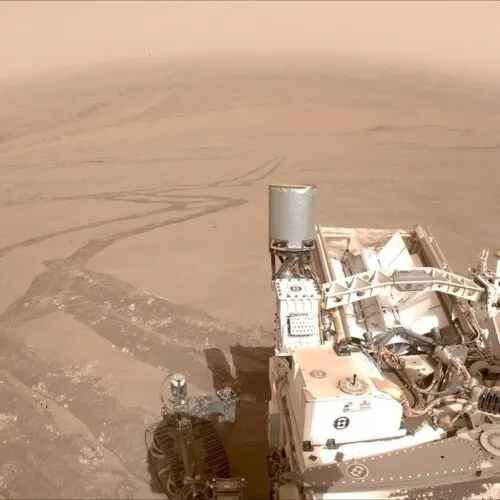
NASA’s Perseverance rover is expected to become the most widely travelled vehicle on another world, passing Opportunity’s 45.16km record next week. Its achievement matters because it demonstrates that autonomous navigation can greatly increase the pace and scientific reach of planetary exploration, allowing a rover to spend less time awaiting instructions from Earth.
Perseverance landed on Mars in February 2021 and has driven about 90% of its distance autonomously, compared with roughly 10% for the older Curiosity rover, whose computer is far less capable. Its navigation system uses onboard cameras and computing to avoid hazards while moving, although its top speed is only about 150 metres per hour; this has helped it explore widely separated sites in Jezero Crater, including rocks around four billion years old that may reveal Mars’s ancient environmental conditions.
In short
- Perseverance is set to break the off-world driving-distance record.
- Autonomous navigation has enabled far faster Martian travel.
- The rover is examining ancient rocks in Jezero Crater.
Explained simply
Mars is explored by robotic rovers that drive across the surface and study rocks and soil. Because radio signals take time to travel between Mars and Earth, teams cannot steer a rover continuously; they send instructions from Earth and the vehicle must handle some decisions on its own.
NASA’s Perseverance rover landed in Jezero Crater in 2021. It uses cameras and onboard computers to spot hazards and choose a safe route, allowing it to make many journeys without waiting for detailed directions from Earth. Its predecessor Curiosity has less capable navigation technology and has driven a smaller share of its route autonomously.
This matters because more independent driving can help a rover cover ground and visit distant places of scientific interest. Perseverance is examining very old rocks that could offer clues about Mars’s past environment, when conditions may have been different from those today.