Science news and discussion on TalkFuse.
‘Seeing eclipse is once-in-a-lifetime opportunity’
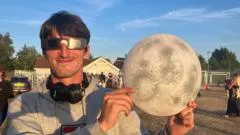
A large crowd gathered at Brough Observatory in East Yorkshire to watch Wednesday’s partial solar eclipse, described as the UK’s most dramatic in nearly 30 years. The event prompted strong demand for certified viewing glasses and renewed safety warnings, as looking directly at the Sun can damage the retina.
Kian Lodge cycled for around three and a half hours to attend after finding eclipse glasses expensive and slow to obtain online, calling the trip a once-in-a-lifetime opportunity. Up to 95% of the Sun was obscured by the Moon, while the eclipse also coincided with the Perseids meteor shower, although astronomers said viewers needed dark skies and patience to see many meteors.
In short
- Large crowds watched a major partial solar eclipse in East Yorkshire.
- Certified eclipse glasses were in high demand.
- The event coincided with the Perseids meteor shower.
Explained simply
A solar eclipse happens when the Moon passes between Earth and the Sun, blocking some or all of the Sun from view. In a partial eclipse, the Moon covers only part of the Sun; how much people see depends on where they are.
Eclipses are visible only from particular parts of Earth and last for a limited time, so some people travel to watch them. Astronomers study and explain these events, while observatories and other public venues can give people a place to view them safely.
The Sun’s light can harm the retina, the light-sensitive tissue at the back of the eye, even when much of the Sun is covered. People need viewing glasses made for solar observation or another recommended safe viewing method; ordinary sunglasses are not sufficient.