Culture news and discussion on TalkFuse.
Have physicists finally discovered glueballs? New evidence points to yes.
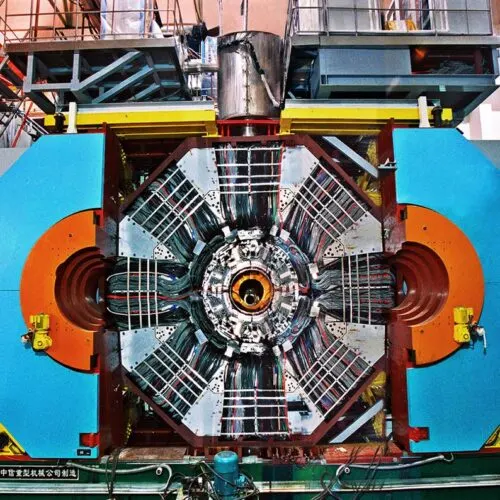
Physicists working on the Beijing Spectrometer III experiment have reported strong new evidence for glueballs: hypothetical particles made entirely of gluons, the force-carrying particles that bind quarks together. Their finding matters because glueballs are predicted by quantum chromodynamics, the theory of the strong nuclear force, but have remained unconfirmed despite decades of searches.
The leading candidate is X(2370), first identified at BES III in 2011. Using a dataset exceeding 10 billion J/ψ particles, researchers measured its mass at 2.395 GeV/c², matching the lattice-QCD prediction for the lightest glueball state; the results were posted as an arXiv preprint and presented at ICHEP.
In short
- BES III reports compelling evidence for the long-sought glueball.
- X(2370)’s measured mass matches theoretical predictions.
- Confirmation would strengthen quantum chromodynamics.
Steelman: both sides, in good faith
The strongest fair case each way — we don't pick a winner.
The case for
This finding warrants serious consideration as evidence of glueball discovery because the exceptionally large dataset of 10 billion particles provides robust statistics, and the measured mass of 2.395 GeV/c² aligns precisely with lattice-QCD predictions. After decades of theoretical work predicting these particles, observing one whose properties match predictions so closely constitutes credible scientific evidence of discovery.
The case against
Whilst the evidence is intriguing, claiming discovery is premature without independent confirmation from other experiments, as the work remains in preprint form awaiting peer review. Systematic uncertainties could affect measurements at this precision level, and history demonstrates that previous glueball candidates have failed scrutiny, warranting measured scepticism before declaring this the definitive answer.
Explained simply
Gluons are the particles that carry the strong force, which binds quarks together inside protons and neutrons. The theory describing this force, quantum chromodynamics, allows for gluons to bind to one another and form glueballs, but none has been confirmed.
The BES III experiment in Beijing studies particles produced when J/ψ particles decay. Its researchers first identified a particle called X(2370) in 2011; its possible link to glueballs has drawn interest because testing for these particles could help physicists understand how the strong force behaves.