Cerebras CS-4 rack systems juice their dinner-plate-sized AI chips for every last drop of AI perf
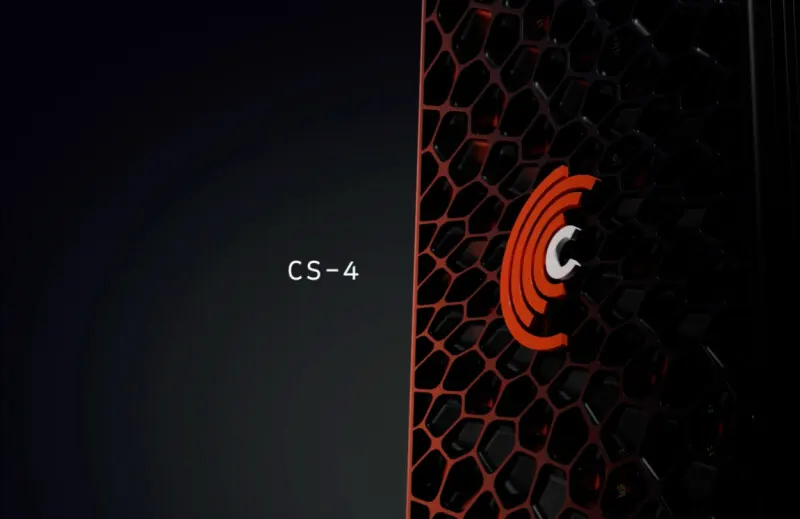
Cerebras has unveiled its next-generation Wafer Scale Engine chip, the WSE-3T, along with new Nexus rack systems, aiming to boost AI inference throughput per watt by up to tenfold compared with its previous generation. Rather than introducing new silicon, the "Turbo" chip uses the same process technology, wafer size and transistor count as its predecessor but pushes far more power through it, reportedly nearly doubling clock speed, which the company says enables faster token generation for AI workloads.
The WSE-3T offers 250 petaFLOPS of sparse AI compute, 44GB of on-chip SRAM, 43.2 petabytes per second of memory bandwidth and 2.4 Tbps of connectivity, roughly double the specifications of the WSE-3. However, much of this headline performance relies on sparsity, which typically does not benefit large language model inference, so real-world dense FP16 performance is likely closer to 25 petaFLOPS. Notably, Cerebras has also partnered with AWS and AMD to offload compute-heavy prompt processing onto their Trainium and Instinct chips respectively, with its own wafer-scale accelerators now focused primarily on the memory-intensive decode stage of inference, allowing far fewer chips to serve very large models.
- Cerebras unveils WSE-3T chip and Nexus racks, doubling per-chip AI performance.
- New chip is same silicon as before, just run at much higher power and clock speed.
- Cerebras now partners with AWS and AMD, focusing its chips on decode-stage inference.
New here? Start with this
AI inference is the process of using a trained model to respond to a prompt. It has two broad stages: processing the prompt, then generating the reply token by token. The second stage can be limited by how quickly a system moves data to and from memory.
Cerebras makes AI processors by building a very large chip across an entire silicon wafer, rather than using many smaller chips. Its systems are designed to run large AI models, and the company says its latest version can generate replies faster while using less power than its previous generation.
Cerebras is also working with AWS and AMD, whose chips can handle the prompt-processing stage while Cerebras systems generate replies. This split reflects a wider challenge in AI computing: improving speed and efficiency as models grow, while headline performance figures may differ from results on real workloads.
Both sides, in good faith
The strongest fair case each way — we don't pick a winner.
The case for
Cerebras is making a pragmatically sound decision by specialising their wafer-scale technology for memory-intensive decode operations, where their massive on-chip SRAM and exceptional bandwidth genuinely excel. Rather than attempting a one-size-fits-all solution, partnering with AMD Instinct and AWS Trainium for compute-heavy prompt processing follows proven industry practice and allows each architecture to compete where it has real advantages. The WSE-3T improvements, including doubled clock speeds without new process technology, demonstrate continued engineering progress and meaningful performance gains for real workloads.
The case against
This strategy suggests fundamental limitations in Cerebras' wafer-scale architecture. A genuinely superior AI accelerator would handle the full inference pipeline efficiently, yet Cerebras must now offload prompt processing to competitors, undermining its original value proposition. The substantial gap between headline sparse performance metrics and realistic dense floating-point throughput raises questions about whether marketing claims accurately reflect practical capabilities. Rather than the revolutionary breakthrough promised, this appears to be a company narrowing its focus and becoming dependent on partnerships to complete basic inference tasks.