Giant whales move into Greenland waters as ice disappears
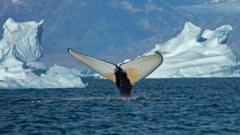
Sea ice loss along East Greenland's coast has opened up previously inaccessible waters to giant baleen whales, according to a decades-long scientific study. Researchers recorded humpback, fin and minke whales feeding in newly ice-free coastal seas each summer, describing the phenomenon as seasonal Arctic "feeding frenzies" that mark a major regime shift in the region's ocean environment, driven by warming seas and fish moving into the area.
The scale of change is striking: no humpback whales were sighted in the region until 2006, but by 2024 there were 150 ship-based sightings, alongside an estimated 4,000 humpbacks, 6,000 fin whales and 6,000 minke whales visiting the Greenland Sea that summer, together consuming at least 800,000 tonnes of fish and krill. The findings, published in Frontiers in Marine Science, combined aerial surveys, satellite tagging and Inuit hunter testimony, though it remains unclear whether this reflects genuine population growth or a redistribution from West Greenland, a sensitive issue given local whale hunting. Scientists noted that while these "opportunistic" whales appear to be benefiting from the changes, other Arctic species such as narwhals and belugas are losing habitat as a result.
- Melting sea ice lets giant whales colonise new East Greenland waters
- Humpback sightings rose from zero pre-2006 to 150 by 2024
- Narwhals and belugas losing habitat as other whales move in
New here? Start with this
Sea ice along Greenland's east coast has been retreating for years, and scientists have been tracking how this affects marine life in the region. Baleen whales, such as humpback, fin and minke whales, feed on fish and krill, and until recently much of this coastal Arctic water was too choked with ice for them to reach. As the ice melts, these waters are opening up for longer each summer, giving whales access to feeding grounds they could not previously use.
Researchers have been monitoring the area for decades, using methods including ship and aerial surveys, satellite tracking tags, and knowledge shared by Inuit hunters who live and work along the coast. This combination of scientific and local observation allows them to build a picture of how whale numbers and behaviour have changed over time, rather than relying on a single snapshot.
The wider significance is that this shift reflects broader changes happening across the Arctic as the region warms faster than the global average. It matters both for understanding how marine ecosystems are reorganising as ice disappears, and for local communities, since Greenland has traditions of whale hunting that make questions about whale numbers and movements more than just an academic issue.