World news and discussion on TalkFuse.
Why Nigeria’s one-time political giant may face extinction
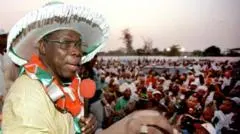
Nigeria's once-dominant Peoples Democratic Party (PDP) is facing an existential crisis ahead of January's general election, with a bitter leadership dispute now playing out in the courts threatening its very survival. The party, which governed Nigeria for 16 unbroken years after founding in 1998, has collapsed dramatically since losing power in 2015, a decline that accelerated sharply through 2025 as a wave of defections stripped it of state control and internal factionalism left it effectively paralysed.
Under presidents Olusegun Obasanjo, Umaru Musa Yar'Adua and Goodluck Jonathan, the PDP once controlled most of Nigeria's 36 states before losing to Muhammadu Buhari and the newly formed APC in 2015. It began 2025 holding eight states but now holds none, after five governors defected to the ruling APC and Oyo state slipped away last month; it has also lost prominent figures such as former Vice-President Atiku Abubakar. The crisis peaked in November 2025 when a majority faction held a disputed convention in Ibadan that expelled Nyesom Wike, a party co-founder and rival faction leader who is legally recognised as heading the true PDP, leaving the party locked in a paralysing standoff over its identity ahead of the election.
In short
- Nigeria's once-dominant PDP now controls zero of 36 states
- A leadership feud has split the party into rival factions
- Court battle over legitimacy threatens PDP's survival before January's election
Steelman: both sides, in good faith
The strongest fair case each way — we don't pick a winner.
The case for
The PDP's loss of all state control and defections of prominent figures represent an unprecedented collapse suggesting fundamental loss of public confidence. A paralysing internal dispute demonstrates the party cannot even govern itself. The simultaneous loss of state power, institutional resources and internal coherence creates a downward spiral from which recovery becomes extraordinarily difficult when facing a well-resourced ruling party.
The case against
The PDP's decline, whilst sharp, reflects normal democratic change after 16 years in power rather than terminal dysfunction. The party retains millions of supporters and institutional legitimacy. The leadership dispute, though destabilising, can be resolved through courts and internal mechanisms. Parties with deep institutional roots often recover with renewed leadership and compelling policies.
Explained simply
Founded in 1998, the Peoples Democratic Party (PDP) governed Nigeria for 16 years, from 1999 until it lost the 2015 election to the All Progressives Congress (APC). Nigeria has 36 states, and the PDP once controlled most of them; governors and other politicians can change parties, affecting which party holds power locally and nationally.
The party is now split between rival groups disputing who has authority to lead it. Nyesom Wike, a founding member and leader of one faction, is at the centre of that dispute, which is being argued in court. The outcome could determine whether the PDP can organise and take part as a united party in the coming election.
Africa Elections Politics World