SpaceX intends to invest up to $100 billion in massive Louisiana spaceport
Developed over time first seen 2 months ago
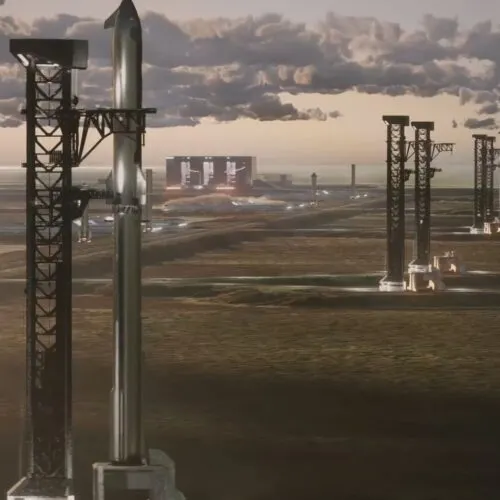
SpaceX will invest up to $100 billion to build "Starbase Louisiana," a vast new Starship factory and launch site on the Gulf coast, Louisiana Governor Jeff Landry confirmed. The project, unveiled by SpaceX president Gwynne Shotwell in the small town of Abbeville, aims to replicate and scale up the company's existing Starbase Texas facility, giving SpaceX the extra launch capacity it needs to pursue plans for thousands of annual Starship flights, including deployment of a large orbital data-centre satellite constellation.
The site sits on roughly 125,000 acres of coastal wetland known as Pecan Island, dwarfing the 350-acre Texas facility, and became available through a legal settlement over pollution and coastal erosion lawsuits against ExxonMobil; SpaceX first showed interest around six months ago. Construction of the first launch facilities is due to begin in 2027, with an initial launch targeted for 2029. The facility is planned as self-sufficient, including propellant production, power generation, deep-water shipping and an airport, while SpaceX has pledged to use only a small portion of the land, support coastal erosion mitigation, and create jobs in the region. The location also offers easier access to polar orbits and barge transport to SpaceX's existing Texas Starfactory.
- SpaceX to spend up to $100bn on new Louisiana "Starbase" spaceport
- Site covers 125,000 acres, far larger than Starbase Texas
- Construction starts 2027, first launch targeted for 2029
New here? Start with this
SpaceX has built a growing business launching rockets from a handful of sites, including a private facility called Starbase in southern Texas. Its Starship rocket, the biggest launch vehicle the company has developed, is central to founder Elon Musk's plans for frequent, large-scale space missions, but the Texas site is small and limits how many launch towers can be built there.
Louisiana's Governor, Jeff Landry, has been courting the company as part of efforts to bring major investment and jobs to the state. The proposed new site sits on a large stretch of land along the Gulf coast that recently became available following a legal settlement involving ExxonMobil over pollution and coastal damage claims, an area that also includes sensitive wetlands.
The project matters because of its scale, both in money and land, and because it reflects SpaceX's ambitions to dramatically increase how often it can launch rockets, including for new satellite systems it plans to build. Any development of this size also raises practical questions about construction timelines, environmental impact and the effect on local communities along the coast.
Both sides, in good faith
The strongest fair case each way — we don't pick a winner.
The case for
Supporters see this as a landmark opportunity for economic renewal in a state still recovering from industrial decline and coastal environmental damage, arguing that a $100 billion investment will bring thousands of skilled jobs, new infrastructure and long-term tax revenue to a historically underserved region. They point to the site's vast size and isolation as a genuine safety and operational advantage, allowing SpaceX to pursue ambitious launch cadences without competing for range access, while trusting the company's stated commitment to minimise its footprint and support wetland restoration as a net environmental improvement over the area's industrial past. For advocates of American spaceflight leadership, the project also represents a meaningful step towards reducing costs and expanding capability for both commercial and national space ambitions.
The case against
Sceptics, including some environmental advocates and coastal residents, worry that placing a vast industrial rocket facility on ecologically sensitive Gulf wetlands risks compounding erosion and habitat loss in a region already battered by decades of industrial harm, regardless of mitigation pledges, and note the irony of building on land freed up by a pollution settlement. They also raise concerns about the wisdom of concentrating such enormous public attention and infrastructure spending around a single private company's ambitions, questioning whether local communities will see promised benefits or instead face disruption, noise, launch-related risks and diminished say over land historically tied to fishing and conservation. Others caution that long timelines and the scale of the commitment warrant closer scrutiny of the incentives and regulatory arrangements involved before treating the project as an unambiguous win.
Full account
Louisiana's governor, Jeff Landry, and SpaceX have announced that the rocket company intends to invest up to $100 billion (£79bn) in a new spaceport on the state's Gulf Coast, in Vermilion Parish. Speaking at an event in Abbeville, a town of around 12,000 people near the proposed site, SpaceX president and chief operating officer Gwynne Shotwell described the project as "Starbase Louisiana", a companion to the firm's existing Starbase complex in South Texas. Construction of the first launch facilities is expected to begin in 2027, with SpaceX targeting an initial launch from the site as early as 2029, though the state's own economic development agency has offered a more cautious estimate of operations beginning in 2030.
The Louisiana site, built on land formerly owned by Exxon in an area known as Pecan Island, would give SpaceX roughly 125,000 acres to work with — vastly more than the approximately 350 acres available at its constrained Texas base, where public access to a nearby beach must also be maintained. Unlike its Florida operations at Cape Canaveral, where SpaceX shares launch range access with several rival companies, the Louisiana location would reportedly give the firm exclusive use of the surrounding airspace and range. Shotwell said the facility is intended to become a largely self-sufficient spaceport, incorporating its own propellant production, power generation, deep-water shipping access, vehicle processing buildings and even an on-site airport, reflecting SpaceX's ambitions to eventually launch Starship rockets multiple times a day.
The investment comes as SpaceX continues to develop Starship, the enormous and still-unproven rocket central to the company's future plans. The vehicle has flown 13 test missions since 2023 and has yet to demonstrate full reusability, including returning both its booster and upper stage safely for reuse in a single flight — a milestone the firm hopes an upcoming 14th test might move closer to achieving. Despite this, SpaceX has reportedly told customers it intends to phase out its workhorse Falcon 9 and Falcon Heavy rockets once Starship is flying regularly, a plan founder Elon Musk confirmed recently. SpaceX has already spent more than $8bn developing Starship, according to regulatory filings, and regards the rocket as essential to expanding its Starlink satellite internet business and to a proposed new network of satellites intended to support AI computing in orbit.
Beyond the scale of the investment, the announcement carries economic and environmental dimensions. State officials estimate the project could create around 3,000 direct jobs over a decade, with average salaries approaching $93,000, alongside tens of thousands of temporary construction roles. The chosen wetlands are also home to significant birdlife and other wildlife, and Louisiana's coastline is losing between one and three metres of land annually to erosion. SpaceX has said it would occupy only a small fraction of the total site, aiming to preserve the surrounding wetlands for conservation and recreational use such as fishing and hunting, and has indicated it wants to work with state and federal bodies on coastal protection measures, including erosion-slowing breakwaters, as part of Louisiana's existing coastal restoration strategy.
Where outlets differ
The Ars Technica-style account (Source 1) emphasises the strategic rationale for choosing Louisiana over SpaceX's existing Texas and Florida sites — comparing acreage, range competition and environmental mitigation plans in detail — while giving less attention to Starship's technical track record.
TechCrunch (Source 2) frames the story more around the seven-year search for a new site and pairs the announcement with a sceptical assessment of Starship's development status, noting the rocket has yet to achieve full reusability despite 13 test flights.
The two sources give slightly different timelines: SpaceX's own projection is a 2029 first launch, but Louisiana Economic Development's public estimate is more conservative, pointing to operations beginning in 2030.
TechCrunch links the announcement to related SpaceX news — Elon Musk's comments on eventually retiring the Falcon 9 and Falcon Heavy rockets, and the company's Starship development spending disclosed in SEC filings — details not covered in Source 1.
Only Source 2 provides specific jobs figures (3,000 direct jobs, average salary, 30,000+ construction jobs) from Louisiana Economic Development.