Far-right Israeli lawmaker damages Palestinian memorial with sledgehammer
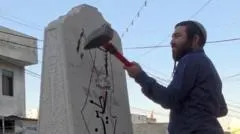
A far-right Israeli MP, Zvi Sukkot, used a sledgehammer to badly damage a Palestinian memorial in the West Bank village of Madama while under military escort, prompting widespread condemnation from Palestinians and figures across the Israeli political spectrum. The monument commemorated Palestinians killed in the 1968 battle of Karameh and during the first and second intifadas. The incident has intensified concern over rising settler violence in the West Bank, which has already drawn international criticism.
The Israeli military said it had approved a tour of monuments for Sukkot and provided security, but accused him and his group of acting deceptively and without authorisation before soldiers intervened and escorted them out. Netanyahu's office criticised the act as "taking the law into one's own hands", while election rival Gadi Eisenkot called it "a disgrace", accusing Netanyahu of allowing settler anarchists free rein. Finance minister Bezalel Smotrich, whose party Sukkot belongs to, instead attacked the opposition for condemning Sukkot rather than "terrorism itself". Separately, a senior Israeli general reportedly warned Netanyahu that escalating settler violence risks triggering a major escalation.
- Israeli MP Zvi Sukkot smashed a Palestinian memorial with a sledgehammer under military escort
- Netanyahu's office and rival Gadi Eisenkot condemned the act; Smotrich defended Sukkot
- Incident heightens fears over rising settler violence in the occupied West Bank
New here? Start with this
The West Bank is a territory captured by Israel in the 1967 war, where Palestinians live under Israeli military occupation and Israeli settlements have been built. Madama is a Palestinian village there. The memorial in the village honoured Palestinians killed in the 1968 Battle of Karameh and during two periods of Palestinian uprising known as the intifadas.
Zvi Sukkot is a lawmaker from a far-right Israeli party led by Finance Minister Bezalel Smotrich. Israeli forces provide security in the West Bank, while the Palestinian Authority has limited self-rule in parts of it. Israeli settlements and control of the territory are among the central and long-running disputes in the Israeli-Palestinian conflict.
Attacks by Israeli settlers on Palestinians and their property have raised concern among Palestinians and drawn criticism abroad. The issue also divides Israeli politicians over how the government should respond, and military leaders have warned that worsening violence could fuel wider unrest.
Both sides, in good faith
The strongest fair case each way — we don't pick a winner.
The case for
This incident exemplifies a dangerous pattern of settler violence that undermines rule of law and risks escalation. The destruction of a Palestinian memorial by a government-escorted lawmaker, condemned across Israeli politics, violates international norms protecting cultural heritage. Military commanders have warned that escalating settler violence could trigger major conflict. Authorities must enforce consistent legal consequences and address systematic settler violence to restore rule of law and prevent further deterioration.
The case against
The incident should be contextualised within the broader Israeli-Palestinian conflict rather than presented as evidence of systemic lawlessness. The memorial commemorated those involved in violent actions against Israelis; attributing particular significance to this destruction overlooks Palestinian violence and attacks. Disproportionate international media focus on this incident, compared to lesser attention given Palestinian terrorism, reflects selective scrutiny of Israeli actions. Israeli security concerns deserve equal consideration in evaluating such incidents rather than using them to delegitimise settlements and Israeli presence in the West Bank.