Airlink jets sweep low over Cape Town before Springboks Test
Developed over time first seen 2 months ago
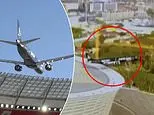
Two Embraer E-Jets operated by South African carrier Airlink performed a strikingly low-altitude flyover above a Cape Town stadium ahead of a Test rugby match between South Africa's Springboks and New Zealand's All Blacks. The stunt formed part of the pre-match build-up to the "Rugby's Greatest Rivalry" tour and has drawn considerable attention online, with footage showing the passenger jets passing extremely close to the stadium roof, well below the altitude typically associated with flyovers at comparable sporting events elsewhere.
Video captured from several angles showed the aircraft skimming just above the stands as spectators watched from below, prompting comment that such low-level passes appear far more commonplace in South Africa than in other countries. The flyover took place during festivities for one of several fixtures being staged worldwide as part of the ongoing All Blacks–Springboks series, and the clips continued to circulate widely after the match, with no further developments or official comment reported since.
- Airlink jets flew unusually low over a Cape Town rugby stadium
- Stunt preceded a Springboks vs All Blacks Test match
- Footage went viral for its dramatically low altitude
New here? Start with this
Airlink is a South African regional airline that operates passenger jets across the country and neighbouring nations. It is one of several airlines contracted to provide ceremonial flyovers at major sporting events, a tradition often used to mark the start of high-profile matches. The Springboks and All Blacks are the national rugby teams of South Africa and New Zealand respectively, and their fixtures are among the most closely watched in the sport due to a rivalry stretching back over a century.
The flyover took place ahead of a Test match, the term used for an official international rugby fixture between two countries' senior national teams. This particular game is one of several being played around the world as part of a wider series between the two sides, often promoted under banners referencing their historic rivalry. Pre-match flyovers by military or civilian aircraft are common at major sporting fixtures internationally, typically performed at a set minimum altitude for safety.
Regulations governing how low civilian aircraft may fly over crowded venues vary between countries, and are generally intended to balance spectacle with public safety. This context matters because it helps explain why footage of the Cape Town flyover has drawn particular attention, with viewers comparing the altitude involved to flyovers they are used to seeing elsewhere.
Both sides, in good faith
The strongest fair case each way — we don't pick a winner.
The case for
Supporters see the flyover as a stirring piece of showmanship that fits the occasion, arguing that experienced commercial pilots operating within controlled airspace and cleared flight parameters are well placed to judge safe margins, much as air forces and airlines have long done at major sporting and national events. They point out that South Africa has a established culture of skilled, low-level flying displays without incident, and that such moments generate excitement, national pride and goodwill for the sport and the airline, with no suggestion that safety protocols or air traffic control clearances were breached.
The case against
Critics argue that flying large passenger jets unusually close to a packed stadium roof carries real, if statistically small, risks – to spectators below and to the aircraft and crew – and that the apparent gap between this manoeuvre and more conservative flyover norms elsewhere raises fair questions about whether regulatory limits are appropriately cautious. They contend that even a rare mechanical fault, bird strike or misjudged margin at that altitude could have catastrophic consequences, and that aviation authorities and airlines have a responsibility to prioritise verifiable safety margins over spectacle, regardless of pilot skill or past safety record.
Full account
Two passenger jets operated by South African carrier Airlink performed a strikingly low flypast over Cape Town's DHL Stadium on Saturday, moments before the Springboks kicked off against the All Blacks in the latest fixture of the 'Rugby's Greatest Rivalry' series. Footage circulating online showed the pair of Embraer E-Jets cutting through plumes of coloured pyrotechnics fired from the stadium roof as the 55,000-strong crowd roared, with several camera angles making it appear as though the aircraft's tails came perilously close to the venue's upper structure.
Flight-tracking data cited by one outlet suggested the jets passed within roughly 41 to 46 feet of the top of the stadium, which itself rises to about 164 feet, placing the manoeuvre well below the altitudes at which flypasts are typically flown elsewhere. The two aircraft involved were identified by their registrations, ZS-YAE and ZS-YDE, and had been specially liveried in green and black for the occasion. Airlink, an official partner of the rugby series, later said both jets had operated within pre-approved and rehearsed altitude and speed parameters, describing the display as a spectacular addition to the pre-match build-up.
Reaction online was divided. A number of social media users reacted with alarm, branding the stunt reckless and questioning how it could be considered safe given the apparent proximity of the jets to spectators, with some noting that fans had travelled from abroad to attend the match. Others, however, treated the flypast as an impressive piece of showmanship rather than a cause for concern, and there was no suggestion from any report that the aircraft had actually come into danger of striking the stadium or that any safety incident had occurred.
The two accounts differ notably in tone and framing. The more sensational report leaned heavily on the perceived danger, precise altitude estimates and critical social media commentary, while the other treated the flypast with a lighter, more admiring touch, noting that such low-level displays are a long-established tradition at major South African rugby fixtures and drawing comparisons with military and motorsport flyovers staged elsewhere, including a recent bomber display at a Washington motor race. Where one source emphasised public unease and safety questions, the other framed the same footage chiefly as an eye-catching spectacle typical of South African sporting culture.
Where outlets differ
The Daily Mail-style report frames the flyover as alarming, citing precise flight-tracking altitude figures, aircraft registration numbers, and extensive negative social media reaction calling it 'dangerous' and 'moronic'.
The Fox News-style report treats the flyover as an impressive spectacle rather than a safety concern, emphasising that such low flypasts are a long-standing tradition in South African rugby and drawing lighthearted comparisons to US military and motorsport flyovers.
Only Source 1 includes Airlink's official response defending the flight as within approved safety parameters and the specific aircraft registrations/colour schemes.
Only Source 2 provides broader context comparing the event to other recent flyovers (the Freedom 250 Grand Prix, a B-2 bomber display) and uses a notably more informal, humorous tone throughout.
Coverage
- Daily Mail — Terrifying moment jets appears to skim the roof of packed sports stadium during pre-game flyover
- Fox News — Footage of two planes stunning a rugby stadium with one of the wildest flyovers ever goes viral
Culture Entertainment Horror Travel Trending Weird & Viral World