NASA launches Roman telescope to chart thousands of exoplanets
Developed over time first seen 2 months ago
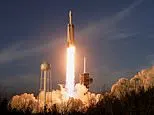
NASA has launched its new flagship observatory, the Nancy Grace Roman Space Telescope, sending it into orbit on Sunday aboard a SpaceX Falcon Heavy rocket from the Kennedy Space Center in Florida. Speaking at a ceremony in Houston on Friday, President Donald Trump said the telescope "will help unlock the secrets of the universe", as the mission begins a years-long effort to build the most detailed map of the cosmos yet and probe some of physics' deepest unsolved questions, including dark matter and dark energy, which together are thought to make up around 95% of the universe.
Standing over 12 metres tall and developed over more than a decade at a cost exceeding $4 billion, Roman is named after astronomer Nancy Grace Roman, known as the "Mother of Hubble". It has a field of view more than 100 times larger than Hubble's and wider than the James Webb Space Telescope's, and will survey vast areas of sky from a vantage point 930,000 miles from Earth after a roughly 100-day journey to reach it. Using infrared vision to look billions of years into the universe's past, Roman is expected to catalogue thousands of exoplanets and tens of thousands of supernovae, complementing work by the Rubin Observatory and ESA's Euclid probe, with scientists hoping its findings could challenge existing models of the universe's early expansion.
- NASA's Roman Space Telescope launched Sunday on a SpaceX Falcon Heavy rocket
- Mission will map dark matter, dark energy and thousands of exoplanets
- Named after Nancy Grace Roman; cost over $4 billion, field of view 100x Hubble's
New here? Start with this
Roman is a new space telescope that NASA has just sent into orbit, joining a small group of powerful observatories already studying the universe, including the Hubble and James Webb telescopes, the Rubin Observatory in Chile, and Europe's Euclid probe. What sets it apart is its unusually wide field of view, letting it scan much larger patches of sky in one go than earlier instruments, which makes it well suited to surveying huge numbers of stars, galaxies and planets outside our solar system, known as exoplanets.
The mission is led by NASA and named after Nancy Grace Roman, an astronomer regarded as instrumental in getting Hubble built. It cost more than $4 billion and launched on a SpaceX rocket, with a lengthy journey ahead before it settles into position far from Earth to begin its work.
Scientists hope Roman's data will help answer some of the biggest open questions in astronomy, such as how common planetary systems like ours are, and will contribute to research into dark matter and dark energy, two mysterious forces thought to shape how the universe has expanded and holds together.
Full account
NASA has launched its newest flagship observatory, the Nancy Grace Roman Space Telescope, on a multi-year mission to produce what officials describe as the most detailed map of the cosmos yet attempted. The spacecraft lifted off from the Kennedy Space Center in Florida on Sunday morning aboard a SpaceX Falcon Heavy rocket, with reports differing slightly on the precise launch time. Around thirty minutes after lift-off, the telescope separated from its rocket and began the outward journey towards its operating position, with NASA project staff describing the ascent as smooth and accurately targeted.
Roman is now travelling towards a gravitationally stable point beyond the Moon known as the second Sun-Earth Lagrange point, roughly one million miles from Earth, a journey expected to take about three months. Once in place, its defining feature will come into play: a field of view more than a hundred times larger than that of the Hubble Space Telescope, paired with a 300-megapixel infrared camera that NASA says will let it survey the sky some 1,000 times faster than Hubble can. A built-in coronagraph will also allow the telescope to block out the glare of distant stars, making it possible to directly image exoplanets, including smaller, older and colder worlds that orbit close to their host stars.
Scientifically, the mission has two broad thrusts. The first is a hunt for planets beyond our solar system and for exploding stars: NASA officials have suggested Roman could ultimately catalogue anywhere from tens of thousands to as many as 100,000 exoplanets, alongside tens of thousands of supernovae, building what one NASA technical manager called the largest catalogue of astronomical objects ever assembled. The second is a bid to shed light on dark matter and dark energy, the mysterious phenomena thought to make up around 95 percent of the universe. Through three-dimensional scans, gravitational lensing measurements and wide-area surveys, scientists hope Roman will narrow down what dark matter might actually be and trace how dark energy has driven the universe's expansion over cosmic history. The telescope is designed to complement rather than replace existing instruments, working alongside the James Webb Space Telescope, which offers sharper, more detailed observations of individual targets once Roman has identified them.
The telescope honours Nancy Grace Roman, NASA's first chief astronomer and its first female executive, who was instrumental in securing congressional backing for the Hubble telescope and was later dubbed the 'mother of Hubble'. Its mission followed years of funding uncertainty and an earlier name change before Congress ultimately preserved the project. Officials at NASA, including administrator Nicky Fox, framed the launch in sweeping terms, with Fox predicting the telescope would transform astronomers' understanding of the universe and bring humanity closer to answering fundamental questions about its cosmic origins and, potentially, whether life exists elsewhere. President Donald Trump also marked the occasion, though accounts vary on exactly how: one report placed his remarks at a NASA ceremony in Houston, Texas, days before launch, while another described him dialling into NASA's post-launch news conference to congratulate the team. Roman's primary mission is expected to last five years, with NASA aiming to extend operations to a decade.
Where outlets differ
Sources give inconsistent distances for Roman's operating point: 930,000 miles (Source 1) versus 'roughly one million miles' (Source 2) and 'one-million-mile journey' (Source 3), though all agree on a roughly 100-day/three-month transit.
Accounts of Trump's involvement differ: Source 1 has him speaking at a NASA HQ ceremony in Houston on the Friday before launch, while Source 2 says he phoned into the post-launch press conference on Sunday to congratulate the team; Source 3 does not mention him at all.
Estimates of how many exoplanets Roman will find vary: Source 1 says 'thousands' (plus tens of thousands of supernovae), while a NASA administrator quoted in Source 2 suggests 'tens of thousands, maybe even 100,000' exoplanets.
Only Source 1 gives the telescope's physical size (over 12 metres tall) and development cost (over $4 billion).
Only Source 2 mentions the five-year primary mission with a ten-year extended goal, and frames the launch partly around exploring black holes and mapping billions of galaxies.
Only Source 3 details the technical instruments (300-megapixel infrared camera, coronagraph) and specifies the precise destination as the second Sun-Earth Lagrange point (L2), plus notes the project's funding struggles and earlier name change.
Source 1 emphasises Roman's field of view is wider than both Hubble's and James Webb's, whereas Source 2 states it is 100 times larger than both Hubble and Webb combined.
More coverage
- BBC Science — Nasa launches powerful new space telescope to explore mysteries of the Universe
- The Verge — The Nancy Grace Roman Space Telescope launches to study dark matter and dark energy
- Fox News — Trump surprises NASA officials with call after Roman Space Telescope launch
- Engadget — NASA's Nancy Grace Roman Space Telescope is now on its way to study the 'dark universe'
Read the full article at the source →
Originally published by Daily Mail as “Tense launch for NASA’s new ultra-powerful $4.3bn telescope: ‘It’s going to find tens of thousands of planets’”.