Germany proposes Baltic task force to counter Russian hybrid threats
Developed over time first seen 2 months ago
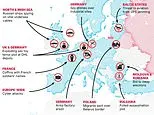
Germany has proposed creating a rapid-response task force among Baltic Sea states after formally attributing an Aug. 4 explosives-laden drone attack on Leipzig/Halle Airport to Russia, in what Berlin and its allies describe as an escalating campaign of Russian hybrid warfare across Europe. Interior Minister Alexander Dobrindt put forward the initiative following an Aug. 28 meeting in Flensburg, aiming to let Baltic nations rapidly share information and coordinate responses to threats including drones, sabotage, cyberattacks, disinformation and attacks on infrastructure. Latvia went further, branding the airport plot "state-sponsored terrorism on German soil" rather than merely a hybrid attack, while a retired US Air Force general called the German attribution "particularly serious" evidence of widening Russian gray-zone activity.
German officials said the drone's construction, explosives and detonation methods matched patterns seen in earlier Russian operations and in the war against Ukraine, though much of the underlying evidence, including details on suspects and surveillance material, has been withheld to protect the investigation. In response, Germany closed Russia's consulate general in Bonn, ended the arrangement governing Berlin's Russian House cultural centre, tightened entry controls for Russian nationals, and pledged greater pressure on Russia's "shadow fleet"; Russia has denied any role, calling the accusations "entirely fabricated". The episode came alongside separate German investigations into suspected sabotage of electricity infrastructure, including a suspicious device found near a substation in Dormagen and interference that temporarily knocked out roughly 4,200 megawatts of lignite-fired generating capacity in Bergheim.
- Sources
- 2
- Outlets
- 2
- Left · Centre · Right
- 0 · 0 · 2
In short
- Germany blames Russia for Aug. 4 drone attack on Leipzig airport
- Berlin proposes Baltic states task force against hybrid threats
- Germany expels Russian diplomats, closes cultural centre, cites sabotage cases
How this story developed
- 2 months ago Analysts widen the lens beyond the airport plot, reporting that Russian jet incursions, drone strikes and suspected arson have hit European targets throughout 2026 at a pace exceeding 2024 and 2025, with the Baltic coalition Berlin is assembling framed as part of a broader EU push to build coordinated defences against this grey-zone campaign.
- 2 months ago German officials formally attribute the Aug. 4 drone attack on Leipzig/Halle Airport to Russia and push Baltic Sea states to form a rapid-response task force, pairing the accusation with expulsions, tightened entry rules and a probe into suspected grid sabotage in Dormagen and Bergheim.
Full account
Germany is seeking to establish a rapid-response task force among Baltic Sea nations to counter what Berlin describes as an intensifying campaign of Russian hybrid warfare. The proposal was put forward by Interior Minister Alexander Dobrindt following a meeting of regional partners in Flensburg on 28 August, and is designed to let countries bordering the Baltic share intelligence and coordinate their responses more quickly to threats such as drone incursions, sabotage, cyberattacks, disinformation campaigns and strikes on critical infrastructure. Dobrindt framed the initiative as an attempt to convert a shared vulnerability into a shared defence, cautioning that such hybrid activity was growing both more frequent and more sophisticated.
The push for closer cooperation follows Germany's formal attribution of an attempted drone attack on Leipzig/Halle Airport, a major hub for cargo and military-related flights, to Russia. German authorities said an unmanned aircraft carrying explosives was intercepted on 4 August, and that an assessment of police evidence, intelligence and the technical hallmarks of the device — including its construction and detonation mechanism — pointed to techniques previously associated with Russian hybrid operations and with Moscow's war in Ukraine. Berlin has kept much of its supporting evidence confidential, saying that details such as the suspects' identities, their travel movements, surveillance material and forensic evidence must remain undisclosed while the investigation continues.
Reaction from allies has been pointed. Latvia's foreign minister, Baiba Braže, went further than Berlin's own language, describing the Leipzig incident not simply as a hybrid provocation but as an act of state-sponsored terrorism carried out on German soil, and renewed calls for tougher sanctions to curb Russia's capacity to manufacture missiles and drones alongside continued military support for Ukraine. A retired senior American air force officer, Lieutenant General Richard Newton, said the episode fitted a broader pattern of Russian grey-zone activity — cyber intrusions, disinformation, sabotage and covert action — deliberately calibrated to fall short of triggering a full Nato military response, and called Germany's willingness to publicly attribute the plot to Moscow especially significant.
Coverage of the episode has also placed it within a wider narrative of escalating Russian pressure across Europe through 2026, with reported incidents including close encounters between Russian jets and RAF aircraft, drone sightings near Nato airspace and suspected arson plots, all said to be occurring at a higher tempo than in the previous two years, while remaining calibrated to avoid crossing the threshold for a collective Nato response under Article 5. Some commentary has suggested the Baltic states and the Lithuania-Poland border could be at particular risk of more direct confrontation, and has raised concerns that Britain — including firms supplying military equipment to Ukraine — could increasingly be targeted, citing the Ministry of Defence's confirmation that drones observed over UK airbases in November 2024 were of Russian origin.
Where outlets differ
From the full account, which is AI-written from the sources:
Fox News Digital concentrates narrowly on the Dobrindt-led Baltic task force proposal and the specifics of the Leipzig/Halle drone plot, including direct quotes from German officials, Latvia's foreign minister and a retired US general, giving a more procedural, diplomatic account of attribution and alliance response.
The Daily Mail situates the story within a much broader, continent-wide narrative of Russian 'grey zone' aggression throughout 2026, emphasising a graphic/data-driven overview of incidents (jet incursions, arson, drone sightings) and drawing heavily on commentary from a former British Army officer warning about risks to the Baltics and the UK specifically.
The Mail introduces a UK-centric angle — concerns about Andy Burnham and British defence manufacturers being targeted, and confirmed Russian drone activity over RAF/US bases — that is entirely absent from the Fox News account, which stays focused on Germany and its immediate Baltic partners.
Latvia's characterisation of the Leipzig attack as 'state-sponsored terrorism' (reported by Fox News Digital) is notably stronger than Germany's own more measured official attribution language, a distinction not addressed in the Mail's piece.
Steelman: both sides, in good faith
The strongest fair case each way — we don't pick a winner.
The case for
Supporters of the task force argue that a coordinated Baltic rapid-response mechanism is a proportionate and overdue answer to a clear pattern of hybrid aggression, from drone incursions and cyberattacks to suspected sabotage of energy infrastructure. They contend that Germany's intelligence and law-enforcement agencies are best placed to judge when methods match known Russian tradecraft, and that withholding sensitive evidence is standard practice to protect an ongoing investigation rather than evidence of weak grounds. On this view, pooling information swiftly across Baltic and North Sea states, paired with measures such as closing consular facilities and tightening entry rules, sends a necessary deterrent signal and protects citizens and critical infrastructure without waiting for an attack to succeed.
The case against
Sceptics counter that formally attributing a serious attack to a state actor while keeping the underlying evidence confidential asks the public and other governments to take a significant claim largely on trust, which risks setting a precedent for accusations that cannot be independently scrutinised. They worry that swiftly expelling diplomatic staff, closing cultural institutions and building a new multinational task force could harden a cycle of retaliation and diplomatic rupture at a moment when off-ramps and channels for de-escalation may prove valuable. From this perspective, similar sabotage incidents have sometimes had prosaic or ambiguous causes, so caution, transparency and robust independent verification should precede far-reaching institutional and diplomatic responses, even while taking the security concerns themselves seriously.
Explained simply
Germany is dealing with a suspected drone attack on Leipzig/Halle Airport on 4 August, which it has now formally blamed on Russia. In response, Berlin is asking other countries around the Baltic Sea to set up a joint rapid-response team that would let them quickly share information and coordinate action against so-called hybrid threats: a mix of tactics such as drones, sabotage, cyberattacks and disinformation that fall short of open military conflict. The idea was put forward by German Interior Minister Alexander Dobrindt after a meeting of regional officials in Flensburg on 28 August.
The row matters because it marks one of Germany's strongest public accusations yet against Russia over incidents on its own soil, and because several Baltic and northern European states have reported similar unexplained incidents in recent months, from damaged undersea cables to airspace violations. Latvia has gone further than Germany, describing the airport plot as state-sponsored terrorism. Russia denies any involvement and says the accusations are fabricated.
Germany has already taken diplomatic and security steps alongside the new proposal, including closing a Russian consulate, ending an arrangement with a Russian cultural centre in Berlin, tightening entry rules for Russian nationals, and stepping up scrutiny of the so-called Russian shadow fleet, tankers that Western governments say are used to bypass sanctions. These moves reflect a broader European debate about how to respond to activities that are disruptive and hard to trace, without amounting to a formal act of war.
Coverage · 2 sources
Bias meters
From 2 rated sources.