‘I’m only alive thanks to one man’ – driver rescued from car fire
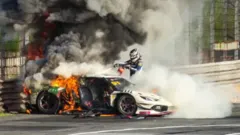
British racing driver Ollie Millroy says he owes his life to fellow competitor Loek Hartog, who pulled him from his burning Ferrari during a China GT Championship race in Shanghai. Hartog, a Dutch driver, abandoned his own car to run to Millroy's blazing vehicle, using a fire extinguisher to fight the flames before dragging him to safety, with no marshals or fire crews present at the time. The incident has raised serious questions about safety standards at the event and prompted sharp criticism from Millroy's team of the organisers' emergency response.
Millroy suffered five broken ribs, a broken collarbone, a broken hand, a broken finger and a bruised lung, but said "it could have been much worse". His team, AAI Motorsport, said the car burned for more than a minute without effective firefighting or rescue efforts and announced it would no longer compete in China GT races, accusing organisers of negligence. China GT said it would review the crash and improve its emergency response and medical provisions, while Hartog said he felt he had no choice but to act and downplayed his own heroism.
In short
- Loek Hartog rescued rival Ollie Millroy from a burning car in Shanghai.
- No marshals or fire crews were present when Hartog intervened.
- Millroy's team is boycotting China GT over safety failings.
Steelman: both sides, in good faith
The strongest fair case each way — we don't pick a winner.
The case for
Those criticising the organisers argue that a fire burning for over a minute without any marshal or fire crew intervention represents a serious and unacceptable safety failure. Motorsport bodies have a fundamental duty of care to competitors, and modern racing series are expected to have rapid-response fire and rescue coverage precisely because fires in high-speed accidents are foreseeable and can prove fatal within moments. From this view, the absence of trained personnel at a professional international event, leaving a fellow driver to perform the rescue unaided, points to a systemic lapse in planning or resourcing that deserves robust accountability, including a team's decision to withdraw rather than expose its drivers to similar risk again.
The case against
Others would caution against rushing to judge the organisers before a full review is complete, noting that even well-run events can be caught out by the sheer speed and chaos of a car fire, and that positioning marshals and fire crews across every metre of a long circuit is a genuine logistical challenge rather than evidence of negligence. China GT has acknowledged the incident, committed to reviewing its emergency response and improving medical provisions, which is the responsible course of action rather than an admission of wrongdoing. On this view, isolated failures during a fast-moving emergency do not necessarily reflect indifference to safety, and fair-minded observers would want the facts of the review established before concluding the organisers were at fault.
Explained simply
GT racing is a form of motor sport in which drivers race high-performance cars, often based on road-going models, around a circuit. China GT is a championship held in China; Ollie Millroy, a British driver, was competing in a Ferrari, while Dutch driver Loek Hartog was a fellow competitor.
Racing cars can catch fire after a crash, so events rely on trained marshals, fire crews and medical staff to respond quickly. The incident has drawn attention to whether those safety arrangements were adequate and how organisers should protect drivers when a car is burning.
Millroy’s team, AAI Motorsport, and China GT have different roles: the team enters and supports his car, while the championship’s organisers oversee the event. Their responses matter because they may shape whether the team continues to race in the series and what safety measures are reviewed.