Jon Stewart ridicules Trump aide Natalie Harp comparing her to Elizabeth Holmes
Developed over time first seen 2 months ago
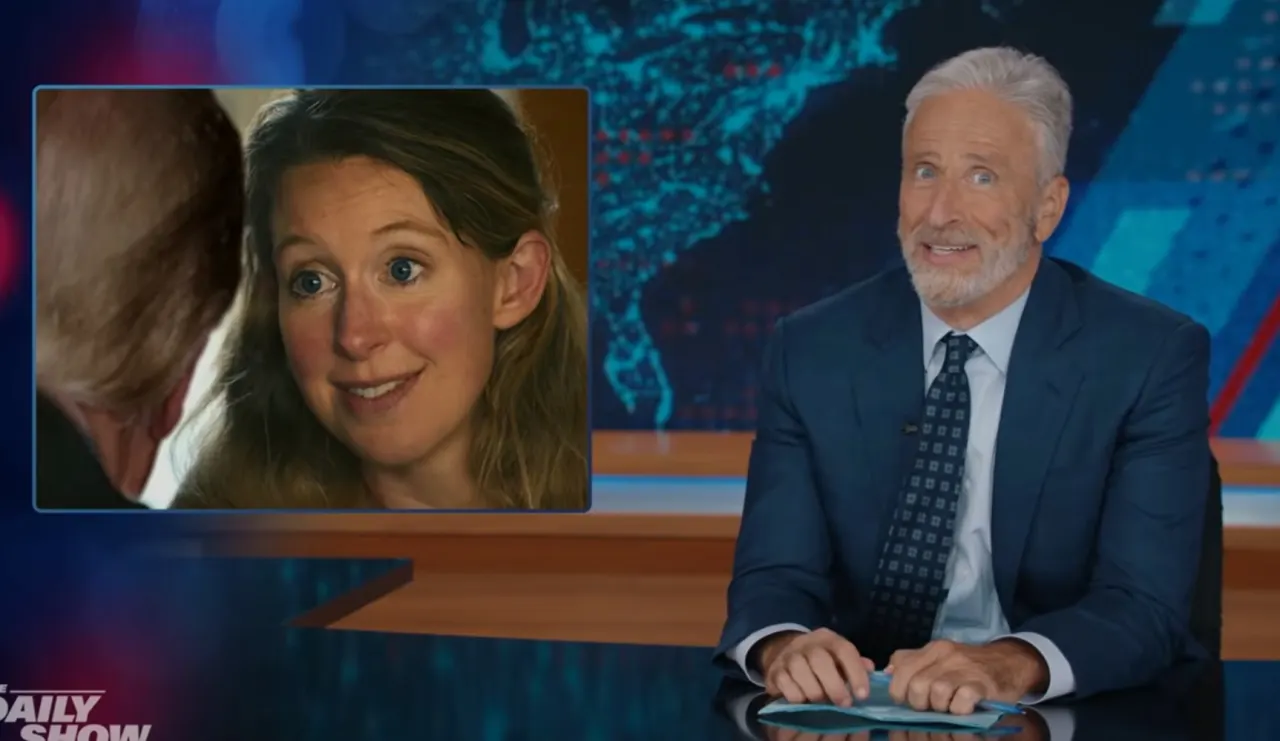
Jon Stewart returned to The Daily Show after a month-long break and mocked Trump aide Natalie Harp by comparing her to disgraced Theranos founder Elizabeth Holmes, using the viral trailer for Nathan Fielder's documentary "You Can See Everything" as his springboard. Stewart displayed a CNN clip of a letter Harp reportedly wrote to Trump reading "I never want to bring you anything but you", joked he would pretend it referred to dishwashing liquid, and argued that Harp acts as a "single conduit" filtering all information reaching Trump's mind. The bit reflects how Trump's inner circle, and the loyalty of aides around him, continues to be a target for satirists amid the administration's ongoing controversies, including Trump's recent order renaming Lake Ontario "Lake America".
Stewart's segment cut to the Fielder trailer, premiered by A24 at the Telluride Film Festival, which had gone viral for superimposing Trump's face onto Fielder's body opposite Holmes, playing Harp, asking "Why would I deceive you? There's no reason for me to do that." The original clip had drawn attention for Holmes's intense demeanour and for an image of her rocking a baby with her foot during the conversation. Stewart was not the only Comedy Central figure taking aim at Trump that night: South Park announced it was renaming itself "South America" in response to the Lake Ontario decision, extending the same joke across the network's programming.
- Sources
- 2
- Outlets
- 2
- Left · Centre · Right
- 0 · 0 · 0
In short
- Jon Stewart likened Trump aide Natalie Harp to Elizabeth Holmes on The Daily Show
- He used Nathan Fielder's viral "You Can See Everything" trailer as a springboard
- South Park mocked Trump's Lake Ontario renaming by calling itself "South America"
How this story developed
- 2 months ago Coverage settled into a fuller account of the same broadcast, detailing how editing spliced Trump's likeness into the Fielder-Holmes footage to cast Harp as a Holmes-like filterer of reality who leaves Trump with a distorted picture of information, much as Holmes misled her investors.
- 2 months ago Jon Stewart marked his return to The Daily Show by mocking Trump aide Natalie Harp, comparing her to Elizabeth Holmes via Nathan Fielder's viral "You Can See Everything" trailer and a CNN-sourced letter in which Harp reportedly told Trump "I never want to bring you anything but you," while also riffing on Trump's "Lake America" renaming and South Park's mock rebrand.
Full account
Jon Stewart marked his return to The Daily Show desk on Tuesday, following a month away from the programme, with a monologue that took aim at Donald Trump before turning its focus to one of the president's closest aides. Stewart first mocked Trump for supposedly inhabiting a self-contained version of reality in which the assessments of experts and journalists are routinely dismissed in favour of his own worldview, joking that he almost envied those able to accept a more comfortable, if false, version of events, in the manner of a character offered the 'blue pill' in The Matrix.
From there, Stewart moved on to Natalie Harp, a Trump staffer who has become known in some quarters as 'the human printer' owing to her habit of accompanying the president everywhere armed with a laptop and printer so she can supply him with a constant flow of favourable news coverage. Using a run of news clips, Stewart recapped some of the more eyebrow-raising details that have emerged about Harp, including a CNN report that she once climbed into the boot of an SUV so as not to be separated from Trump ahead of a court appearance, and a TMZ characterisation of letters she has sent him as reading like declarations of love. One outlet's broadcast of a letter in which Harp reportedly told Trump she never wanted to bring him anything but herself gave Stewart the opening for a quip that he would rather assume she meant washing-up liquid. He went on to suggest, more pointedly, that Harp effectively functions as a single filter through which all outside information reaches the president.
Stewart used this framing to introduce a comic segment purporting to be 'exclusive footage' filmed over a month with Harp and Trump to reveal the true nature of their working relationship, before cutting to the trailer for Nathan Fielder's documentary about Elizabeth Holmes, You Can See Everything, digitally altered so that Trump's face replaced Fielder's opposite Holmes. In the doctored clip, Holmes, standing in for Harp, insists there would be no reason for her to deceive him, a line lifted directly from the real trailer.
The genuine documentary, made for A24, follows Fielder and a film crew documenting Holmes at home in the weeks leading up to her surrendering to prison; she was sentenced in 2022 to more than eleven years for defrauding investors through her Theranos blood-testing venture. Coverage of Stewart's segment noted that the film had its first showing at the Telluride Film Festival, with one account describing this as a secret screening, while another highlighted how the released trailer had already gone viral in its own right, partly because of an unguarded moment in which Holmes is seen rocking a baby with her foot mid-conversation. Reports of the episode also differed in how much surrounding context they included: one concentrated almost entirely on the Harp segment and the background details about her nickname and conduct, while another situated it within a wider monologue that also mocked Trump's renaming of Lake Ontario as 'Lake America' and noted that South Park had responded in kind by joking it would rename itself 'South America'.
Where outlets differ
From the full account, which is AI-written from the sources:
Source 1 focuses narrowly on the Harp/Holmes segment, giving fuller detail on the 'human printer' nickname, the SUV trunk anecdote and the 'love letters' description, and states the documentary debuted at a secret Telluride screening.
Source 2 places the segment within a broader monologue recap (the Lake Ontario/'Lake America' joke and South Park's 'South America' response), quotes a different letter line ('I never want to bring you anything but you') with Stewart's dishwashing-liquid joke, and adds detail on why the real Fielder/Holmes trailer went viral (Holmes rocking a baby during the conversation), without describing the premiere as secret.
Steelman: both sides, in good faith
The strongest fair case each way — we don't pick a winner.
The case for
Supporters of the sketch would argue satire has always subjected the powerful and those who serve them to ridicule, and that comparing an aide's effusive personal devotion to Elizabeth Holmes-style theatrics is a legitimate way of questioning whether the president receives candid information or only flattery. They would say a free press and its comedic wing play a valuable role in scrutinising the insular dynamics of any administration, and that mocking perceived sycophancy is fair game precisely because access to a president's ear carries real consequences for governance.
The case against
Critics would counter that reducing a named staffer's private correspondence to a punchline for a late-night audience is personal mockery dressed up as political commentary, unfairly singling out a lower-profile aide who cannot respond in kind. They would argue such segments trade on caricature and guilt-by-association with a notorious fraudster, undermining reasoned debate about the administration's information flow by substituting ridicule for evidence, and that this kind of comedy coarsens public discourse rather than illuminating it.
Explained simply
Trump renamed Lake Ontario "Lake America" earlier this year, a move widely mocked online, including by South Park, which jokingly said it was rebranding itself "South America." That episode fed into a wider pattern of comedians and satirists poking fun at Trump's administration and the people around him.
Natalie Harp is an aide known for her closeness to Trump and for reportedly filtering the information and material that reaches him. Elizabeth Holmes is the founder of the failed blood-testing company Theranos, convicted of fraud for making claims about her technology that turned out to be false; her name has become shorthand for deception dressed up as loyalty or expertise.
Jon Stewart hosts The Daily Show, a long-running satirical news programme, and frequently targets political figures and their inner circles. His comparison drew on a trailer for a new documentary by filmmaker Nathan Fielder, in which Holmes appears in a re-enacted scene, giving Stewart a pop-culture reference point to make his joke about Harp's role land with viewers.
Coverage · 2 sources
Art Culture Government Politics Trending Weird & Viral