Nats boss to meet UK transport secretary as second day of flight chaos takes cancellations past 1,300 – business live
Developed over time first seen 2 months ago
The Guardian's live business coverage tracked two separate stories converging on UK household costs: aviation disruption caused by air traffic control provider Nats, and a sharp rise in petrol and diesel prices. The Nats disruption ran into a second day, with cancellations passing 1,300 flights and chief executive Martin Rolfe due to meet transport secretary Heidi Alexander to address the fallout. Alongside this, motoring groups reported that fuel costs had jumped sharply, driven by surging oil prices linked to the US-Iran conflict, adding fresh pressure on households already grappling with the cost of living.
The AA said petrol had risen 4.4p a litre since the previous week's bank holiday to average 166.2p, with diesel up 4.1p to 187.7p, while the RAC recorded weekly increases of around 5p a litre for both fuels, taking unleaded to 167.17p and diesel to 188.63p — adding roughly £2.75 to the cost of filling a family car. Both organisations pointed to oil averaging $96 a barrel over the past week as the main driver, with the RAC's Rod Dennis warning of no imminent relief and calling for the chancellor to hold off planned fuel duty rises; the AA also highlighted a persistent 6p-a-litre gap between mainland UK and Northern Ireland pump prices, despite many stations able to match the cheaper rates.
- Sources
- 5
- Outlets
- 2
- Left · Centre · Right
- 2 · 0 · 3
In short
- Nats flight disruption hit 1,300+ cancellations over two days
- Nats boss to meet transport secretary Heidi Alexander over chaos
- Petrol and diesel prices jumped sharply on rising global oil costs
How this story developed
- 1 month ago The Guardian's live coverage of the UK flight chaos has added a further strand: petrol and diesel prices have jumped sharply this week, according to the AA and RAC, as surging oil costs linked to the US-Iran conflict feed through to the forecourt.
- 1 month ago The Guardian's live coverage of the UK flight chaos has added a new strand: petrol and diesel prices have jumped sharply, according to the AA and RAC, driven by surging oil costs linked to the US-Iran conflict.
- 1 month ago The Guardian's live business coverage tracked two separate stories converging on UK household costs: aviation disruption caused by air traffic control provider Nats, and a sharp rise in petrol and diesel prices.
- 2 months ago The head of Nats, Martin Rolfe, is due to meet transport secretary Heidi Alexander on Wednesday morning as UK flight disruption entered a second day, with cancellations passing 1,300.
- 2 months ago The head of Nats, the UK's air traffic control provider, is due to meet transport secretary Heidi Alexander on Wednesday morning as flight disruption stretched into a second day, with cancellations now surpassing 1,300.
- 2 months ago The head of Nats, the UK's air traffic control provider, is due to meet transport secretary Heidi Alexander as flight disruption stretched into a second day, with more than 1,300 flights cancelled at British airports.
- Daily Mail Flight chaos after tech failure is expected to last for DAYS after more than 1,000 jets were grounded: Calls for air traffic boss to quit grow as he is set to meet Transport Secretary this morning
- Daily Mail Under-fire Nats boss 'rules out' cyber attack as cause of air traffic control meltdown – and says there will be 'thorough investigation' into issue that sparked flight chaos
- Daily Mail Hundreds more flights grounded on second day of air traffic control chaos: Ryanair and Wizz Air boss demand NATS boss resigns – as it emerges latest meltdown 'was repeat of issue from 2023 outage'
- The Guardian Air traffic control boss given a week to report after UK flight chaos causes 2,000 cancellations
- The Guardian Nats boss to meet UK transport secretary as second day of flight chaos takes cancellations past 1,300 – business live
Full account
Air traffic chaos across the UK stretched into a second day on Wednesday after a technical fault at National Air Traffic Services (Nats) forced more than 1,300 flight cancellations, with tens of thousands of passengers affected. Nats, which provides air traffic control for 15 UK airports, reported a problem with its flight processing system that began at around 1pm on Tuesday. Although the company said the fault itself was resolved roughly four hours later, the knock-on disruption continued to ripple through the network into Wednesday morning, hitting departures and, later, arrivals across much of southern England. Heathrow, Gatwick, Manchester, Stansted and Birmingham were among the airports worst affected, with tracking data cited by outlets suggesting 246 cancellations at Heathrow and 33 at Gatwick by 6am on Wednesday alone.
The fallout for passengers and airlines was severe. British Airways said it had cancelled or diverted more than 100 flights, affecting tens of thousands of customers, while Ryanair put the number of its own passengers hit by the disruption at over 65,000. Some travellers faced extraordinary delays: one flight from Heathrow to New York reportedly sat on the runway for as long as nine hours before its passengers could disembark. With crew and aircraft left out of position, airlines warned that the disruption—and the scramble to rebook stranded holidaymakers, pilots and cabin crew—could continue for several days.
The episode has intensified scrutiny of Nats and its chief executive, Martin Rolfe, who earns a reported £1.5m a year and was due to meet the transport secretary, Heidi Alexander, on Wednesday morning, shortly before she opened the second reading of the Civil Aviation Bill in the Commons. Asked whether he was considering resigning, Rolfe said he accepted full responsibility as head of a piece of critical national infrastructure, but framed his priority as restoring normal operations and supporting airlines, airports and passengers rather than his own position. Nats itself described the recovery as complex and said it would take time for the wider aviation network to return to normal. The breakdown was described as the third major stoppage attributable to Nats in just over three years.
Reaction from airlines and politicians was considerably sharper than Nats' own statement. Ryanair's chief operating officer, Neal McMahon, publicly called for Rolfe to be replaced, branding him an “overpaid failure” and urging the government, the Civil Aviation Authority and the Nats board to appoint new leadership capable of preventing repeated failures. Wizz Air said it was “extremely disappointed” by yet another outage and argued Nats was “not fit for purpose” in its current form, while the Conservative shadow transport spokesman, Greg Smith, questioned why Britain kept struggling to keep its airspace running smoothly and demanded clarity on what had gone wrong and how resilience would be improved. Nats is 49% government-owned, a fact several critics highlighted in pressing ministers to act.
Where outlets differ
From the full account, which is AI-written from the sources:
The Guardian's live blog centres on the process story: the Rolfe–Alexander meeting, its timing alongside the Civil Aviation Bill's Commons debate, precise FlightRadar cancellation counts, and Rolfe's own measured quotes about accepting responsibility without confirming or denying he might quit.
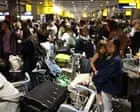
The Daily Mail leads with the political and industry backlash, giving prominent space to explicit resignation calls from Ryanair's Neal McMahon (who calls Rolfe an 'overpaid failure') and criticism from Wizz Air and a Conservative frontbencher, and includes more human-interest detail such as the nine-hour runway wait and terminal queue scenes.
The two sources give different topline cancellation figures — the Guardian cites 'more than 1,300' flights, while the Mail cites 'more than 1,000' departures and arrivals — likely reflecting different snapshot times as the total climbed.
The Mail specifies Rolfe's £1.5m salary and Nats' 49% government ownership as pointed context for the resignation calls; the Guardian extract does not mention his pay and focuses instead on Nats being 'critical infrastructure'.
Left-leaning outlets 2
- Nats boss to meet UK transport secretary as second day of flight chaos takes cancellations past 1,300 – business liveThe Guardian
- Air traffic control boss given a week to report after UK flight chaos causes 2,000 cancellationsThe Guardian
Only here: cancellations, takes, past, business, given
Right-leaning outlets 3
- Flight chaos after tech failure is expected to last for DAYS after more than 1,000 jets were grounded: Calls for air traffic boss to quit grow as he is set to meet Transport Secretary this morningDaily Mail
- Under-fire Nats boss 'rules out' cyber attack as cause of air traffic control meltdown – and says there will be 'thorough investigation' into issue that sparked flight chaosDaily Mail
- Hundreds more flights grounded on second day of air traffic control chaos: Ryanair and Wizz Air boss demand NATS boss resigns – as it emerges latest meltdown 'was repeat of issue from 2023 outage'Daily Mail
Only here: grounded, meltdown, issue, tech, failure
Every side used: nats, boss, meet, transport, secretary, second
Headline columns compared word for word; nothing in them is AI-written.
Steelman: both sides, in good faith
The strongest fair case each way — we don't pick a winner.
The case for
Those pressing Nats and its leadership hardest argue that a body responsible for critical national infrastructure cannot suffer a third major stoppage in three years without serious questions being asked about its systems, investment and governance. They contend that repeated failures point to underlying resilience problems rather than one-off bad luck, that passengers and airlines bear enormous cost and disruption each time, and that proper accountability – potentially including leadership changes – together with independent scrutiny and increased investment in modernising ageing infrastructure is the only way to prevent recurrence. On this view, an apology and a promise to fix the immediate fault are not enough given the pattern.
The case against
Others argue that complex, safety-critical technical systems will occasionally fail despite best efforts, and that Nats' priority in the moment was rightly the swift, safe resolution of the fault and support for stranded passengers rather than a distracting debate about personnel. They point out that Rolfe accepted responsibility as CEO without deflecting blame, that air traffic control failures are rare relative to the volume of flights safely managed, and that knee-jerk calls for resignation or drastic restructuring risk undermining the stability and expertise needed to manage recovery and prevent political point-scoring from overshadowing a measured, evidence-based review of what went wrong.
Explained simply
Air traffic control in the UK is handled by a single organisation, Nats, which manages the skies for 15 airports including Heathrow and Gatwick. When its systems fail, flights across the country can be delayed or cancelled, since planes cannot safely take off or land without proper coordination. A fault in Nats' flight processing system on Tuesday triggered widespread disruption that has now stretched into a second day, with well over a thousand flights cancelled.
This is not the first time this has happened. It is the third major breakdown at Nats in a little over three years, prompting renewed questions about the reliability of the system that underpins UK aviation and about accountability at the organisation, led by chief executive Martin Rolfe. The government, represented by transport secretary Heidi Alexander, oversees aviation policy and regulation, which is why a meeting between the two has drawn attention.
The disruption matters because it affects hundreds of thousands of passengers, airlines' schedules and airports' operations well beyond the original fault, since aircraft and crews often end up out of position once flights are cancelled or delayed. It also comes as parliament considers new aviation legislation, adding a political dimension to a story that is otherwise about the resilience of critical transport infrastructure.
Coverage · 5 sources
Bias meters
From 5 rated sources.
- The GuardianLeftNats boss to meet UK transport secretary as second day of flight chaos takes cancellations past 1,300 – business live
- Daily MailRightFlight chaos after tech failure is expected to last for DAYS after more than 1,000 jets were grounded: Calls for air traffic boss to quit grow as he is set to meet Transport Secretary this morning
- Daily MailRightUnder-fire Nats boss 'rules out' cyber attack as cause of air traffic control meltdown – and says there will be 'thorough investigation' into issue that sparked flight chaos
- Daily MailRightHundreds more flights grounded on second day of air traffic control chaos: Ryanair and Wizz Air boss demand NATS boss resigns – as it emerges latest meltdown 'was repeat of issue from 2023 outage'
- The GuardianLeftAir traffic control boss given a week to report after UK flight chaos causes 2,000 cancellations
Business Culture Markets Travel UK World