Six hundred UK flights cancelled after NATS system failure
Developing story first seen 1 hour ago
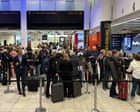
Cancellations and delays continued into Wednesday morning after a technical fault in NATS' flight processing system on Tuesday triggered widespread chaos across UK airports. Around 250 flights had been cancelled at Heathrow alone by 6am, with British Airways scrapping more than 190 services, showing the disruption has far outlasted the original fault, which NATS said it had identified and fixed on Tuesday.
Roughly 600 flights were cancelled on Tuesday as the failure hit Heathrow, Gatwick, Manchester and Birmingham before spreading across European airports. Passengers described gruelling ordeals, including broadcaster Martin Brundle, who said he was stuck aboard a plane at Heathrow for nine hours without food and with blocked toilets, and a mother and daughter left stranded in Milan after a six-hour tarmac wait, now facing a 700-mile detour home via Menorca. Travellers in Rhodes queued outside the airport overnight before being moved to a conference room, while Gatwick passengers reported four-hour queues caused by e-gate problems, with one calling for NATS' head to be sacked.
- NATS fault disruption persists into Wednesday, ~250 more Heathrow cancellations
- BA has scrapped over 190 flights; Tuesday saw 600 cancellations overall
- Passengers report gruelling delays in Heathrow, Milan, Rhodes and Gatwick
New here? Start with this
Air traffic across the UK relies on NATS (National Air Traffic Services), the organisation responsible for managing the flow of planes through British airspace. Its computer systems track and process flight data so that airports and airlines know when aircraft can safely take off and land. When a technical fault hit one of these systems, it disrupted the normal processing of flights, forcing airlines to cancel or delay services because they could not be guaranteed safe passage through the airspace as usual.
The fault affected major airports including Heathrow, Gatwick, Manchester and Birmingham, and its knock-on effects spread to airports elsewhere in Europe, since flights and aircraft schedules are interconnected across the continent. Airlines such as British Airways were forced to cancel large numbers of flights, leaving passengers stranded at airports or, in some cases, stuck on aircraft for extended periods.
This matters because it highlights how dependent modern air travel is on a small number of centralised technical systems, and how a single fault can ripple outward to affect hundreds of thousands of passengers over several days. NATS is a critical piece of national infrastructure, and incidents like this raise questions about resilience, contingency planning and how quickly normal operations can be restored once a fault has been fixed.
Both sides, in good faith
The strongest fair case each way — we don't pick a winner.
The case for
Many affected passengers and their advocates argue that this scale of disruption points to real accountability failures: a single technical fault should not be able to cascade into 600 cancelled flights, nine-hour tarmac ordeals, and knock-on chaos lasting well into a second day. They contend that critical national infrastructure like flight processing deserves far greater investment in resilience and redundancy, and that when failures do occur, the organisations responsible – NATS, and the airlines managing the fallout – owe passengers swifter communication, better care during delays (food, working toilets, clear information) and generous compensation, with leadership held answerable for repeated or prolonged failures.
The case against
Others, including many in aviation operations, would argue that even highly resilient, well-engineered systems can suffer rare technical faults, and that NATS identifying and fixing the underlying issue within a day reflects competent crisis handling rather than negligence. They point out that the ripple effects – aircraft and crew out of position, congested airports, knock-on delays across European hubs – are an inherent feature of a tightly interconnected air traffic network and cannot be undone the moment a fault is patched. On this view, calls to sack individuals conflate an unfortunate, quickly resolved technical failure with personal culpability, and risk discouraging the transparency needed to diagnose and prevent future incidents.
Full account
A significant technical failure at National Air Traffic Services (Nats), which handles air traffic control for 15 UK airports, plunged the country's aviation network into disarray on Tuesday. The fault, described as affecting the organisation's flight processing system, triggered widespread delays and cancellations at major hubs including Heathrow, Gatwick, Manchester and Birmingham, with knock-on effects reported at airports across Europe. Around 600 flights were scrapped on the day itself. Nats said it had traced the cause and put a fix in place within hours, but the disruption proved far more stubborn than the technical problem, with cancellations and delays still mounting a day later.
The human cost of the breakdown played out at airports and on stranded aircraft throughout Tuesday. Motor racing broadcaster Martin Brundle described being held on a British Airways plane at Heathrow for nine hours without food, at a remote stand, as toilets became unusable and passengers including a family with a baby and someone with a medical condition waited for steps or a bus to disembark. Actress Rebel Wilson posted footage of long queues at the same airport, while at Gatwick passengers reported waits of up to four hours to get through the terminal, compounded by separate problems with e-gates. Further afield, travellers described overnight queues outside the airport in Rhodes as they tried to get back to Britain, and a mother and daughter, Julia Kobrin and Daniela, spent six hours stuck on the tarmac in Milan before their flight was finally declared cancelled; unable to reach the airline until the early hours, they eventually secured a hotel themselves and were rebooked on a route home via Menorca, adding roughly 700 miles to their journey.
Although Nats resolved the underlying software issue on Tuesday, the fallout continued into Wednesday, when hundreds more flights were axed and the cumulative number of cancellations climbed past 2,000. Heathrow alone had scrapped around 250 flights by six o'clock that morning, and British Airways had cancelled more than 190 services as it worked through the backlog. The scale and persistence of the disruption prompted the UK transport secretary to summon Nats' chief executive to account for what had happened and explain how a fix implemented within hours of the fault could leave passengers facing a second day of chaos.
For those still caught up in the disruption, UK aviation rules set out clear obligations on airlines. Under Civil Aviation Authority guidance, carriers must provide care and assistance – food, drink, means of communication and, where an overnight stay is required, hotel accommodation and transfers – once a delay passes a threshold that varies with the length of the flight; passengers who have to arrange this themselves should keep receipts, as the CAA notes that airlines are unlikely to reimburse alcohol, luxury hotels or expensive meals. Where a flight is cancelled and covered by UK law, airlines must offer a choice between rebooking or a full refund, and travellers facing delays of more than five hours may opt out of travelling altogether for a refund. Rory Boland, editor of Which? Travel, urged affected passengers to consider rerouting rather than a refund, since accepting a refund ends the airline's further obligations, and stressed that carriers are required to get passengers to their destination at the earliest opportunity, even if that means booking them onto a rival airline.
Where outlets differ
Source 1 (a UK broadsheet-style report) concentrates on the unfolding regulatory and consumer-rights angle: it gives the running total of cancellations passing 2,000 by Wednesday, reports that the Nats chief executive was summoned by the transport secretary, and devotes most of its space to explaining CAA entitlements to care, rerouting and refunds, quoting Which? Travel's Rory Boland.
Source 2 (a tabloid-style report) foregrounds individual passenger ordeals and colourful detail rather than policy — Martin Brundle's nine-hour ordeal on the tarmac, Rebel Wilson's social media footage, the Kobrin family's diversion via Menorca, and overnight queues in Rhodes — and gives more specific operational figures (15 airports served by Nats, 600 flights cancelled on the first day, roughly 250 Heathrow cancellations and 190-plus British Airways cancellations by Wednesday morning).
Only Source 2 mentions the separate e-gates problems that added to queues at Gatwick, and only Source 1 mentions the transport secretary summoning the Nats boss and the overall cancellation total exceeding 2,000.
Coverage
- The Guardian — UK airport disruption: what are your rights if you have been affected?
- Daily Mail — ‘A complete nightmare’: Airport chaos leaves Brits stranded for 16 hours – and most won’t get a penny back