World news and discussion on TalkFuse.
Tartuffe (Remixed) review – Mark Rylance sinks his false teeth into Molière’s trickster comedy
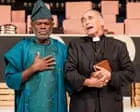
Mark Rylance stars in Darren Raymond's Tartuffe (Remixed), a modern update of Molière's 1664 comedy about a religious fraudster who infiltrates a devout household, now transplanted to the eve of a Jamaican-Nigerian wedding at London's Marylebone theatre. The production continues a trend of relocating the play's central hypocrite figure to new cultural settings, following earlier versions that recast the character as a fake imam, though the choice to keep Rylance's Pastor Blake white raises questions about why the families would hire him over a Black clergyman, weakening the story's internal logic.
The show retains Molière's rhyming couplet structure, mixing clever wordplay with cruder rhymes, and Rylance delivers a broadly comic performance, complete with false teeth, a Bible-clutching manner and moments of physical farce. Strong supporting turns come from Usifu Jalloh, Nakeba Buchanan, Sara Mokonen and Ivandro Da Cruz Leite, though the review notes the nearly three-hour running time suffers from an overlong second act, and that shifting the satire away from Molière's original church-and-monarchy targets dilutes its political bite. The production runs at Marylebone theatre until 24 October.
In short
- Mark Rylance leads a modern remix of Molière's Tartuffe in London
- Story reset at a Jamaican-Nigerian wedding, retaining rhyming couplets
- Enjoyable but overlong, with reduced political sting; runs until 24 October
Steelman: both sides, in good faith
The strongest fair case each way — we don't pick a winner.
The case for
The modern setting gives Molière’s satire fresh cultural texture, while the rhyming couplets and Rylance’s physical comedy preserve much of the original’s comic appeal. Strong supporting performances help the production bring the household’s tensions to life, and recasting the trickster in a new context can make questions of trust and religious authority newly resonant.
The case against
Keeping Pastor Blake white in a Jamaican-Nigerian family’s story may make their decision to hire him less convincing and blunt the update’s cultural logic. The long second act and the shift away from Molière’s original targets of church and monarchy can also leave the production’s satire less focused and politically sharp.
Explained simply
Molière was a 17th-century French playwright whose comedies often exposed hypocrisy and the misuse of religious authority. In Tartuffe, a seemingly devout man gains the trust of a wealthy household and tries to take advantage of it.
The play has been adapted in many settings, with the central character recast to reflect different communities and institutions. This production moves the action to a Jamaican-Nigerian family preparing for a wedding in London, where Pastor Blake becomes part of the household’s life.
The story’s central tension is between outward piety and private motives. Its setting also raises questions about who is trusted as a religious leader, while changes to the original targets of Molière’s satire affect how its criticism lands.
Africa Art Basketball Culture Entertainment Fitness Health Music Software Sport Technology World