Steam Frame shows strong VR performance despite industry slowdown and steep pricing
Developing story first seen 3 hours ago
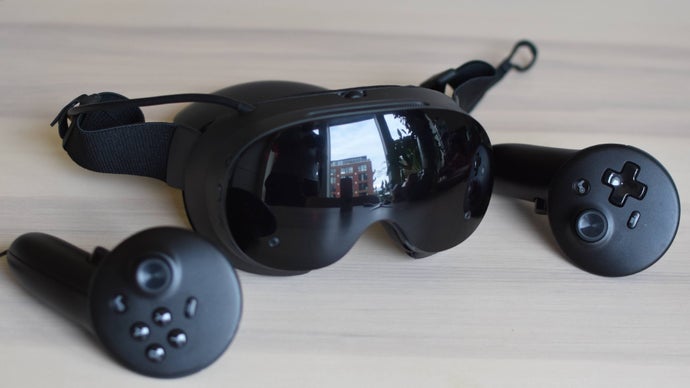
Valve has launched the Steam Frame, a standalone and PC-streaming VR headset priced from £889/$1,059, and Rock Paper Shotgun's review finds it a genuinely accomplished piece of hardware despite arriving amid a global components shortage and a slowdown in new VR game releases. The reviewer highlights a mix of solid core VR performance and inventive engineering touches, some of which could influence PC gaming more broadly rather than just VR titles, though the steep price reflects the difficult economics behind its launch.
Compared with Valve's cabled Index, the wireless, battery-powered Frame is lighter, more compact and easier to set up, with sharper 2,160×2,160 LCD lenses that edge out rival Meta Quest 3, while Zenni Optical prescription inserts are available for glasses wearers who need them. Its redesigned controllers swap the Index's precise finger-tracking for a gamepad-style layout with drift-resistant thumbsticks borrowed from Valve's Steam Controller, and while passthrough is only basic monochrome (behind Quest 3's colour cameras), the headset's modular design – allowing swappable straps, speakers, batteries and facepads – shows promise, though only Valve's own Ergonomic Accessories Kit is confirmed so far. The review also praises the Frame's balance of streaming and standalone use, aided by features such as foveated streaming that uses eye tracking to improve visual efficiency.
- Valve's Steam Frame VR headset launches from £889/$1,059
- Review praises hardware despite high price and component shortages
- Lighter than Index, sharper than Quest 3, but basic passthrough cameras
New here? Start with this
Valve is a video games company best known for creating the Steam platform, the largest online store and library system for PC games. It has now released the Steam Frame, a new virtual reality (VR) headset that can be used either as a standalone device or connected wirelessly to a gaming PC for extra power. VR headsets let wearers see and interact with a fully three-dimensional digital environment rather than looking at a flat screen.
The Frame arrives at a difficult time for VR generally, with fewer new games being made for the technology and a global shortage of the electronic components used to build such devices, which has pushed up manufacturing costs. Its main rival in the VR headset market is Meta's Quest 3, made by the company behind Facebook and Instagram, while Valve's own earlier headset, the Index, required a cable connection to a PC.
This matters because VR remains a niche but closely watched corner of gaming, and how well a major company like Valve can balance cost, comfort and performance says something about the technology's wider prospects. Some of the design ideas in the Frame, such as its wireless streaming methods, could also end up shaping PC gaming hardware beyond VR specifically.
Full account
Valve has begun shipping its long-awaited Steam Frame headset, the last of the three devices – alongside the Steam Machine and a redesigned Steam Controller – that the company unveiled back in November 2025. Early hands-on impressions suggest the standalone, wireless VR headset is a genuinely likeable and well-engineered piece of hardware, arriving at a moment when the broader VR market is in something of a lull, with fewer new original VR titles being released and component shortages continuing to squeeze the hardware industry. Both reviewers found plenty to admire in the Frame's design and capability, even as they flagged its price as the most likely sticking point for prospective buyers.
On the hardware side, reviewers praised the Frame as a clear step up from Valve's tethered, base-station-reliant Index headset, noting that it is lighter, more compact and considerably easier to set up despite being fully wireless and battery-powered. Its twin 2,160×2,160 LCD lenses were said to offer a modest sharpness advantage over Meta's rival Quest 3, and prescription lens inserts, produced in partnership with Zenni Optical, mean most glasses-wearers should be able to find a comfortable fit without them. The redesigned controllers drop the Index's finely detailed finger-tracking in favour of a more conventional gamepad-style layout with face buttons and a D-pad, which one reviewer felt made the controllers feel immediate and familiar rather than diminished, helped by drift-resistant magnetoresistance thumbsticks carried over from the new Steam Controller. Passthrough camera quality was flagged as a relative weak point, with the Frame's monochrome cameras judged less capable than the full-colour passthrough offered by the Quest 3, though this was not seen as a major drawback given that mixed-reality applications remain a fairly niche use case.
A recurring theme across the coverage was the Frame's strength as a wireless PC VR streaming device. Its built-in Qualcomm Snapdragon 8 Gen 3 chip was described as capable enough to run a range of standalone and lighter indie titles directly on the headset, but the more striking experience came from pairing the Frame with a powerful desktop PC over its bundled 6GHz wireless dongle, which one reviewer said delivered some of the most impressive gaming experiences they'd had in years when streaming graphically demanding titles at high settings. Combined with inside-out tracking from onboard cameras and internal eye tracking, this positions the Frame as a rival not just to consumer headsets such as the Quest 3 and Sony's PS VR2, but also to more expensive dedicated PC VR devices like the Samsung Galaxy XR and Play For Dream MR, both of which carry sharper optics but considerably higher price tags.
Pricing emerged as the clearest point of concern in both accounts. Valve had reportedly hoped to keep the Frame's cost below that of the original £799/$999 Index, but supply issues, particularly a prolonged shortage affecting memory chip prices, pushed the eventual starting price to £889/$1,059 for the base 256GB model, rising to $1,299 for a 1TB version. That leaves the Frame considerably pricier than mainstream competitors such as the $599 Quest 3 and $399 PS VR2, the latter of which also requires a separate PC adapter and remains tethered when used with a computer. Reviewers agreed this price gap will likely deter buyers simply seeking an affordable standalone headset, even as they credited the Frame with genuine engineering merit and strong performance for those already invested in a capable gaming PC.
Where outlets differ
The Rock Paper Shotgun-style review frames the Frame primarily around its hardware design and engineering ambition – portability, lens sharpness, controller ergonomics and passthrough quality compared with the Quest 3 – and cites UK pricing (£889) alongside the US figure.
IGN's review centres more on the Frame's performance as a wireless PC VR streaming device paired with a high-end gaming rig, and goes into more detail on pricing tiers (256GB vs 1TB models) and comparisons with a wider range of rival headsets, including the PS VR2, Samsung Galaxy XR and Play For Dream MR – comparisons not mentioned in the other account.
Only the first source mentions the Zenni Optical prescription lens inserts and a rumoured third-party colour camera accessory; only IGN specifies the exact PC hardware used for streaming tests (RTX 5090, Ryzen 7 9850X3D) and named streamed titles.
More coverage
Read the full article at the source →
Originally published by Rock Paper Shotgun as “Steam Frame review: Another best-in-class VR headset by Valve, though virtual realities clash with economic ones”.