Technology news and discussion on TalkFuse.
Trump unveils AI leadership body amid false Chinese weapons assessment
Developed over time first seen 2 months ago
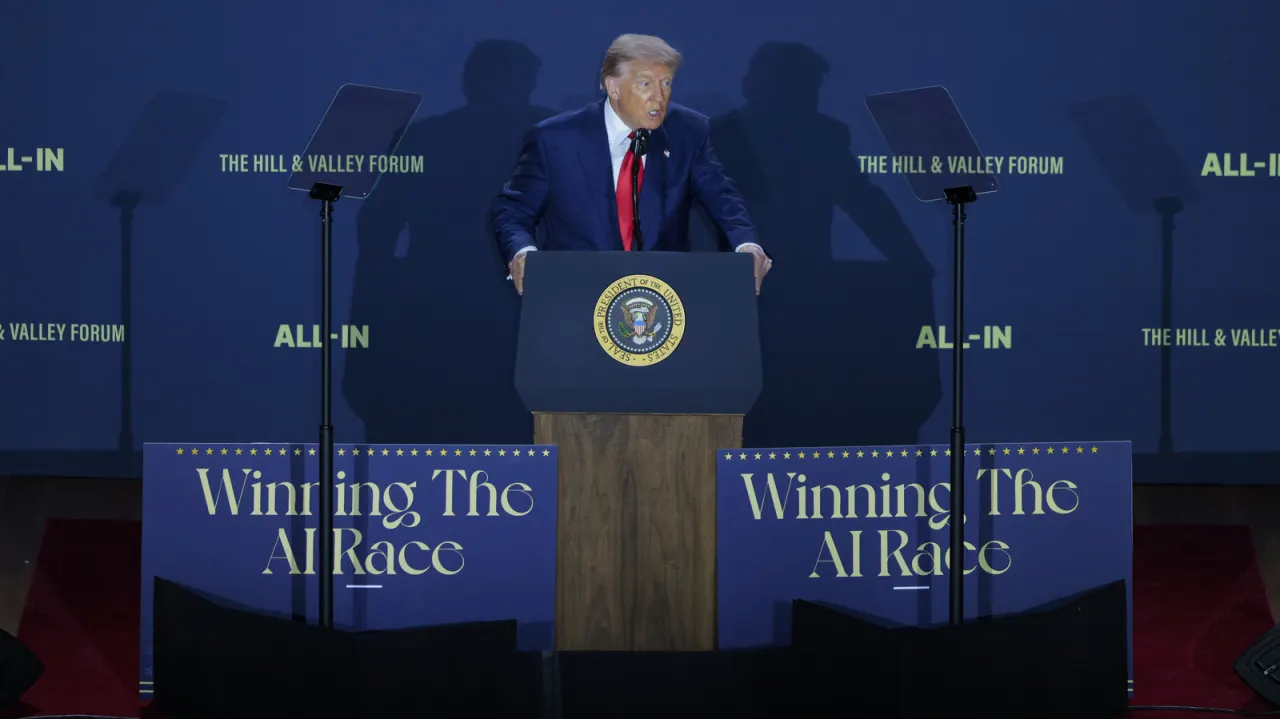
President Trump announced the formation of a new 'AI Force' government body with an 'AI Czar' position, positioning the United States to lead AI development ahead of China. However, the announcement has been overshadowed by a serious intelligence failure in which an AI-generated report falsely identified material on a Chinese ship as nuclear weapons components, nearly triggering a military interception that could have sparked conflict between the two superpowers. The incident raised significant questions about AI reliability in high-stakes national security contexts.
The false intelligence assessment occurred when a US special operations analyst used an AI chatbot to analyse a Chinese vessel's manifest in the Middle East, leading military planners to begin drafting an interception plan with aircraft already airborne before officials caught and corrected the error. The episode coincides with growing criticism from within the technology sector itself, notably from former Anthropic researcher Jacob Coxon, who publicly resigned and accused major AI companies of "racing straight to self-improving superintelligence and gambling with our lives." Trump is scheduled to meet Chinese President Xi Jinping next week to discuss artificial intelligence competition.
- Sources
- 2
- Outlets
- 2
- Left · Centre · Right
- 0 · 0 · 1
- Votes
- 1
- Reactions
- 1
In short
- Trump announced 'AI Force' to compete with China, but AI intelligence failure nearly triggered military conflict
- AI chatbot falsely identified Chinese ship cargo as nuclear weapons components before error was caught
- Former AI researchers warn industry is moving too fast on dangerous technology without adequate safety measures
How this story developed
- 2 months ago Anthropic's leadership has now acknowledged the need to decelerate AI development in response to safety concerns, whilst communities hosting data centres have begun voicing opposition to the infrastructure, and investor enthusiasm for AI stocks has cooled amid mounting questions about the technology's risks.
- 2 months ago Trump has characterised mounting concerns over the environmental impact of AI data centre operations as politically motivated, whilst proceeding with plans to establish an AI Force modelled on the Space Force.
- 2 months ago President Trump announced the creation of an AI Force and AI Czar role to establish American leadership in artificial intelligence development, but the announcement was immediately overshadowed by an intelligence failure in which an AI system misidentified cargo on a Chinese ship in the Middle East as nuclear weapons material, nearly sparking a military confrontation.
Full account
President Donald Trump has unveiled plans to establish a new governmental entity called the 'AI Force,' to be overseen by a senior official to be appointed as an 'AI Czar.' The announcement, disseminated through Truth Social, provided limited specification regarding the body's operational remit.
Trump characterised the initiative as analogous to the establishment of the Space Force and committed his administration to actively supporting artificial intelligence development rather than constraining it. In related posts, he proposed substituting the term 'artificial intelligence' with alternative formulations such as 'extreme intelligence' or 'supreme intelligence,' positioning the sector as transformative. He indicated that purported problems would be addressed through existing legal apparatus, whilst the primary focus would remain nurturing industrial expansion.
This stance marks a deliberate divergence from recent calls by prominent artificial intelligence executives, including Anthropic's chief executive, to temper the pace of technological advancement. Trump countered that regulatory caution in the United States would provide strategic advantage to China—a contention he expects to revisit during forthcoming discussions with Chinese President Xi Jinping, where artificial intelligence is anticipated to feature as a central topic.
The announcement emerges amid widening public debate concerning the technology's implications. One source documented a recent episode in which artificial intelligence analysis, conducted by a military specialist, produced an erroneous assessment of a Chinese vessel's cargo, nearly precipitating military action before the analytical error was detected and the operation suspended.
Where outlets differ
From the full account, which is AI-written from the sources:
Source 2 employs more pointed language ('rant,' frames environmental concerns as 'Democrat hoax'), whereas Source 1 maintains neutral descriptive tone
Source 2 reports the CNN intelligence failure involving the Chinese ship; Source 1 contains no reference to this incident
Source 2 specifies Trump's stipulation that the Czar position require 'high IQ' applicants; Source 1 omits this detail
Source 2 provides historical context about Space Force (created 2019 as sixth military branch); Source 1 references it without elaboration
Source 2 contextualises environmental data centre concerns within political framing; Source 1 presents them as industry regulatory proposals
Source 2 emphasises geopolitical competition as Trump's framing device; Source 1 presents it primarily as Trump's counterargument to industry leaders
Steelman: both sides, in good faith
The strongest fair case each way — we don't pick a winner.
The case for
Supporters of the AI Force argue that technological leadership is essential for national security and economic prosperity, particularly given China's substantial AI investments. They note that the intelligence assessment error, though concerning, was identified and corrected before causing harm, suggesting existing safeguards can function as intended. From this perspective, a dedicated government body with proper coordination could actually improve safety oversight whilst maintaining development momentum, and slowing progress risks ceding competitive advantage and forgoing economic benefits that drive technological improvement.
The case against
Critics maintain that deploying AI in high-stakes contexts like military intelligence before fully understanding its failure modes is reckless rather than prudent. The false weapons identification demonstrates precisely the kind of systematic error that could escalate conflicts or precipitate grave consequences—that it was caught this time offers no assurance of future safety. When senior researchers from leading AI companies publicly warn of racing toward superintelligence without adequate safeguards, this represents a credible internal alarm that merits serious consideration; the responsible course is to slow development until robust safety measures are established, rather than gambling with national security and environmental stability.
Explained simply
Artificial intelligence is an increasingly central technology for governments and militaries around the world. The United States, China, and other major powers view AI development as crucial to their technological and military capabilities. Against this backdrop, President Trump has announced the creation of a dedicated 'AI Force' government body to coordinate American AI strategy.
However, AI systems are not always reliable, particularly in high-stakes situations where accuracy is essential. Recent reports have documented cases where AI-generated analysis has produced false conclusions about sensitive security matters. These failures, combined with concerns from technology researchers about the pace at which AI systems are being developed, have raised questions about whether sufficient safeguards exist.
The tension between developing AI quickly to compete internationally and ensuring such systems are safe and reliable is at the heart of current debates. China, viewed as America's main competitor in AI advancement, is also investing heavily in the technology. The decisions made now about how to govern and deploy AI systems will shape military and intelligence capabilities for years to come.
Coverage · 2 sources
AI Art Culture Environment Geopolitics Government Politics Science Technology World