Politics news and discussion on TalkFuse.
Sheffield leader seeks government help to break stalled green belt plan
Developed over time first seen 2 months ago
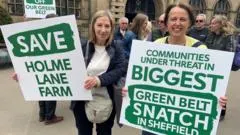
Sheffield Council leader Fran Belbin has asked the government to help resolve the stalled Local Plan after 19 months of objections and another delay caused by planning inspectors seeking further information. A fifth public consultation is under way, while the council warns that abandoning the plan would mean starting again and potentially increasing housing targets.
The plan sets out development through 2039, including 3,500 homes, cemeteries and schools across 14 green belt sites, with most proposals concentrated in the S13 and S35 areas. Residents, including actor Sean Bean, say the distribution is unfair and have campaigned to protect the land; political parties remain divided over whether the plan should proceed, be independently audited or be paused.
- Sources
- 3
- Outlets
- 3
- Left · Centre · Right
- 0 · 1 · 0
In short
- Government help sought over Sheffield’s stalled Local Plan
- 3,500 homes proposed across 14 green belt sites
- Residents oppose concentration in S13 and S35 areas
How this story developed
- 2 months ago The latest position left political parties divided over whether the plan should proceed, undergo an independent audit or be suspended while concerns about S35 and S12 sites persisted.
- 2 months ago The council warned that the impasse was leaving Sheffield exposed to speculative applications as a fifth consultation began on proposals for 3,500 homes and other facilities.
- 2 months ago After 19 months of objections and a further inspectors’ delay, council leader Fran Belbin said abandoning the plan could force a restart and raise housing targets.
- 2 months ago Sheffield City Council sought government help over plans to build homes and jobs on 14 Green Belt sites amid fierce environmental opposition.
Full account
Sheffield’s council leader has asked the government for help in resolving a prolonged dispute over the city’s proposed Local Plan, which includes development on 14 green-belt sites across South Yorkshire. The plan is intended to guide growth until 2039, but has attracted hundreds of objections from residents and campaigners. Among those opposing development near fields associated with his childhood is Sheffield actor Sean Bean.
The proposals include about 3,500 homes, as well as cemeteries and schools. Critics argue that much of the planned development would fall within the S35 and S12 postcode areas, while more affluent parts of south-west Sheffield would face less of the impact. Campaigners have questioned whether sufficient brownfield and other previously used land has been considered before green-belt sites are released.
Fran Belbin, the Labour leader of Sheffield City Council, said she had contacted ministers after 19 months of objections and described the position as exceptionally difficult. She said the city needed an up-to-date plan because the absence of one reduced its ability to manage development and left it more exposed to speculative planning applications, including proposals affecting green-belt land. A fifth public consultation is now taking place, something she described as unprecedented.
The plan has already faced repeated delays, with planning inspectors requesting further information on aspects of the proposals. Belbin said the council could not substantially rewrite the document without abandoning the process and starting again, which would extend the planning period and potentially increase the number of homes required. She also pointed to Sheffield’s geographical constraints, including the Peak District, and said that planned national planning reforms would not arrive in time to resolve the present dispute. Labour and Green councillors have previously supported the plan, while Liberal Democrat councillors opposed it; Reform UK has called for a pause and an independent review of brownfield and underused land.
Where outlets differ
From the full account, which is AI-written from the sources:
Only the third supplied source contains substantive reporting. Sources 1 and 2 consist of Google sign-in and cookie notices and provide no account of the Sheffield planning dispute, so there are no meaningful differences in emphasis to compare between the outlets.
Steelman: both sides, in good faith
The strongest fair case each way — we don't pick a winner.
The case for
Without an updated Local Plan, Sheffield surrenders strategic control over its development, leaving the city vulnerable to speculative building applications that may prove less accountable to community needs. A comprehensive plan allows the council to direct growth purposefully, ensure necessary infrastructure like schools and community facilities, and maintain democratic oversight of development. Delay merely postpones the housing challenge whilst risking worse outcomes later, as unmet demand accumulates and makes eventual development targets even larger.
The case against
Green belt land provides essential environmental, recreational, and quality-of-life value that cannot easily be recovered once lost, and that value deserves protection from development pressure. The concentration of proposed development in just two postcode areas raises genuine fairness questions about which communities bear the burden of growth. The five rounds of consultation suggest the original scheme has not adequately addressed legitimate resident concerns, and democratic accountability matters—imposing an unpopular plan that has generated hundreds of objections risks undermining public trust in planning processes.
Explained simply
A Local Plan is a long-term blueprint for a city's development, setting out where new homes, schools, and other facilities will be built over several decades. Sheffield has been working on an updated plan but has not yet secured approval. Without an agreed plan in place, the council loses much of its control over where development happens, leaving it vulnerable to property developers submitting speculative applications.
The proposed plan would allow building on fourteen sites currently designated as greenbelt—protected land on the edges of cities that typically serves as countryside or green space. The development would create approximately 3,500 new homes, alongside schools and cemeteries, but the majority of this building would be concentrated in just two postcode areas, S35 and S12. This geographical concentration has prompted hundreds of objections from residents in those areas and wider concerns about whether development is being distributed fairly.
The plan has faced mounting scrutiny over environmental impacts and site selection, with the process extended multiple times as planning inspectors requested additional information. Residents, environmental groups, and notable figures including actor Sean Bean have registered formal objections. The resulting stalemate has meant the plan remains unresolved after nearly two years of public dispute.