Science news and discussion on TalkFuse.
X-planes: Are they needed in the new era of drones?
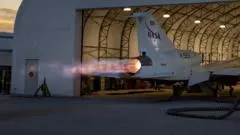
Nasa’s X-59 experimental aircraft is testing whether supersonic flight can return over land by reducing the disruptive sonic boom to a quieter sound. Its findings could help make faster-than-sound passenger travel commercially viable, while also demonstrating whether specialised crewed research aircraft remain useful in an era of rapidly advancing drones.
The X-59 first flew in 2025 and is now breaking the sound barrier over selected US communities, with residents assessing whether its boom sounds roughly like a car door closing across the street. Built from parts of T-38, F-16 and F-18 aircraft, it uses an elongated nose and a cockpit camera system; Nasa says future X-planes are likely to be uncrewed where that is practical and cheaper, though some research still requires pilots or benefits from having them.
In short
- X-59 aims to make supersonic flight over land acceptable.
- Community surveys will judge whether its quieter boom is tolerable.
- Drones may dominate future testing, but crewed aircraft remain useful.
Steelman: both sides, in good faith
The strongest fair case each way — we don't pick a winner.
The case for
Crewed experimental aircraft offer unique advantages that autonomous systems cannot yet fully replicate. Human pilots provide real-time decision-making, scientific judgment and the ability to respond to unexpected phenomena in experimental flight regimes where surprises are common. Maintaining expertise in crewed aviation engineering also represents irreplaceable institutional knowledge that, once lost, becomes extraordinarily costly to rebuild. Some research genuinely benefits from having a skilled pilot who can interpret anomalies and adapt strategy mid-test.
The case against
Uncrewed aircraft and drones represent the future of aerospace research because they eliminate pilot risk entirely whilst typically costing a fraction of crewed programmes. Autonomous systems can fly longer missions without fatigue, require less complex support infrastructure, and advancing artificial intelligence increasingly enables them to handle complex decisions and scientific interpretation. Resources devoted to expensive crewed X-planes would be better invested in rapidly developing drone technology, which can achieve equivalent research outcomes more efficiently and safely.
Explained simply
X-planes are experimental aircraft built to test new ideas in flight, from unusual shapes to ways of travelling faster. They are usually designed for research rather than passenger or military service, and their findings can guide later aircraft designs.
Nasa, the US space and aeronautics agency, has used crewed X-planes to study how aircraft behave and how new technology works. Drones can now carry out many research flights without a pilot on board, but some experiments still need a person to control the aircraft or assess what is happening.
The debate matters because research aircraft are costly to develop and operate, while drones may offer a cheaper option for some work. Testing whether quieter supersonic flight is possible could also shape the future of fast passenger travel over land.