World news and discussion on TalkFuse.
Stuck between superpowers: How Australia navigates the China-US rivalry
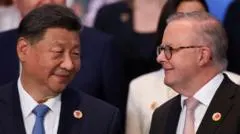
Australia is expanding its military co-operation with the United States as China’s growing military strength and influence in the Pacific raise concern. The move highlights a strategic bind: Australia relies on the US for security while China is its biggest trading partner.
The joint Southern Jackaroo exercise with US and Japanese forces rehearses for a major conflict, though Australian officials have avoided naming a potential adversary. US Marines deployed to Australia have increased from about 200 in 2012 to around 2,500 today; US-linked facilities have also been upgraded, and the Aukus pact provides for Australia to acquire nuclear-powered submarines. A Lowy Institute poll cited in the article found that 31% of Australians trust the US to act responsibly in the world, while 28% trust China.
In short
- Australia is strengthening defence ties with the US and Japan.
- China’s rise creates security concerns and trade dependence.
- Public trust in both superpowers is low.
Steelman: both sides, in good faith
The strongest fair case each way — we don't pick a winner.
The case for
China's rapid military modernisation and increasingly assertive behaviour in the South China Sea and Pacific represent a material security threat to Australia. Proponents of closer US alignment argue that maintaining a strong alliance with Washington—underpinned by shared democratic values—is essential to deter potential aggression and protect Australian sovereignty. Military investment and joint exercises like Southern Jackaroo are presented as prudent, defensive measures that enhance regional stability by making conflict costlier and less likely, and supporters contend that security guarantees cannot be substituted by economic ties alone.
The case against
Critics argue that Australia's economic prosperity depends fundamentally on its largest trading partner, China, and that heavy military alignment with the US risks triggering economic retaliation that could severely damage Australian prosperity. They contend that military buildups risk becoming self-fulfilling prophecies that increase tensions rather than deterring conflict. Advocates of this view argue that Australia should instead pursue balanced diplomatic engagement, maintaining strategic autonomy rather than becoming too dependent on the US alliance, which could draw Australia into unwanted conflicts.
Explained simply
Australia depends on two rival superpowers in different ways, creating a complex strategic problem. The United States has been Australia's security guarantor for decades, providing military protection and alliance. China, meanwhile, has become Australia's most important trading partner, crucial to the country's economic prosperity.
This dual dependence has become increasingly difficult to manage as China's military strength has grown and the competition between Washington and Beijing for influence in the Indo-Pacific has intensified. Australia finds itself caught between its need for security alignment with the United States and its economic reliance on China. The two superpowers' interests often pull Australia in opposite directions.
How Australia manages this relationship is significant for the country and the region. Australia's choices about security and defence will influence the balance of power between the United States and China in the Indo-Pacific. Both superpowers view the region as strategically important, making Australia's alignment choices consequential.
Americas Art Asia Culture World