HP OmniBook 5 14 Challenges MacBook Neo with Standard OLED Display at $699
Developing story first seen 1 hour ago
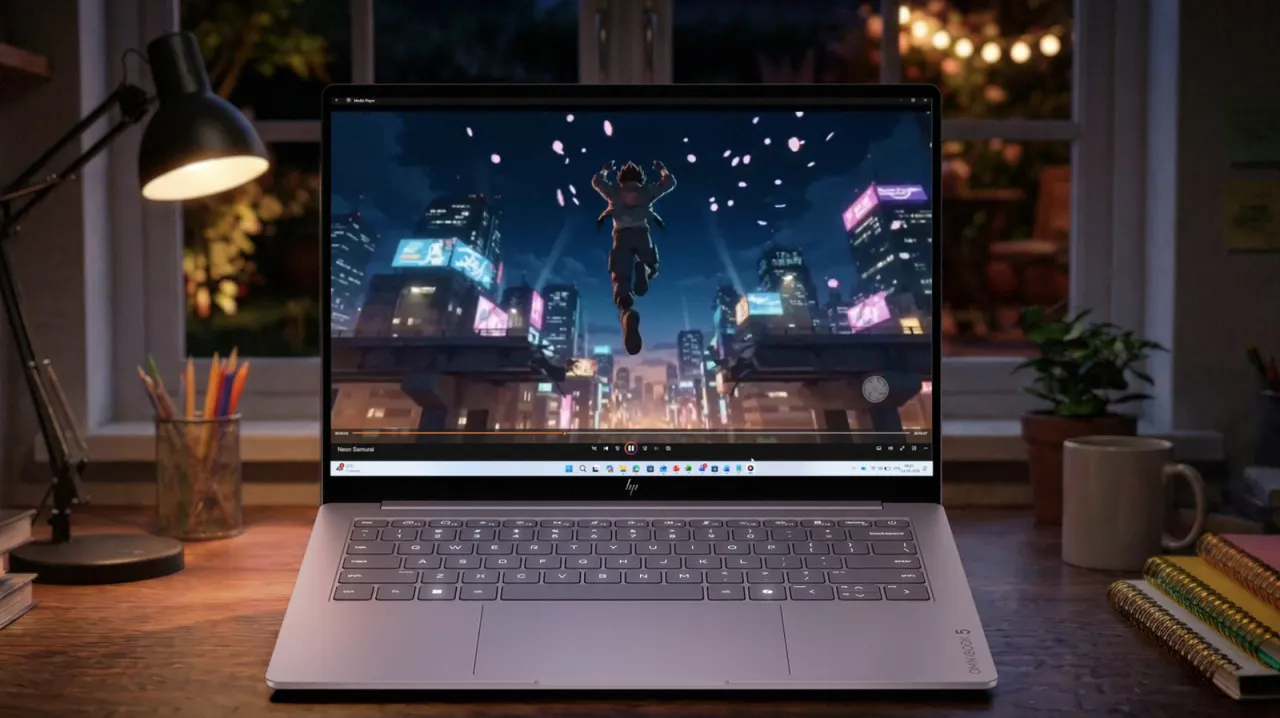
HP says its new OmniBook 5 14 will start at $699 and go on sale this month, adding an OLED touchscreen option to the budget laptop market. Its price puts it in a similar range to Apple’s MacBook Neo, while its display and lightweight design may appeal to Windows buyers.
The 2.5K screen has a 180-degree hinge, and configurations will be available with up to an Intel Core 7 processor and an integrated NPU. HP claims up to 42 hours of battery life based on local video playback, so use with demanding software may reduce that figure; the base model has 8GB of RAM and a 256GB SSD.
- HP’s OmniBook 5 14 starts at $699.
- It includes a 2.5K OLED touchscreen.
- HP claims up to 42 hours of video playback.
New here? Start with this
Apple dominates the premium laptop market with its MacBook range, which commands strong brand loyalty and customer preference. However, other manufacturers like HP constantly challenge Apple by offering powerful, portable computers at lower price points. Competition between these brands shapes the wider laptop market, driving innovation and influencing what features consumers expect at different price levels.
OLED displays are a premium screen technology offering superior colour, brightness and image quality compared to traditional LCD screens. The technology is expensive to produce, so OLED screens traditionally appear only on the most costly laptops or as expensive optional upgrades. When companies make OLED standard on all versions of a laptop model, it represents a significant shift in how they price and position their products.
Consumers evaluating a laptop consider multiple factors: screen quality, how portable and lightweight it is, processing speed, and battery life. When manufacturers announce new models combining premium features with competitive pricing, it creates pressure on established brands and influences market dynamics. These launches matter because they determine what specifications and technology consumers can access at different price points.
Both sides, in good faith
The strongest fair case each way — we don't pick a winner.
The case for
HP has finally brought premium features like OLED screens to an accessible price point, directly challenging Apple's pricing power in the mainstream laptop market. By offering sophisticated technology at £699, HP is forcing the entire industry to reconsider what consumers should expect at different price tiers, delivering genuine value and spurring the kind of meaningful competition that drives innovation and consumer benefit.
The case against
Whilst the specifications sound compelling, bringing together OLED displays, premium processors and ultra-slim design at £699 raises substantive questions about where cost compromises inevitably lie, whether in thermal performance, battery longevity or build durability. Until independent reviewers verify that real-world performance matches the ambitious claims—particularly sustained computational performance and battery endurance—the device remains an interesting specification sheet rather than a proven MacBook alternative.
Full account
Hewlett-Packard has unveiled a new entry-level laptop designed to compete directly with Apple's popular MacBook Neo. The 2026 HP OmniBook 5 14-inch model starts at $699.99 and aims to match or exceed its rival's appeal through a combination of affordable pricing and features typically found in more expensive devices. The base configuration includes an Intel Core 5 315 "Wildcat Lake" processor paired with 8GB of memory and a 256GB solid-state drive, specifications largely in line with competing ultraportables from Dell, Asus, and Acer. The machine comes in four colourways—silver, pink, blue, and green—mirroring the aesthetic choices offered by Apple's own range.
What distinguishes the HP offering is the inclusion of OLED display technology across all model variants, a feature not universally applied by competitors at this price point. However, the entry-level panel involves compromises: it delivers a 1920 by 1200-pixel resolution with a maximum brightness of 300 nits and employs a non-touch interface. A touchscreen variant will be available from the device's October launch, though a more premium configuration featuring 2560 by 1600-pixel resolution and 400 nits of brightness will not arrive until March 2027. Buyers can configure the machine with higher specifications, including an Intel Core 7 350 processor, up to 16GB of RAM, and a 1TB drive. All variants include a 1080p front-facing camera for video conferencing, stereo speakers, HDMI connectivity, a 3.5-millimetre audio jack, and two 10Gbps USB-C ports.
The machine impresses with its physical dimensions and weight. At 2.56 pounds and 11.7 millimetres thick, it edges out the MacBook Neo in both regards, offering a notably portable solution for mobile professionals and students. The device features a 180-degree hinge mechanism permitting flexible positioning for various working scenarios. The exterior casing incorporates a premium logo design usually reserved for costlier models, contributing to an overall aesthetic that belies its competitive pricing.
HP claims an exceptionally long battery lifespan of up to 42 hours per charge during local video playback, though the manufacturer acknowledges that running CPU-intensive applications will reduce this significantly. The company also incorporates an integrated neural processing unit to facilitate artificial intelligence capabilities. Availability is scheduled for October 2026, with no specific release date confirmed as yet. The OmniBook 5 represents an attempt to democratise features such as OLED screens and AI processing that have traditionally been confined to premium-priced laptops.
Where outlets differ
Source 1 specifies the base model display as 1920×1200 non-touch; Source 2 describes a '2.5K touchscreen' without clarifying which configuration level
Source 1 expresses caution about battery claims pending independent testing; Source 2 cites HP's 42-hour claim as stated fact
Source 2 emphasises integrated NPU and AI capabilities; Source 1 omits these aspects
Source 1 details port specifications including HDMI and audio jack; Source 2 prioritises camera and microphone specifications
Source 1 mentions the delayed March 2027 rollout of higher-resolution OLED; Source 2 does not reference this timeline
Coverage
- The Verge — HP’s OmniBook 5 14 takes on MacBook Neo with OLED screen
- Engadget — HP launches OmniBook 5 laptop with OLED touchscreen from $699