Russian media claims a second victim has died from ‘plague outbreak’ at infection zone hospital as Kremlin scrambles to cover up details
Developed over time first seen 13 hours ago
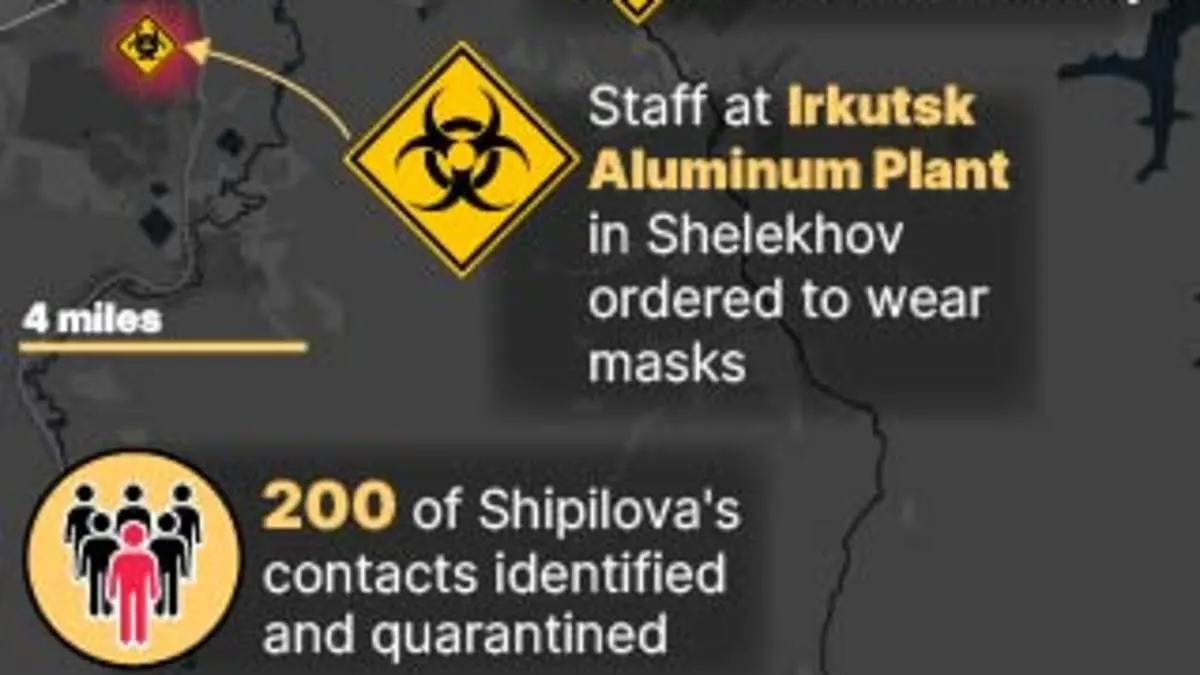
Russian media have reported that a second person has died after contracting plague in Russia’s Irkutsk region, but the claim has not been confirmed by health authorities. The reports follow the death of laboratory technician Darya Shipilova, 28, and have raised concern amid conflicting accounts of the cause and extent of the illness.
Shipilova died on 2 October after reportedly being exposed to pneumonic plague at the Irkutsk Anti-Plague Institute, where she is said to have broken a tube containing live bacteria. Russia’s public health agency says she died of unspecified pneumonia and describes the regional situation as stable; reports also say several hospitals are quarantined and hundreds of staff and patients cannot leave. Russian outlets have removed some coverage, while officials have urged the public to rely on the health agency’s statements.
- Russian media claim a second death linked to plague in Irkutsk.
- Officials say Shipilova died of unspecified pneumonia.
- Reports describe hospital quarantines and deleted coverage.
New here? Start with this
A laboratory technician named Darya Shipilova died on 2 October after reportedly being exposed to pneumonic plague at the Irkutsk Anti-Plague Institute in Russia's Irkutsk region. Unconfirmed reports in Russian media have since suggested additional deaths from the illness.
Russia's public health agency has stated that Shipilova died of unspecified pneumonia and that the situation is stable, but media reports indicate that several hospitals have been quarantined with hundreds of staff and patients unable to leave. This contradiction between official statements and media reports has raised questions about what actually happened at the laboratory and the scope of any outbreak.
The incident raises concerns about safety protocols at Russian research facilities and the openness of official responses to potential public health emergencies. Some Russian media outlets have removed coverage of the situation, and officials have urged the public to rely on official health agency statements, which has created confusion about what is actually occurring.
Both sides, in good faith
The strongest fair case each way — we don't pick a winner.
The case for
Critics point to what they see as systematic downplaying: official characterisation of a confirmed plague-related death as 'unspecified pneumonia,' description of stability alongside extensive quarantines, and removal of media coverage. They argue the public deserves transparent acknowledgment of serious biological incidents rather than information management designed to minimise public concern.
The case against
Supporters of the official response argue that the health agency, with complete information media outlets lack, provides more reliable assessment than unconfirmed reports; categorising pneumonic plague as pneumonia is technically accurate and not misleading. They contend that quarantines are standard precaution in any biological incident and that directing communication through official channels prevents panic and misinformation.
Full account
Russian media have reported a second death at a hospital in Russia’s Irkutsk region amid unconfirmed claims of a pneumonic plague case. Neither account provides independent confirmation of the second person’s identity, cause of death or connection to the first reported case. Russian authorities have described the death of Darya Shipilova, a 28-year-old laboratory worker, as the result of an ‘unidentified pneumonia’.
According to the reports, Shipilova worked at the Irkutsk Anti-Plague Institute in Siberia and told medical staff she had accidentally broken a test tube containing live bacteria. She died on 2 October. The accounts say hundreds of her contacts were quarantined; one adds that five hospitals, including a maternity unit, were affected. These details, like the suggestion that she contracted pneumonic plague, remain attributed to the reports rather than established findings.
Questions about the official account have grown after several Russian news items about the suspected case were reportedly removed. The independent outlet The Insider said that REN TV deleted five articles on the subject, while the first account also cites removed coverage from Channel 5 and Kommersant. It says an Irkutsk region city administration briefly advised residents to limit travel to the Shelekhov district on the basis of unofficial information, then deleted the notice. Those removals have prompted allegations of a cover-up, but they do not by themselves establish why the material was taken down. Kremlin spokesman Dmitry Peskov urged the public to rely on statements from Russia’s health agency, Rospotrebnadzor, rather than speculation.
The reports also describe responses beyond Russia. They say Mongolia, Kyrgyzstan and Uzbekistan have tightened border health controls. US Secretary of State Marco Rubio said Washington was monitoring the situation but saw no immediate cause for alarm. The second account adds that President Donald Trump planned to discuss the reports with Vladimir Putin, and quotes the US Centers for Disease Control and Prevention as saying it was monitoring a suspected case while seeing no indication of a broader threat to the United States. The central uncertainty remains whether either reported death was caused by plague.
Where outlets differ
Source 1 gives more detail about the reported second death, removed Russian coverage and the deleted local travel advisory. Source 2 focuses more on the US response, including Trump’s planned call with Putin and the CDC’s assessment. Source 2 also reports that five hospitals were quarantined, a detail absent from Source 1.