Supreme Court weighs oil firms’ bid to halt US climate claims
Developing story first seen 10 hours ago
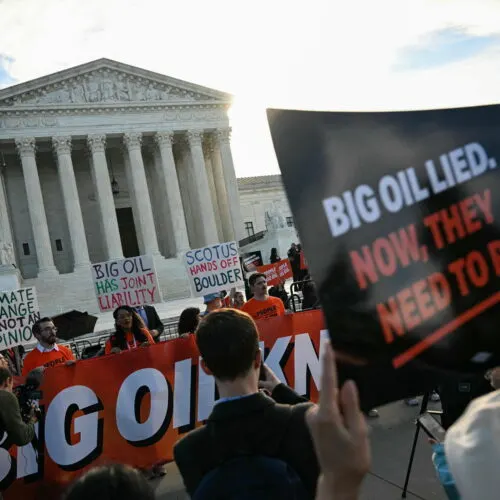
The US Supreme Court heard arguments on whether federal law prevents Boulder and other local governments from pursuing climate deception lawsuits against oil companies. The case could affect more than two dozen claims seeking billions of dollars to help cover costs associated with climate-related extreme weather.
Boulder sued ExxonMobil and Suncor Energy in 2018, seeking damages rather than limits on their activities, its lawyer said. The companies argue the Clean Air Act and Constitution reserve control over interstate pollution to the federal government; justices also questioned whether the case is ready for review before a ruling has been issued.
- Supreme Court weighs whether climate lawsuits can proceed.
- Boulder seeks damages from ExxonMobil and Suncor.
- Justices questioned whether the case is ready for review.
New here? Start with this
Several American cities and states have sued major oil companies seeking compensation for the costs of dealing with extreme weather and climate change. One of the most prominent cases comes from Boulder, Colorado, which filed a lawsuit in 2018 against ExxonMobil and Suncor Energy. The city argues these firms should pay for some of the damages from floods and other weather events that have become more severe as the climate has warmed.
The oil companies are trying to stop the case before it reaches trial, saying that US federal law prevents states and local governments from bringing such lawsuits against them. Boulder's lawyers counter that they are seeking compensation, not attempting to regulate oil production, and that state law allows them to pursue damages. The Supreme Court justices have questioned whether the cases are ready for review and whether federal environmental law or the Constitution might block the lawsuits.
The Supreme Court's decision will determine whether these lawsuits can proceed, and similar cases are currently pending across more than two dozen jurisdictions in America. If the court rules in favour of the oil companies, it could effectively end a major strategy by cities and states to hold the fossil fuel industry financially accountable for climate-related harms. The outcome will have significant implications for whether local governments can recoup costs from extreme weather events through the courts.
Both sides, in good faith
The strongest fair case each way — we don't pick a winner.
The case for
States have traditionally possessed authority over tort law and property rights within their borders, and these lawsuits seek damages for tangible harms rather than imposing new regulations on energy production. The plaintiffs argue that oil companies deceived the public about climate risks whilst profiting from fossil fuels, and neither the Clean Air Act nor the Constitution explicitly preempts state common-law claims for negligence or nuisance. Allowing such suits respects federalism by permitting local governments to seek redress for documented climate-related damages without dictating federal energy policy.
The case against
Federal preemption of energy regulation is essential because a patchwork of state climate liability claims would effectively circumvent federal authority over interstate commerce and undermine unified national energy policy. The oil companies contend that permitting such broad tort liability—especially for decades of historical emissions made lawfully under federal standards—would create inconsistent, unpredictable legal regimes that disrupt energy markets and contradict federal regulatory frameworks like the Clean Air Act. Resolving climate change requires coordinated federal and international action rather than allowing states to impose retroactive liability through litigation.
Full account
The United States Supreme Court has begun examining whether oil companies can use federal law to shield themselves from state-level climate liability claims. The hearing, which took place as the court commenced its new term, centred on more than two dozen lawsuits across the country in which cities, counties and states seek potentially billions of pounds in damages to cover costs associated with climate-related extreme weather. The case under consideration originated in 2018 when Boulder, Colorado and its county filed suit against ExxonMobil and Suncor Energy in state court.
Oil companies argue that federal statutes preempt state governments from pursuing such claims, contending that allowing them would effectively hand regulatory power to thousands of municipalities nationwide. Their legal representatives contended that state law should not govern conduct occurring globally, and warned that permitting the lawsuits to proceed would enable roughly 90,000 municipalities to influence energy policy through jury verdicts. However, Boulder and its fellow plaintiffs rejected this characterisation, emphasising that their cases seek financial compensation for alleged deception rather than attempting to restrict fossil fuel operations directly.
The hearing exposed a procedural complexity that could determine the case's fate without addressing its central substantive question. Justices Ketanji Brown Jackson and Sonia Sotomayor posed repeated questions about whether the Supreme Court possessed jurisdiction to hear the matter whilst proceedings remained ongoing in Colorado's state courts. Jackson suggested the timing appeared premature, noting the court lacked sufficient factual detail to rule confidently on the issues. Conservative legal commentators interpreted these lines of questioning as strategic positioning, arguing the liberal justices were seeking a jurisdictional avenue to avoid deciding whether federal law preempts state claims.
The broader context reveals intensifying efforts to block such litigation. Some states have passed laws prohibiting climate deception suits, whilst Republican-controlled Congress has proposed federal legislation shielding oil producers from liability. The Trump administration has intervened in several state cases including Boulder's, and conservative groups have filed numerous public records requests targeting scientists whose research features in the lawsuits. Whether the Supreme Court's resolution hinges on jurisdiction or substantive preemption will significantly impact the landscape of climate litigation across America.
Where outlets differ
SOURCE 1 emphasises substantive legal arguments regarding federal preemption; SOURCE 2 focuses on judicial strategy and positioning around jurisdiction
SOURCE 1 presents oil company and plaintiff arguments relatively neutrally; SOURCE 2 incorporates conservative commentary interpreting liberal justices' questions as seeking an 'off-ramp'
SOURCE 1 discusses the broader anti-litigation campaign comprehensively; SOURCE 2 concentrates narrowly on hearing dynamics
SOURCE 1 cites academic expert analysis; SOURCE 2 relies on conservative group spokespeople for interpretation
More coverage
Read the full article at the source →
Originally published by Ars Technica as “Big Oil asks Supreme Court to kill climate lawsuits before trial”.