Microsoft Launches $6,000 Surface RTX Spark Dev Box for Local AI Development
Developing story first seen 1 hour ago
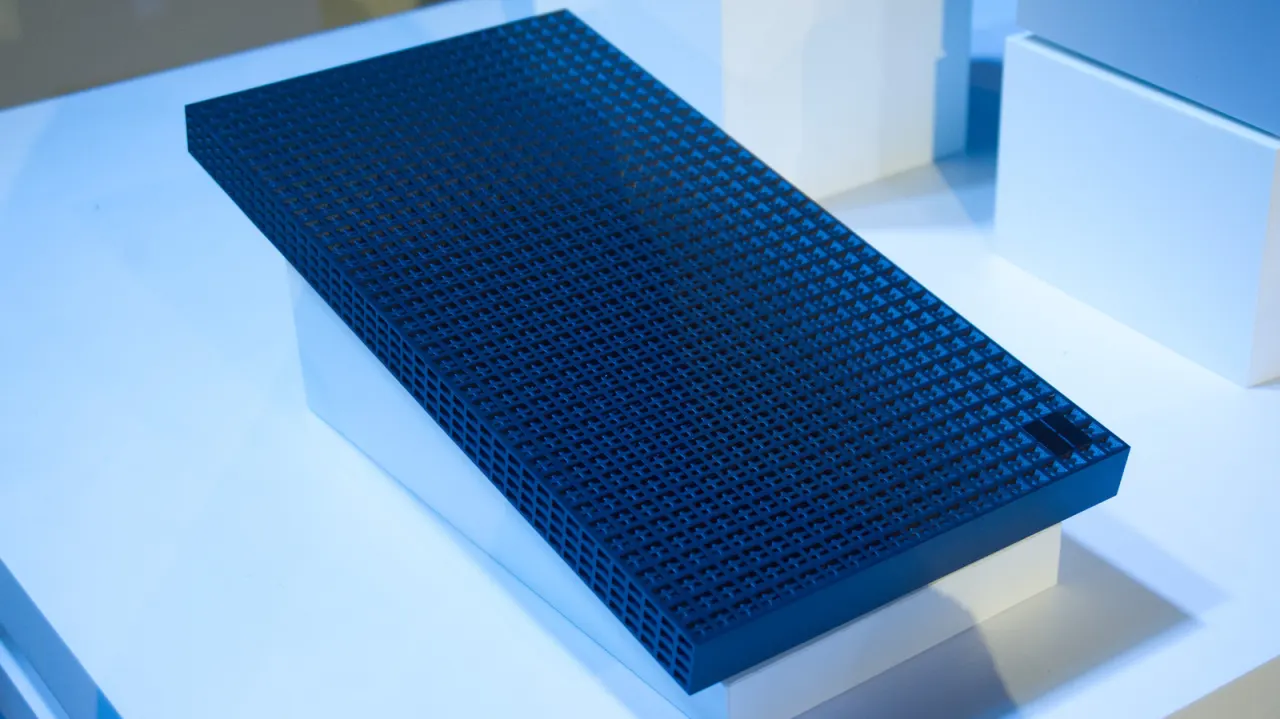
Microsoft has released the Surface RTX Spark Dev Box, a $6,000 developer machine powered by Nvidia's RTX Spark platform, available for preorder with November shipping. The device targets developers looking to run large-scale AI models locally, eliminating reliance on cloud services for AI development and testing.
The Dev Box features 128GB of unified memory, a 100-watt thermal envelope, and Nvidia's Tensor cores capable of handling models exceeding 120 billion parameters. Its distinctive 3D-printed anodised aluminium chassis serves as a heatsink, and it ships as part of Project Zenith with Windows 11 Pro and preinstalled developer tools including Visual Studio Code, GitHub Copilot, Python, and Node. The £6,000 price is steeper than Nvidia's competing DGX Spark, reflecting rising component costs.
- Microsoft launches $6,000 AI developer machine with Nvidia RTX Spark platform
- Supports running large AI models exceeding 120 billion parameters locally
- Ships in November with preinstalled development tools and Windows 11 Pro
New here? Start with this
Local AI development means running artificial intelligence models on your own computer rather than uploading them to cloud services operated by major technology companies. Developers increasingly want this option because it provides privacy and can reduce costs, since paying for cloud computing time can quickly become expensive when working with large models.
Microsoft and Nvidia, a major computer chip manufacturer, have partnered to address developer demand for local AI capabilities. While cloud services offer convenience for AI work, some developers prefer to own their own hardware to maintain control over data and reduce dependence on external platforms.
This new device provides hardware specifically engineered for this purpose. Rather than being limited by the computing power in a standard laptop or relying on subscription fees, developers can now own a machine built to handle the intensive calculations that advanced AI models require.
Full account
Microsoft has unveiled the Surface RTX Spark Dev Box, a high-performance desktop machine priced at $6,000 aimed at accelerating local artificial intelligence development. The company has begun accepting pre-orders with deliveries scheduled for November. This milestone follows an earlier preview and reflects Microsoft's commitment to specialised developer hardware.
The device's most striking characteristic is its unconventional form factor. Its chassis—fabricated through 3D-printing anodised aluminium—features approximately 1,000 apertures serving dual functions: thermal dissipation and visual differentiation. Whilst relatively compact compared to equivalently powerful alternatives, it remains decidedly heavy, with estimates placing its weight at 5 to 6 pounds or higher, rendering single-handed handling difficult. The elevated base mounting adds substantially to its desk footprint, positioning it alongside devices like Apple's Mac Studio in prioritising stationary deployment over portability.
Powering the machine is Nvidia's Arm-based RTX Spark platform, which integrates a 6,144-core graphics processor alongside 128GB of unified memory and a 2TB solid-state drive. A 100-watt thermal envelope manages processing intensity. Connectivity comprises three USB-C ports, one standard USB-A port, HDMI output, Ethernet, and a 3.5mm audio jack. Unlike certain competitor devices, the machine offers no expansion slots.
The Dev Box targets developers pursuing local execution of advanced AI models exceeding 120 billion parameters, eliminating cloud dependency. It ships with Windows 11 Pro configured for development workflows, pre-installed with essential tooling including Visual Studio Code, Git, GitHub Copilot, the Windows Subsystem for Linux, Python, and Node.js. Intended applications encompass model testing, AI agent prototyping, and on-device deployment of sophisticated coding assistance. As part of Microsoft's Project Zenith initiative, it emphasises developer-centric computing solutions.
Where outlets differ
Source 1 approaches the device as a design object, emphasising aesthetics and industrial form (the Lego comparison) and contextualising it within Apple's design philosophy, whilst Source 2 foregrounds technical specifications and developer capabilities.
Source 1 provides exhaustive connectivity details and explicitly notes the absence of expansion slots; Source 2 does not discuss ports or expansion options.
Source 2 situates the device within competitive market dynamics (comparing pricing to Nvidia's DGX Spark and attributing costs to component shortages); Source 1 simply states the price without market context.
Source 2 details the developer software ecosystem and Project Zenith positioning; Source 1 does not address software, tools, or project affiliation.
Source 1 observes that the device was not powered on during the preview, expressing uncertainty regarding thermal performance under load; Source 2 presents the thermal architecture as an accomplished specification.