Senate rivals clash as El-Sayed rejects Iran-Israel threat comparison
Developing story first seen 2 hours ago
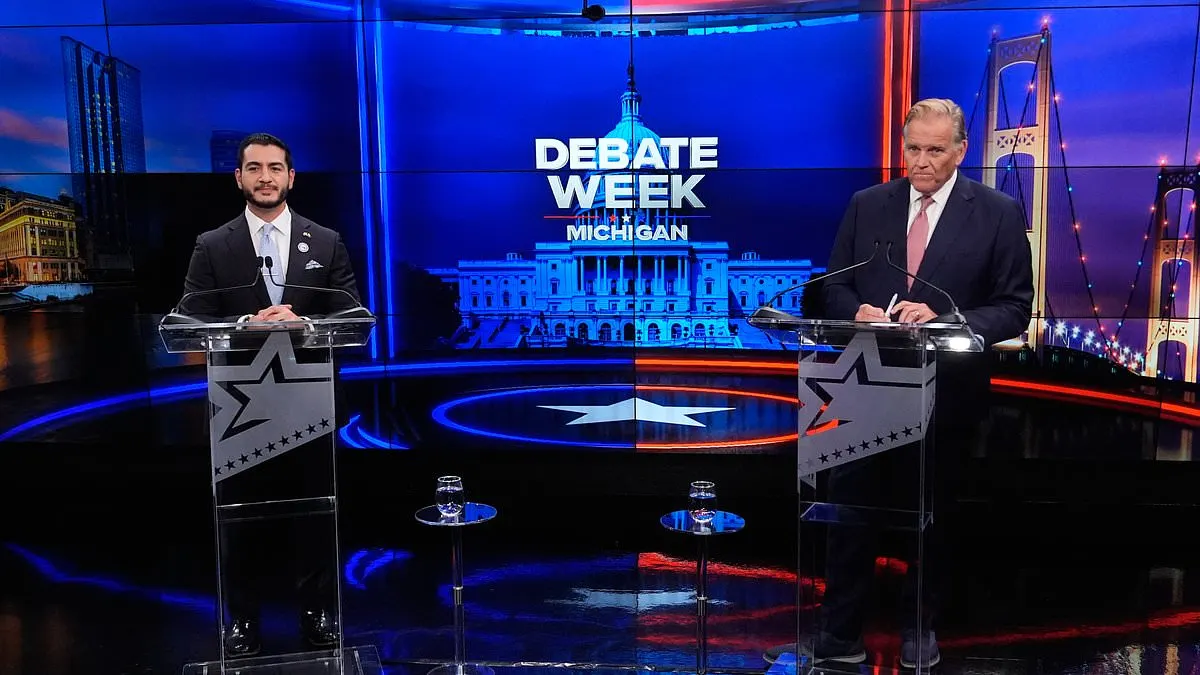
Newly added coverage details how the debate widened beyond foreign policy, with Rogers attacking El-Sayed over his mother’s past charity work and campaign staff turnover. El-Sayed responded that his mother was never charged, and challenged Rogers’ account of the charity’s case.
The debate also covered the Iran war, trade, immigration and healthcare, with personal insults from both candidates and frequent interruptions. The charity pleaded guilty in 2016 to sanctions violations, money-laundering conspiracy and tax obstruction after transferring nearly $1.4 million to Iraq; it was not accused in the article of funding al-Qaeda. The Senate race is close, with recent polling placing the candidates one point apart.
- Rogers’ attacks included claims about El-Sayed’s mother and campaign staff.
- The charity pleaded guilty to offences involving a transfer of nearly $1.4 million to Iraq.
- Polling puts the Michigan Senate race within one point.
New here? Start with this
Michigan is holding a Senate election where voters will choose between Democrat Abdul El-Sayed, a physician, and Republican Mike Rogers to fill the seat of retiring Senator Gary Peters. If elected, El-Sayed would become the first Muslim member of the United States Senate. The race is extremely close, with recent polls showing the candidates separated by just one percentage point.
The election has drawn significant national attention, in part because El-Sayed's potential election would be historic, and in part because former President Donald Trump has endorsed Rogers in his second bid for the Senate. The two candidates hold different positions on healthcare, immigration and trade policy. Both candidates have been targets of personal attacks and criticism during the campaign.
The race has become increasingly contentious as election day approaches. The candidates have engaged in heated exchanges over both policy and personal matters, reflecting the intensity of the competition.
Both sides, in good faith
The strongest fair case each way — we don't pick a winner.
The case for
Foreign policy cannot be reduced to simple rankings of threats, as both Iran and Israel play complex roles in Middle Eastern geopolitics. A thoughtful candidate refusing to engage with an oversimplified false choice demonstrates principled nuance rather than evasion; the real issues—nuclear proliferation, regional stability, American interests—require sophisticated analysis beyond binary comparisons designed to generate controversy rather than illuminate policy.
The case against
Voters deserve direct answers to substantive policy questions from candidates seeking high office. A senator must make difficult geopolitical judgements; refusing to articulate how one prioritises threats amongst major regional powers suggests either evasion or lack of clear thinking. Dismissing a legitimate question as 'dumb' appears dismissive of voter concerns and avoids the accountability expected of serious candidates.
Full account
Democratic Senate candidate Abdul El-Sayed and Republican rival Mike Rogers engaged in a combative debate on Thursday evening in Grand Rapids, marking their first televised confrontation in the competitive race to succeed retiring Michigan Senator Gary Peters. The encounter quickly descended into acrimonious exchanges, with both candidates trading personal insults and accusations spanning topics including healthcare affordability, trade disputes, immigration and Middle Eastern foreign policy. The moderator repeatedly struggled to maintain order, a situation sufficiently unusual that he remarked on its rarity across his three decades of moderating similar events.
A particularly heated exchange emerged when moderators pressed El-Sayed to identify whether Iran or Israel represented the greater security threat to the United States. The Democrat resisted the dichotomy, dismissing the proposition as a 'ridiculous hypothetical' and contending that both nations had proved problematic in distinct ways. One source emphasises his vocal rejection of the binary choice presented by questioners, whilst another account suggests the dispute centred on whether America should commit to providing defensive military support to Israel under hypothetical attack scenarios, revealing deeper disagreements about Middle Eastern policy.
The candidates employed pointed attacks questioning each other's integrity and professional credentials. Rogers repeatedly assailed El-Sayed's claims to medical status, depicting him as fundamentally dishonest. El-Sayed countered by citing his Columbia University medical degree and pivoting to attack Rogers as unprincipled and subservient to the Trump administration. The Republican employed provocative language, comparing El-Sayed to a malfunctioning artificial intelligence system and suggesting ties to militant organisations, whilst El-Sayed characterised Rogers as weak and lacking in resolve.
Both candidates attacked the other's financial dealings and wealth accumulation. El-Sayed alleged Rogers had profited from corporate ties following his congressional career, referencing property acquisitions and watercraft ownership. Rogers denied allegations concerning yacht acquisition but questioned El-Sayed's investment portfolio, including overseas holdings in the United Arab Emirates, and alleged hypocrisy in accepting billionaire donations whilst campaigning against corporate political influence. One account documents Rogers referencing El-Sayed's mother's former employment at a charitable organisation that subsequently faced legal consequences regarding sanctions violations, though El-Sayed's mother was never charged with wrongdoing. Throughout the evening, the moderator intervened repeatedly, attempting unsuccessfully to progress through substantive policy questions amid relentless personal accusations.
Where outlets differ
Source 1 leads with El-Sayed's rejection of the Iran/Israel threat binary as a 'dumb question'; Source 2 begins with affordability debate escalating into personal attacks
Source 1 provides detailed reporting of Rogers attacking El-Sayed's mother's employer, the Islamic American Relief Agency, and its legal troubles; Source 2 omits this incident entirely
Source 2 identifies the moderator as Rick Albin and references his 30 years of experience; Source 1 quotes him without naming him
Source 2 offers more extensive coverage of financial dispute allegations including specific references to yachts and UAE property; Source 1 addresses these matters less prominently
Source 1 mentions Rogers broke ranks with Trump over Canada trade policy; Source 2 does not reference this
Source 2 notes Rogers previously declined a FOX 2 Detroit debate; Source 1 does not mention prior debate declines
More coverage
Government Middle East Politics World
Read the full article at the source →
Originally published by Daily Mail as “Abdul El-Sayed scoffs at ‘dumb question’ and refuses to say whether Iran is bigger threat than Israel”.