Nobel Prize for economics awarded to Hall and Woodford for work on ‘smoothing’ crises
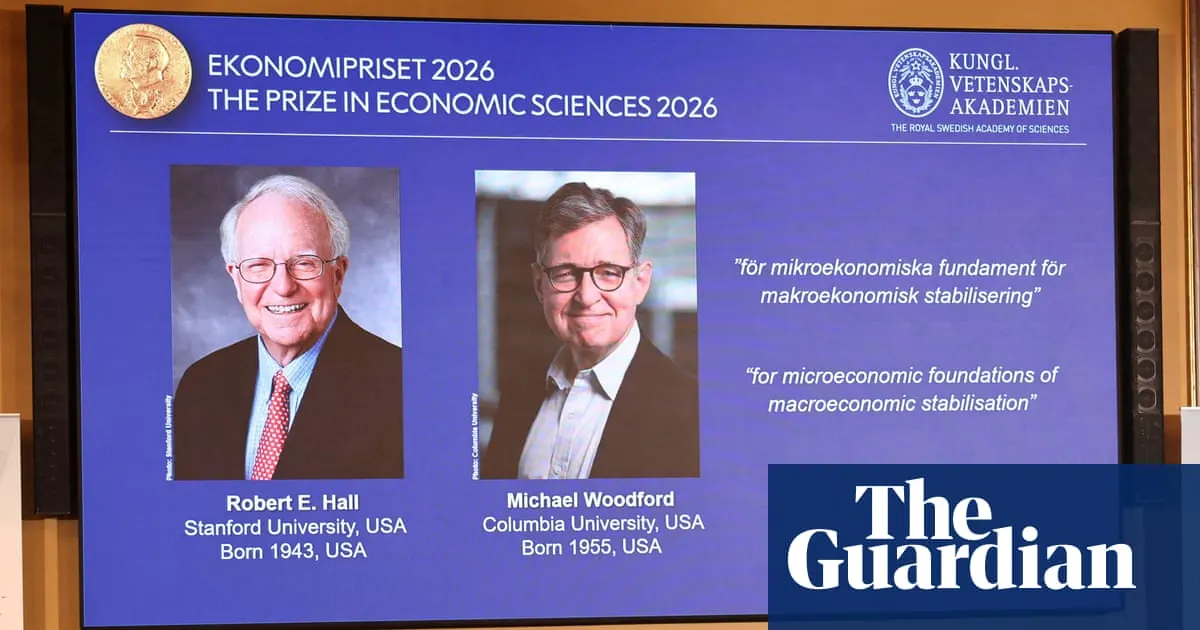
Robert Hall of Stanford University and Michael Woodford of Columbia University have won the 2026 Nobel Prize in Economics for developing models that help central banks and governments stabilise their economies and avoid severe recessions and inflation. Their work on "microeconomic foundations of macroeconomic stabilisation" represents a paradigm shift in how policymakers approach economic management, providing them with better tools to smooth out economic cycles.
The prize is worth a combined $1.2 million (£900,000). Their New Keynesian models improve upon John Maynard Keynes's original theories by incorporating how individual households and businesses actually behave. These models, now used by central banks and finance ministries worldwide, were instrumental during the 2008 financial crisis and Covid pandemic, and they led to the development of forward guidance, where central banks communicate future interest rate expectations.
- $1.2m prize awarded for economic stabilisation models used globally
- New Keynesian framework helps central banks avoid recessions and inflation
- Work guided policymakers through 2008 crisis and pandemic emergency
New here? Start with this
Central banks and governments constantly face a challenge: keeping economies stable while avoiding severe recessions when unemployment soars or inflation when prices spiral out of control. Getting this balance wrong can cause enormous hardship, affecting people's jobs, savings and ability to afford essentials. Economists have spent decades trying to develop theories that help policymakers make better decisions about interest rates and government spending.
Robert Hall of Stanford University and Michael Woodford of Columbia University updated economic theories originally developed by John Maynard Keynes in the early twentieth century, improving them to better reflect how actual households and businesses behave. Their New Keynesian models provide central banks and governments with tools to understand how their economic decisions ripple through the wider economy. These models have become the standard approach used by finance ministries and central banks worldwide.
The practical importance of their work became clear during the 2008 financial crisis and the pandemic. Central banks used their models to shape their response to these shocks, and their theories helped establish forward guidance, where central banks publicly explain what they expect to do with interest rates in the future. Understanding how markets and people respond to such communications has made economic management more effective and helped prevent some of the worst consequences of economic turmoil.
Both sides, in good faith
The strongest fair case each way — we don't pick a winner.
The case for
Hall and Woodford deserve recognition because their New Keynesian models represent genuine scientific progress in understanding how economies function. By integrating microeconomic behaviour into macroeconomic frameworks, they enabled policymakers to make more informed decisions during crises, as evidenced by widespread adoption of their models by central banks worldwide and the development of forward guidance. Their work provides the intellectual foundation for modern economic management and has demonstrably improved outcomes by helping stabilise cycles and prevent deeper recessions.
The case against
Whilst Hall and Woodford's contributions are significant, critics contend that New Keynesian models have substantial limitations the prize may overlook. These models rest on assumptions about rational actors and perfect information that often fail in reality, and they did not predict or prevent the 2008 financial crisis despite widespread use by policymakers. Alternative economic schools including Austrian, post-Keynesian, and Market Monetarist approaches offer competing explanations for economic instability that merit serious consideration, raising questions about whether the award reflects advancing scientific debate or entrenching particular orthodoxy.
Americas Business Economy Government Politics Software Technology World