Trump blames mass migration for French riots… as Macron vows looters and agitators will pay for seeking ‘to bring down the Republic’
Developing story first seen 7 hours ago
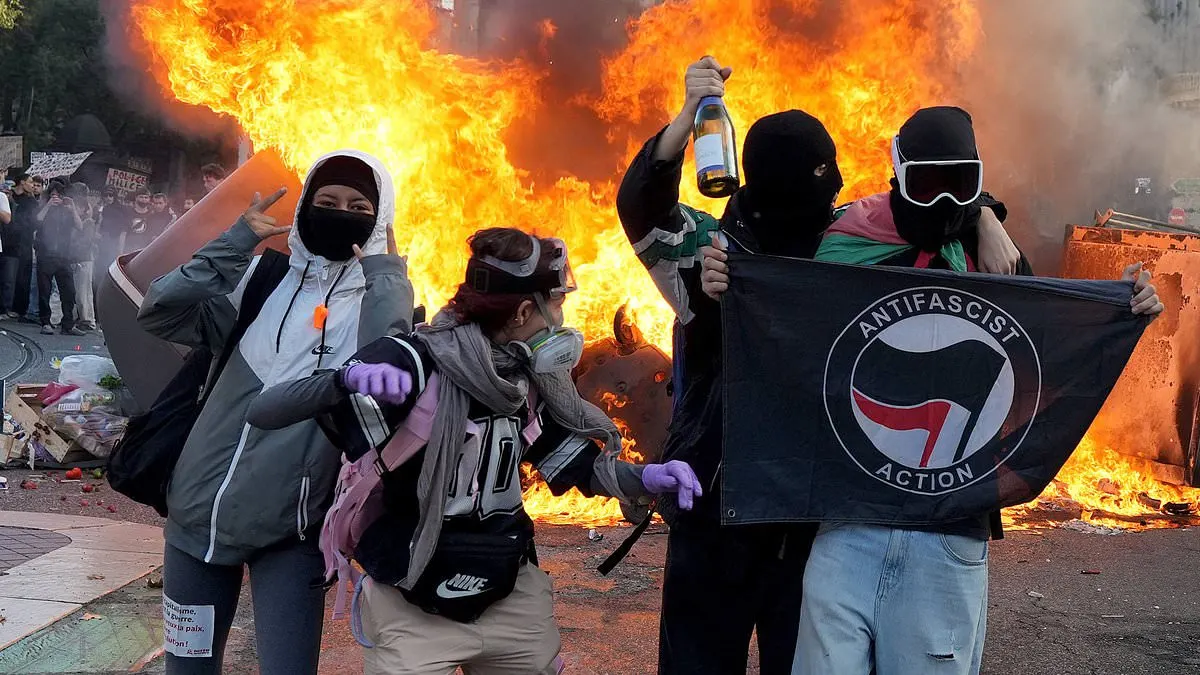
Fresh unrest broke out in Paris after Emmanuel Macron vowed that looters and those seeking to undermine the Republic would be held accountable. The renewed clashes followed a weekend of protests and destruction across France, including a fire that destroyed the historic clock tower of Limoges town hall; Donald Trump blamed immigration for the turmoil.
The demonstrations began a month ago among teachers and students responding to staff shortages, then widened into a movement against rising prices. Up to half a million people protested over the weekend, with hundreds injured, and disturbances also spread to Milan and Lisbon. Macron blamed far-left agitators and criminals, while Trump called for France to close its borders; protesters in Paris later erected barricades and fought with police.
- Unrest resumed in Paris after Macron’s warning.
- Limoges town hall’s historic clock tower was destroyed by fire.
- Trump blamed immigration as protests spread beyond France.
Both sides, in good faith
The strongest fair case each way — we don't pick a winner.
The case for
Those who emphasise migration argue that rapid demographic change and difficulties integrating newcomers can strain public services and social cohesion, and that leaders should address these pressures openly when explaining unrest. They may also argue that failing to discuss such concerns leaves space for resentment to grow, though migration alone would not explain the protests’ reported origins in staff shortages and rising prices.
The case against
Those who reject migration as the explanation argue that the demonstrations began over economic pressures and public services, while blaming a broad group of newcomers risks stigmatising people who had no part in the violence. They may see Macron’s focus on far-left agitators and criminals as more directly tied to the reported rioting, and argue that the response should distinguish peaceful protesters from those who looted or attacked property.
Full account
France faced a weekend of protests against rising living costs and poor conditions in schools, with violence and looting reported in several cities. The unrest began with demonstrations by teachers and students, according to one account, and grew into a broader movement backed by unions, student groups and activists. The Associated Press described the protests as an effort by some organisers to revive the Yellow Vest movement, which emerged in 2018 over social inequality.
The damage included fires and attacks on public buildings and businesses. In Limoges, flames engulfed the 19th-century city hall and its roof collapsed; the first report describes the building’s clock tower as a particularly striking image. In Paris, police used tear gas after tensions flared around Place de la République, where small groups tried to set fire to bicycles and rubbish bins. Looting and damage were also reported in commercial districts in Paris, Marseille, Lyon and Bordeaux.
President Emmanuel Macron addressed the country on Sunday, expressing anger and shame at the violence. He said those responsible for looting would have to pay for the damage and that those who had sought to undermine the Republic would be held accountable. He blamed the violence on radical far-left groups and criminals. Interior Minister Laurent Nuñez also drew a distinction between the right to protest and deliberately causing disorder. Macron said he had asked local officials to protect public buildings and businesses, including by prohibiting demonstrations where necessary.
The reports put the scale of the protests at different levels: authorities estimated around 550,000 participants nationwide, while organisers estimated about 800,000. The Associated Press reported at least 1,800 arrests, including 855 in the Paris region; the first account describes up to half a million protesters. It also reports that Donald Trump blamed immigration for the unrest in a post on Truth Social, calling for France to close its borders. The Associated Press account does not mention Trump’s comments. The first report additionally highlights accusations by French politicians that far-left activists helped incite young protesters, and says protests spread to Milan and Lisbon; those points are absent from the AP report.
Where outlets differ
The Associated Press gives specific figures for arrests and protest turnout, distinguishing between the authorities’ estimate and the organisers’ higher estimate. The first report instead characterises the crowds as up to half a million.
The first report foregrounds Trump’s claim that immigration caused the unrest and the political dispute over far-left activists. The AP focuses on the protests’ domestic causes, the government response and the reported damage, and does not mention Trump.
The first report says unrest spread to Milan and Lisbon and includes Limoges mayor Guillaume Guerin’s accusation that organised extremists incited young people. The AP report does not include either detail.