Sculpture recreates odd optical effects of famed Lycurgus Cup
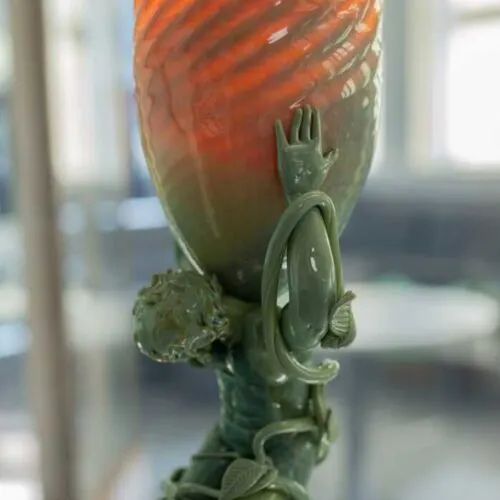
Researchers at the University of Sheffield have recreated a Roman glass recipe that produces the Lycurgus Cup’s striking colour shift: green in reflected light and red when backlit. The work offers a repeatable way to make the unusual glass, helping scientists and artists explore materials that control how light behaves.
The cup dates to around 400 CE and is one of about 40 surviving Roman cage cups. Its colours come from tiny gold and silver particles embedded in the glass, whose interaction with light changes with the viewing angle. Earlier researchers reproduced the effect in a 3D-printable material, but Sheffield researchers Lisa Hollands and Caroline Jackson developed a consistent glass-making recipe; glass artist Elliott Walker then used it to create a contemporary sculpture.
In short
- Sheffield researchers recreated the Lycurgus Cup’s colour-changing glass.
- Embedded gold and silver nanoparticles cause the optical effect.
- A contemporary sculpture was made using the repeatable recipe.
Explained simply
The Lycurgus Cup is a Roman glass vessel made around 400 CE, known for changing colour with the light: it appears green when light reflects off it and red when light shines through it. It is one of about 40 surviving Roman cage cups, whose decorative glasswork surrounds an inner vessel.
The colour shift comes from tiny particles of gold and silver within the glass, which affect light differently depending on how it reaches the cup. Researchers Lisa Hollands and Caroline Jackson at the University of Sheffield developed a repeatable way to make glass with this effect, and glass artist Elliott Walker used it to create a modern sculpture.
A reliable recipe gives scientists and artists a way to study and use glass that changes how light appears. It also helps explore how ancient makers achieved the cup’s unusual effect.
Americas Culture Food Research Science World