Technology news and discussion on TalkFuse.
Astronomers Discover a Possible New Dwarf Planet in Our Solar System
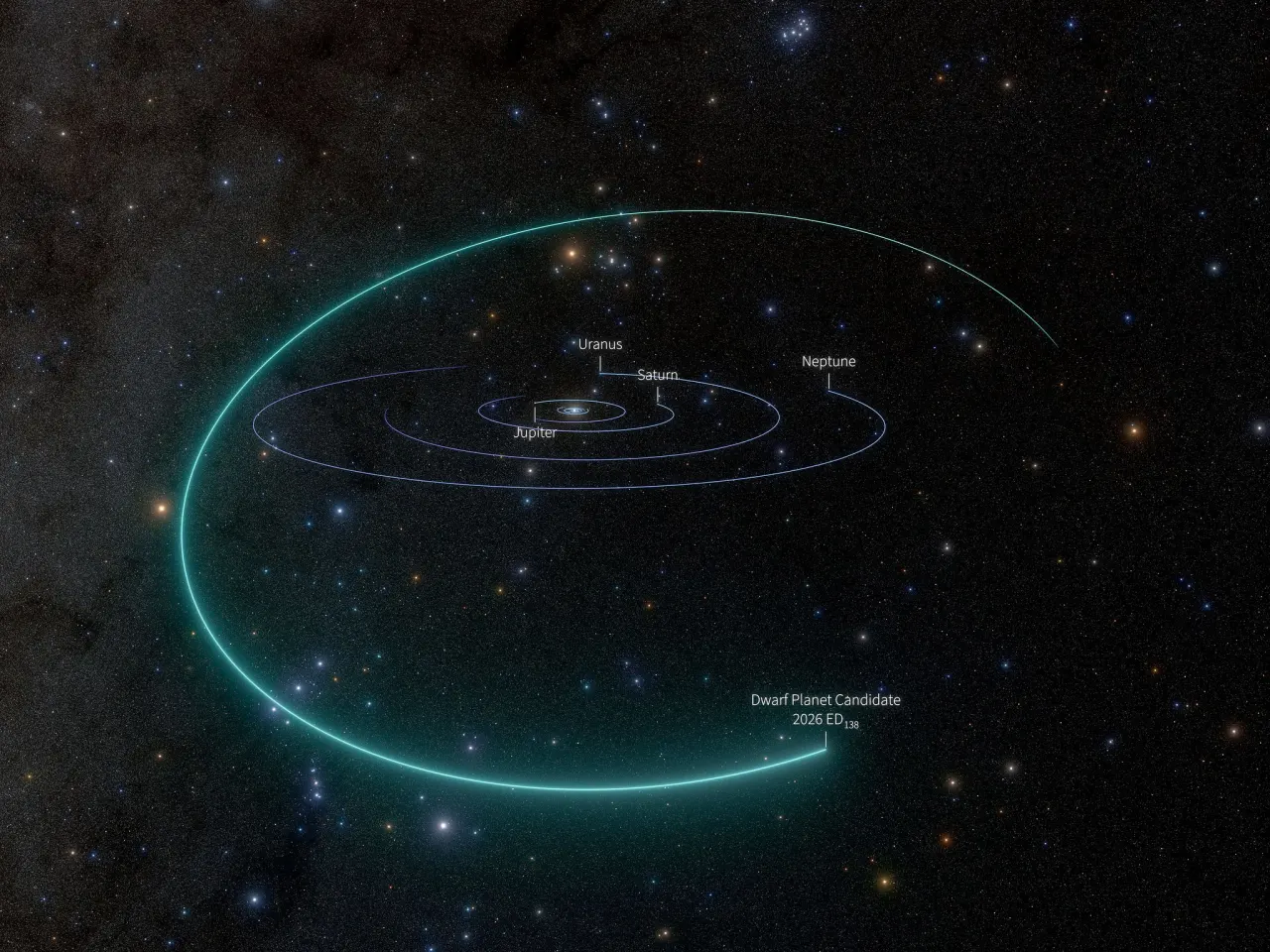
Astronomers have identified ED138, a distant object that may qualify as a new dwarf planet. Its discovery matters because it adds to evidence that the outer Solar System contains many large bodies that remain difficult to observe and classify.
ED138 is estimated to be 600 to 1,500 kilometres across and about 46 astronomical units from the Sun, beyond Neptune. Matthew Holman found it in Rubin Observatory data from 2026; archived observations dating to 2016 helped trace its path. Astronomers must measure its size more precisely to determine whether its gravity has made it nearly spherical. The International Astronomical Union currently recognises five dwarf planets, while several other distant objects are also candidates.
In short
- ED138 may be a new dwarf planet.
- It lies about 46 astronomical units from the Sun.
- Its size and shape still need confirmation.
Explained simply
A dwarf planet is an object that orbits the Sun and is large enough for its own gravity to make it nearly round, but has not cleared other objects from its orbital path. The category helps astronomers describe bodies that are larger than most small Solar System objects but do not meet the definition of a planet.
Neptune marks the edge of the region where the eight recognised planets orbit; many smaller icy bodies travel much farther out. These distant objects are faint and slow-moving, so astronomers often need observations taken over several years to work out their paths and properties.
The International Astronomical Union recognises five dwarf planets, and other far-off bodies remain candidates. Finding and measuring more of them can help scientists understand the size and make-up of the outer Solar System, though an object's classification depends on evidence such as its size and shape.