Contact restored with Voyager 1 after two days of silence
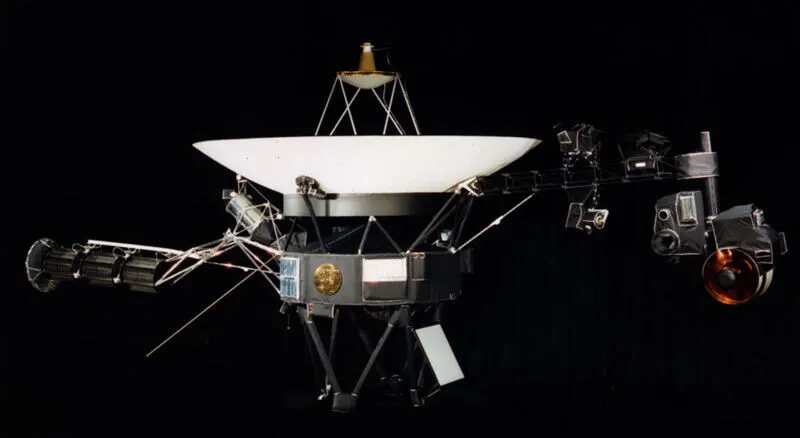
Voyager 1 resumed contact with NASA after the Deep Space Network failed to detect its signal on 18 and 19 October. The brief silence raised concern about the ageing probe’s condition, but engineers are investigating what happened; the incident shows how fragile communications have become as the spacecraft approaches its 50th year.
The signal returned on 20 October, apparently after a group of thrusters went offline and backup thrusters were activated, possibly as part of a safe mode response. NASA recently completed a “Big Bang” procedure to switch both Voyager probes to lower-power equipment and extend their lives. In a few weeks, Voyager 1 will be so distant that a command will take 24 hours to arrive and its reply another 24 hours to reach Earth.
In short
- Voyager 1’s signal disappeared for two days.
- Contact returned on 20 October.
- A one-day communications delay is approaching.
Explained simply
Voyager 1 is a NASA spacecraft launched in 1977 to study the outer planets and then travel beyond the edges of the Solar System. It is now farther from Earth than any other human-made object, so its power and equipment are limited by age and distance.
NASA communicates with the probe through the Deep Space Network, a set of large radio antennas around the world. Voyager 1’s thrusters help point its antenna towards Earth, and backup thrusters can take over if the main ones fail.
The spacecraft’s long journey has made keeping it powered and in contact an ongoing engineering challenge. As it travels farther away, messages take longer to reach it and replies take longer to return, leaving engineers with less immediate information about its condition.
Read the full article at the source →
Originally published by The Register as “Voyager 1 gives controllers the silent treatment”.